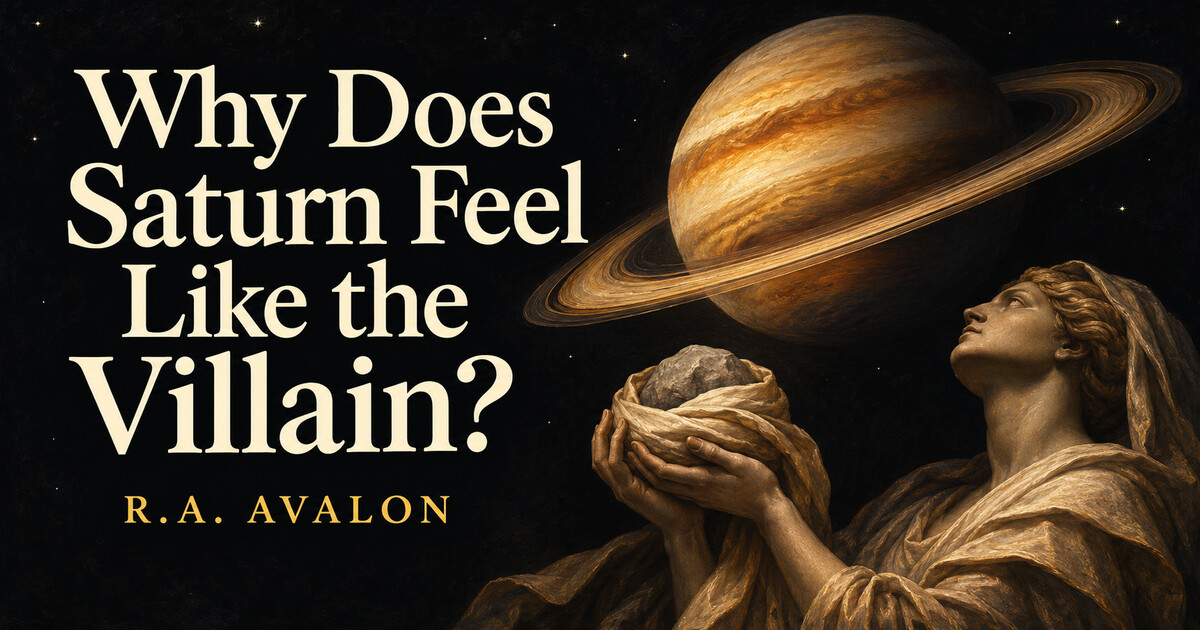
When Saturn’s companions disappeared, Galileo remembered a father who swallowed his children. Following that story led me to a woman with a stone and a different way to read a villain.
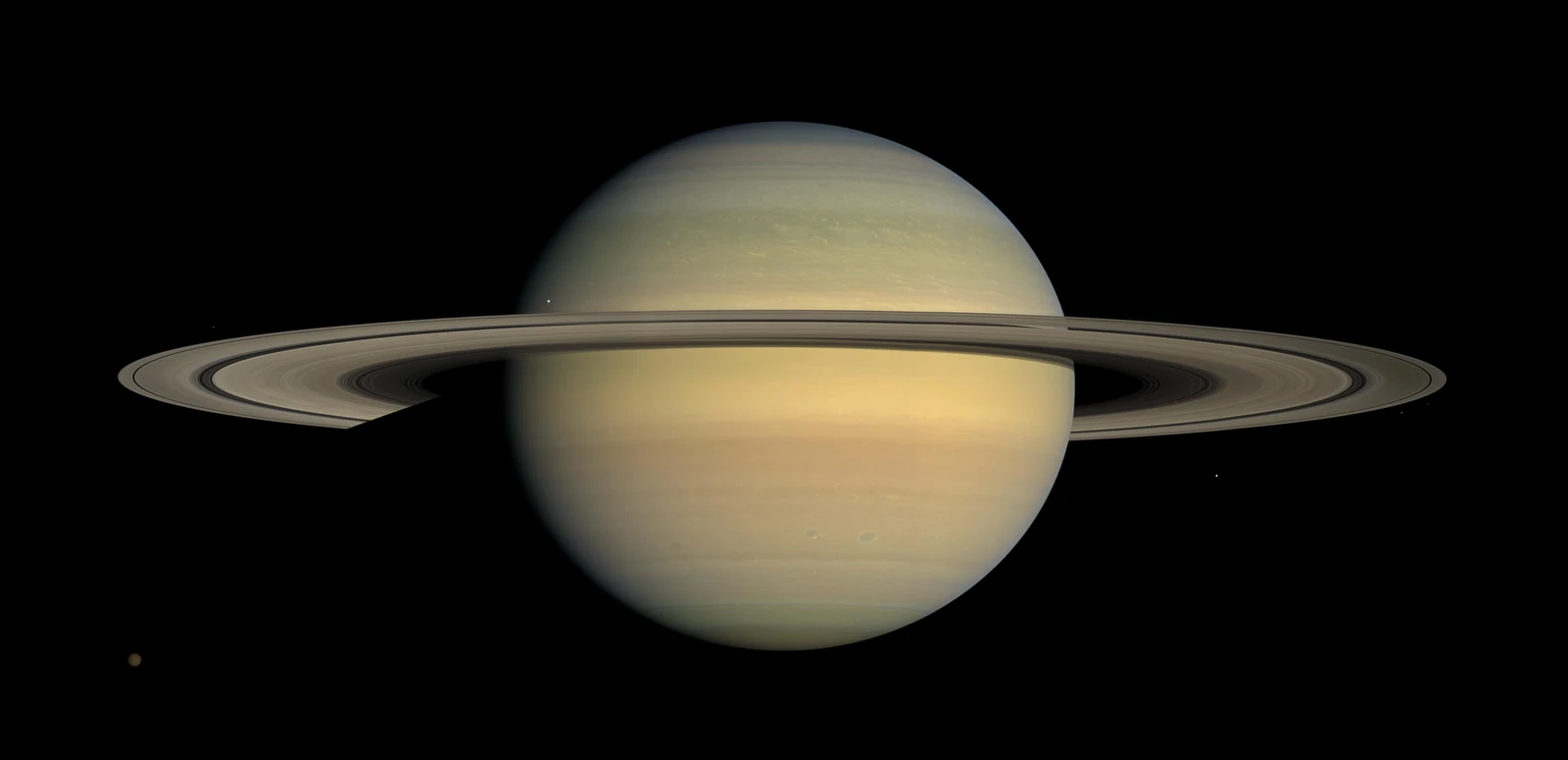
In 1612, Galileo pointed his telescope at Saturn and found that two familiar shapes had gone missing. Two years earlier, he had seen what looked like a small companion on either side of the planet. Now it stood alone. Galileo wondered whether his instrument had played a trick on him. He also had a question for anyone who knew the old stories. “Has Saturn swallowed his children?” Galileo’s observations.
That question caught me halfway through following a different lead. In an interview with Christian White, Jay Weidner hears an echo of Saturn in Sauron, Tolkien’s Lord of the Rings. I could hear it too. A ringed planet, a ring-making villain, two names that start with a hiss. I wanted to know how far that resemblance would take me. Galileo had already given me a reason to doubt my first answer. He could recognise the villain even when the rings were the one thing he couldn’t see. The interview’s Saturn passage.
The woman with the stone
In Hesiod’s Theogony, the Greek Titan Kronos learns that a son of his will overthrow him. Each time his wife Rhea gives birth, he swallows the child. By the time she is expecting Zeus, five children have gone the same way. The poem remembers their names. Hestia was the first. It feels important to say that when the father in this story can barely tell one baby from another. Hesiod on the birth of Zeus.
Rhea goes to her own parents for help. The baby is hidden on Crete. What reaches Kronos is a stone wrapped in swaddling clothes, and he swallows that too. I keep thinking about what it would have taken to ruin the plan. He could have opened the cloth to look at his son’s face. Rhea stakes the child’s life on knowing her husband well enough to be sure he won’t.
I’d followed Saturn into the myth expecting to watch a tyrant lose his crown. From Rhea’s side of the marriage, the question is smaller and much more urgent. Can she get this one child out alive?
A place at Saturn’s table
Rome complicates that first encounter. The Romans identified Kronos with Saturn, their god of sowing. In Virgil’s Aeneid, the exiled Saturn gives a scattered people laws and presides over a peaceful Golden Age. December brought Saturnalia, with gifts, gambling and feasting. Enslaved people could take part in celebrations that briefly relaxed the rules governing their lives. Someone whose best day of the year fell at Saturn’s feast might have been genuinely glad to hear his name. Virgil, Book VIII · Getty on Saturnalia.
Then the feast ends. Who decides when the old rules come back? That question took me from the banquet to a piece of lead small enough to hold in one hand.
What would you ask of Saturn?
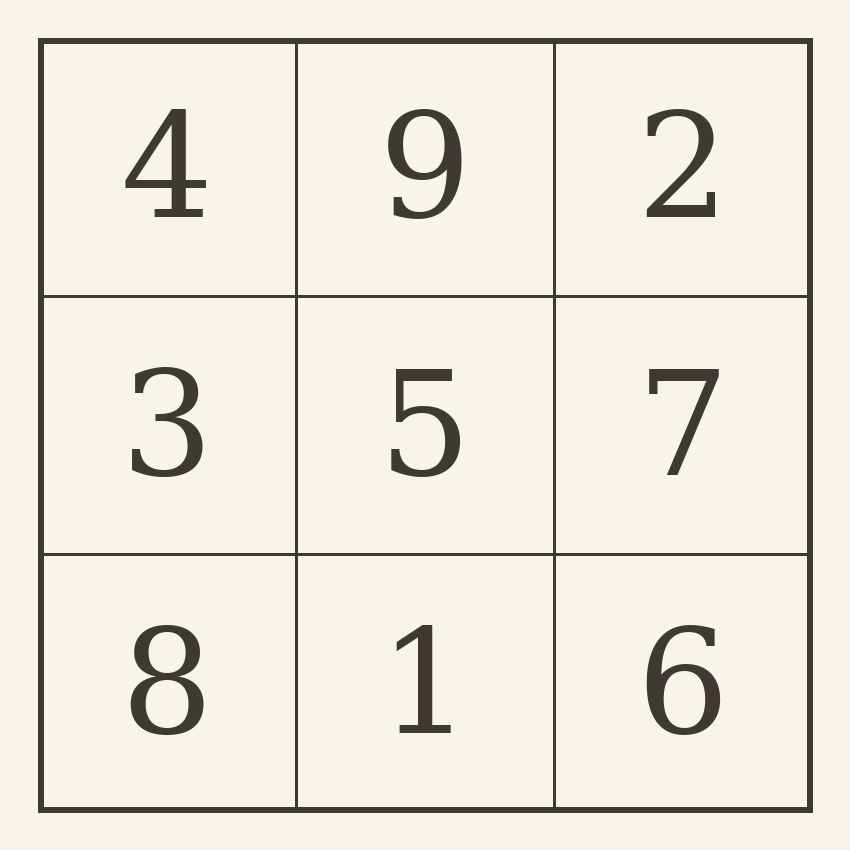
In Renaissance occult philosophy, Heinrich Cornelius Agrippa describes a three-by-three square to be engraved on lead. Follow a row, a column or either diagonal and the numbers add up to fifteen. According to the tradition Agrippa recorded, a square made under a favourable Saturn might help someone petition a prince. Under an unfavourable Saturn, it might hinder planting or building. Anyone can check the sum. The hope that a prince will listen is the part that makes me want to know who carried it. Agrippa on the planetary squares.
Imagine a woman outside the granary with that little piece of lead in her pocket. Her family needs grain. A man on the other side of the door has the key. He asks her to come back tomorrow. Now give exactly that line to the woman when she tells her children what the man said. A whole day has acquired a different weight in the time it took to walk home.
Looking Goya’s Saturn in the eye
There’s an old piece of wordplay behind that feeling. In Cicero’s On the Nature of the Gods, a Stoic speaker hears the Greek word chronos, meaning time, in the name Kronos. He reads the father swallowing his children as time consuming the years it brings forth. The resemblance gave him a metaphor. Another inheritance survives in saturnine, our word for a gloomy disposition. It carries a trace of the astrological tradition that associated Saturn with cold and melancholy. Cicero’s account · The history of saturnine.
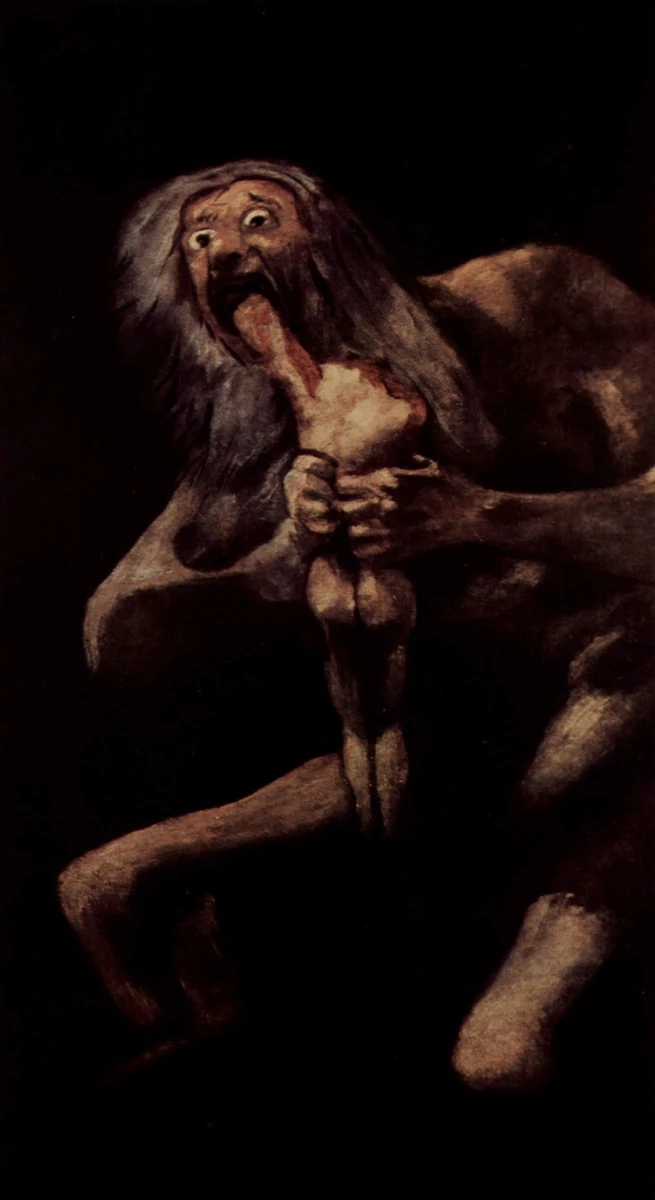

Around 1820–23, Francisco Goya painted Saturn on a wall of his house outside Madrid. Look at the god’s eyes first. He looks frightened enough to make you wonder what he’s seen. Let your gaze drop to his fingers. Suddenly it costs something to keep feeling sorry for him. His hands are digging into the body of the person who has reason to be afraid. I had spent most of this journey asking what frightened the father. Rhea could have told me, five children ago, where to look. Fundación Goya en Aragón on Saturn.
Hearing Sauron differently
Back in Middle-earth, the likeness between Saturn and Sauron still catches my ear. Tolkien traced Sauron’s name to an invented Elvish word meaning “detestable”. The reader whose guess he was answering had heard a resemblance to the Greek for “lizard”. Apparently there is room for more than one monster in those syllables. Tolkien’s account of the name.
Sound symbolism gives us a way to test that instinct. In an experiment spanning 25 languages, people tended to match bouba to a rounded shape and kiki to a spiky one. The experiment asked about shape. A villain is a bigger leap. Say Sauron and then Sam. Both begin with the same hiss. Which name would Frodo want to hear in the dark? By then a reader has walked a long way with Sam. The name carries what he did along the road. The bouba/kiki study.
For me, the resonance between the two rulers lies in a choice. Sauron makes a ring to govern the wearers of the others. Kronos sees his son’s freedom as the beginning of his own defeat. Rhea can imagine a future in which someone she loves grows beyond her reach. She risks everything to get him there. Tolkien on the Ruling Ring.
Back at the telescope
Galileo’s missing companions were the visible ends of Saturn’s rings, turned edge-on to Earth. Decades later, the Dutch astronomer Christiaan Huygens worked out what surrounded the planet. In Hesiod, the missing children come back too. The first thing their father brings up is the stone. Museo Galileo on Saturn’s rings.
That’s the image I’d take back to a writing desk. A woman wraps an ordinary stone in a baby’s clothes, and years later it returns as proof that somebody once outwitted a god. I came looking for the family resemblance between two villains. The next time I look at Saturn, I think I’ll remember Rhea first.
Continue reading Alchemy in Storytelling: The Art of Transformation.