
What happens when your organisation is under attack, but everyone is waiting for the cyber insurer to call back?
Cyber insurance can provide specialist response, legal support and financial protection. Yet those benefits need a working route into your crisis organisation. The question is whether contacting your cyberverzekeraar activates help—or becomes a reason to postpone decisions. NCSC
This concern has appeared in reporting. In October 2019, TechTarget quoted Cisco’s incident-response director describing cases where insurers took a full day to reply. Other practitioners described shorter delays.
When does a cyber insurer get involved?
Involve the insurer early, following the notification route in your policy. Marsh’s incident guidance recommends contacting the insurer immediately while still gathering facts. Policies may provide access to forensic investigators, legal advisers and crisis communications specialists, with conditions governing their appointment and costs.
Those conditions matter. Markel Nederland, for example, says an existing incident-response provider can be used if approved beforehand and listed on the policy. Discovering a mismatch during an attack can create an avoidable handover.
Equally, a policy can require action to limit losses. Allianz’s published CYB24 wording requires reasonable mitigation and provides conditional cover for emergency mitigation costs. Financial approval, appointing specialists and operational response are related decisions that need clear ownership. Your actual policy and endorsements determine the requirements.
Twelve risks of an unplanned wait
The following are risks supported by incident-response guidance and policy obligations. They are conditional consequences of deferred action, rather than a prediction that every delay produces every outcome.
1. The attack spreads. An attacker who retains access may reach additional systems or increase their privileges. NIST SP 800-61r3 warns that delaying containment can enable exactly this expansion.
2. More information can leave the organisation. Ransomware can involve stolen data as well as encryption. If malicious access remains active, further theft remains possible, increasing the material available for extortion. This follows from the attack mechanisms described in the Dutch NCSC ransomware playbook.
3. Recovery options can disappear. Reachable backups can become additional targets. Delaying their protection can leave the organisation with fewer usable recovery options. The UK NCSC specifically identifies backups as targets and recommends protecting them against modification or deletion.
4. Evidence can be lost. Some evidence is volatile or retained only briefly. Deferring its preservation can make it harder to establish what happened and what was exposed. CISA’s data-breach guidance explicitly warns about these limits.
5. Compromised accounts remain useful. Disconnecting one laptop does not establish that the attacker has lost access elsewhere. NIST calls for addressing compromised accounts, entry points and persistence mechanisms: the ways attackers maintain access.
6. Business interruption can last longer. Waiting to assess critical services, dependencies and workarounds delays decisions needed to restore operations. Where disrupted systems support safety, the consequences can extend beyond lost revenue. These are priorities in NCSC’s immediate-response guidance.
7. Partners can remain exposed. Connected suppliers and customers may need information or changes to network access to protect themselves. Postponed coordination can leave those protections unresolved. The Dutch NCSC playbook addresses potentially affected partners and restricting risky connections.
8. Attackers may observe the response. Discussing the insurer’s instructions through compromised email can expose response plans. CISA’s ransomware guide warns that attackers monitoring communications may adapt or accelerate their activity. Establish trusted alternative channels.
9. Recovery can become unsafe. A late investigation followed by hurried restoration can reconnect systems before the attacker’s access is understood. NCSC warns against rushing recovery. The risk comes from poor sequencing, not simply from the clock.
10. Reporting deadlines can be missed. Under GDPR Article 33, controllers must notify the competent supervisory authority of a personal-data breach without undue delay and, where feasible, within 72 hours of awareness, unless the breach is unlikely to pose a risk to people’s rights and freedoms. Information can follow in phases. For organisations subject to the Dutch Cyberbeveiligingswet, significant incidents also require an early warning as soon as possible and within 24 hours of awareness. These clocks depend on awareness, not insurer approval.
11. People lose time to protect themselves. Where a breach is likely to create high risk, GDPR Article 34 generally requires informing affected people without undue delay, subject to specified exceptions. Postponing a required warning delays their opportunity to take precautions.
12. Reimbursement can become disputed. An organisation can encounter both approval requirements and duties to mitigate. Incurring costs without required consent, or failing to take reasonable steps to limit loss, can raise coverage questions. Allianz’s wording illustrates these obligations; the consequences depend on the terms and circumstances. A delayed callback does not automatically invalidate cover.
Build the response before the emergency
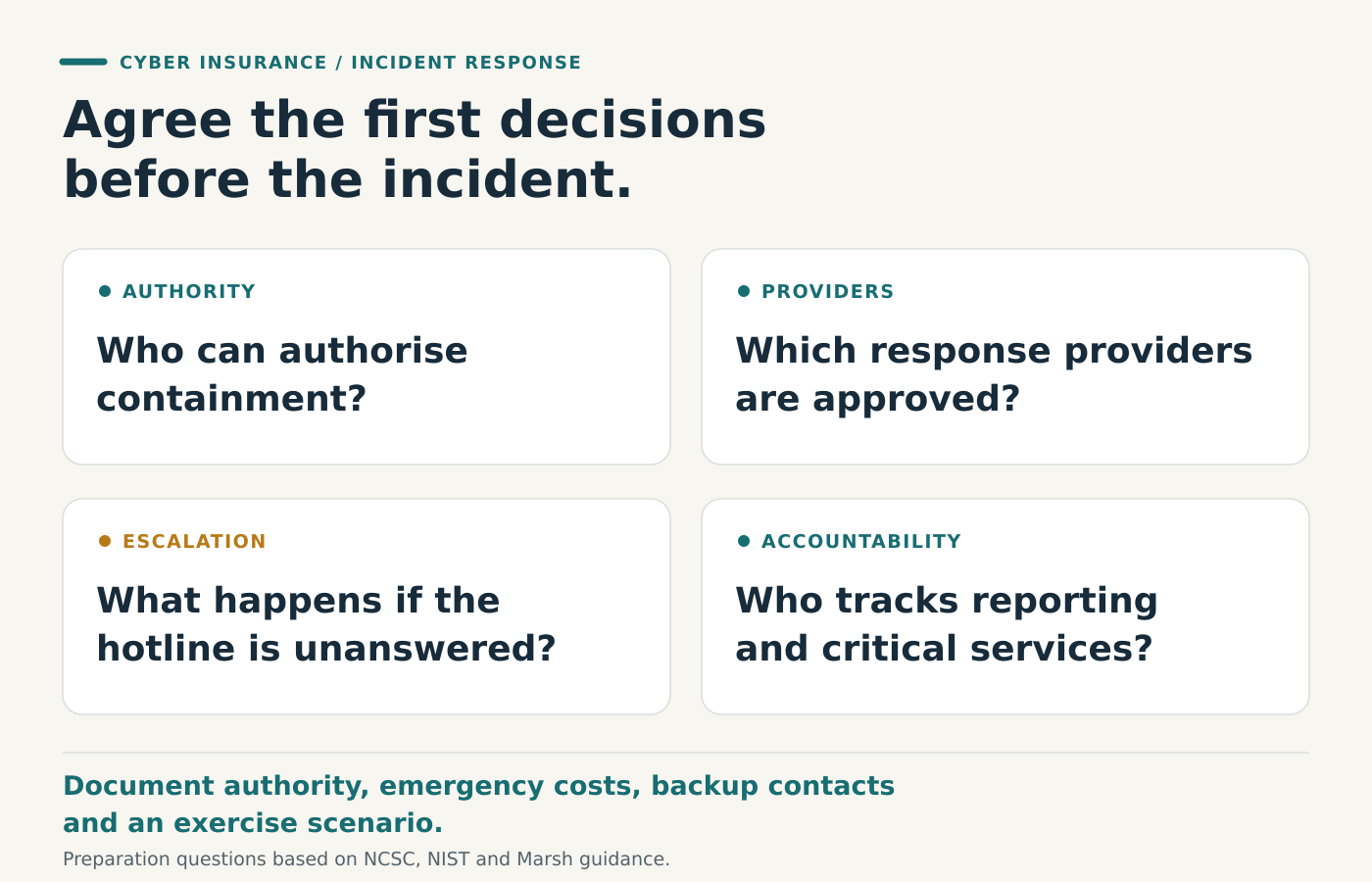
The practical answer is to agree the operating model beforehand. Identify who can authorise containment, which providers are approved, what emergency spending is permitted and who can escalate an unanswered call. Lloyd’s/LMA guidance explicitly anticipates unavailable panel providers and unreachable insurers; it is guidance, not a guarantee of reimbursement.
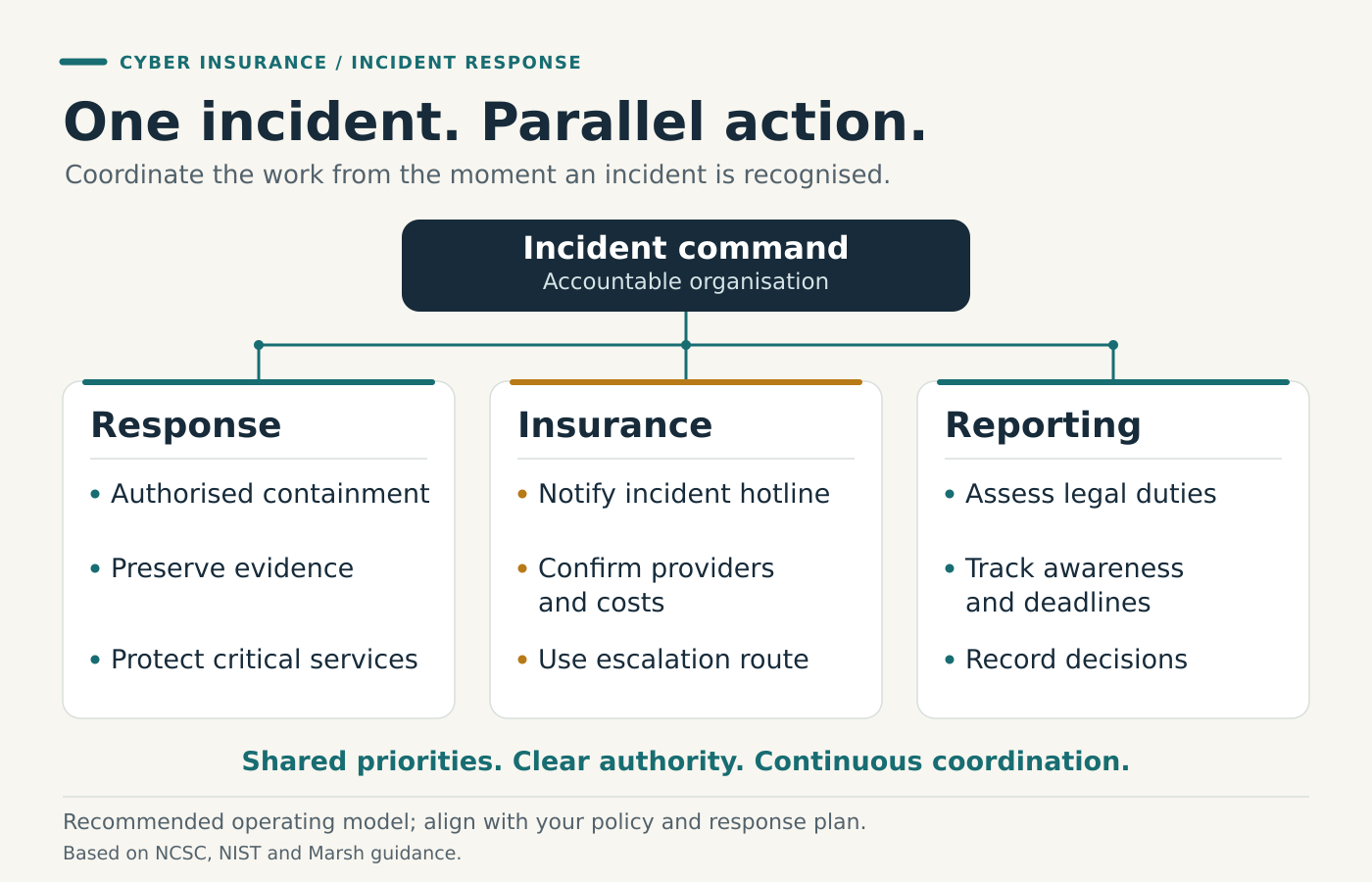
During an incident, run coordinated workstreams: authorised technical response, insurer engagement, continuity and required reporting. Keep a record of observations, decisions, costs and contact attempts. NCSC recommends clear incident command and recording decisions from the outset. It is the coordination challenge I explored in IT Incident Management: More Than Fixing IT.
Speed still requires judgement. Disconnecting a system and powering it off have different consequences; shutdown can destroy evidence, while disconnection may not stop malware already running. Balance containment, safety and investigation with specialist advice. NCSC
So, should your organisation wait for its cyber insurer? Notify promptly, follow the agreed policy process and activate the response you have authorised in advance. The Dutch NCSC is clear that the organisation remains responsible. Insurance works best when it brings help into that response. A ringing telephone should never be your entire crisis plan.