What interests me most in a story is the moment a character can no longer remain who they were. A healer discovers the cost of power. A ruler calls control protection. Someone survives the ordeal, then realises that healing is another journey.
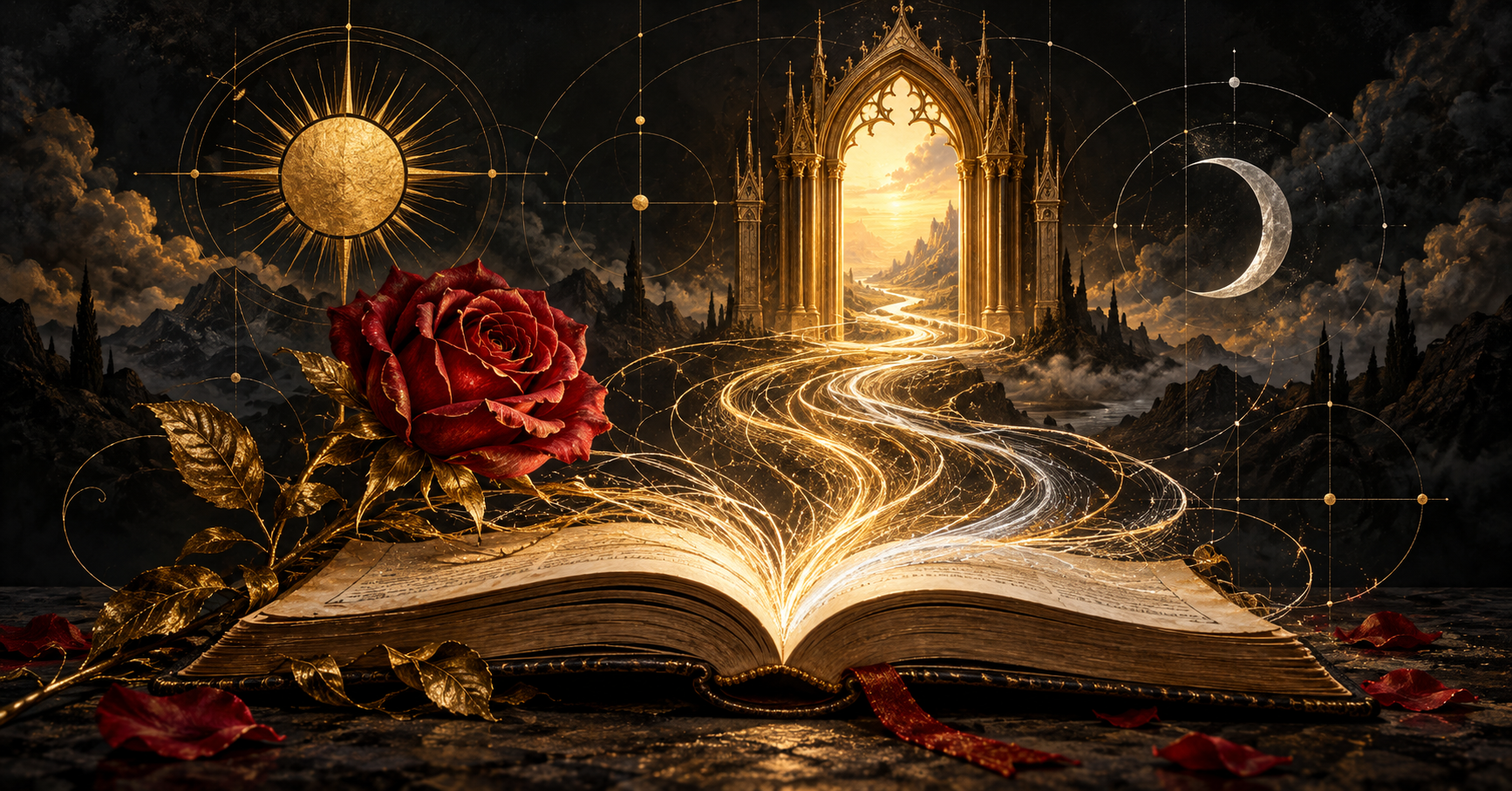
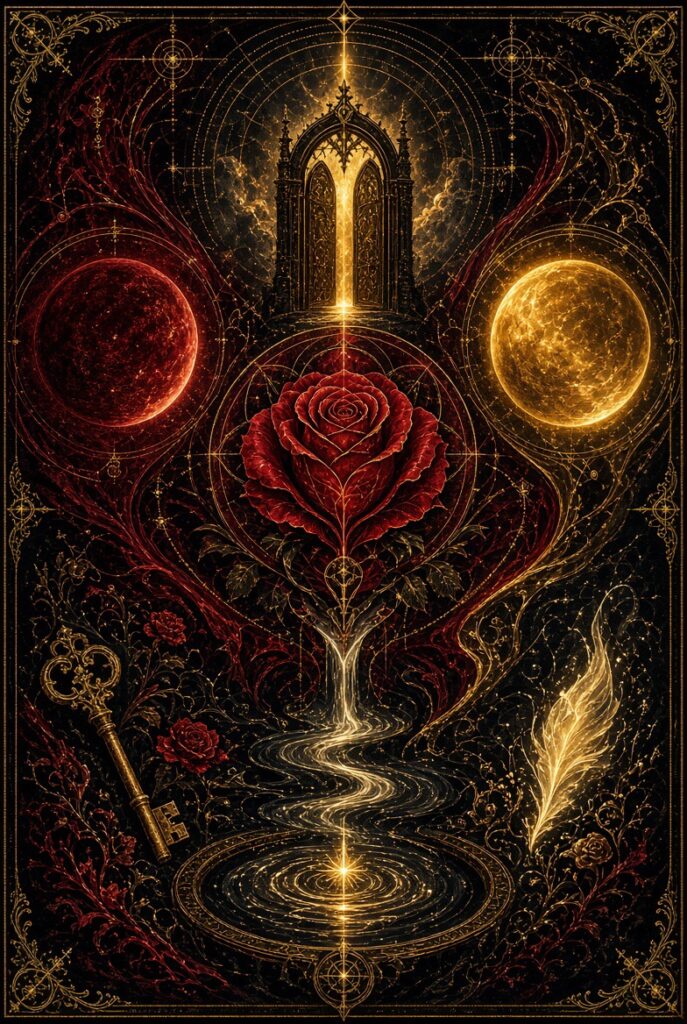
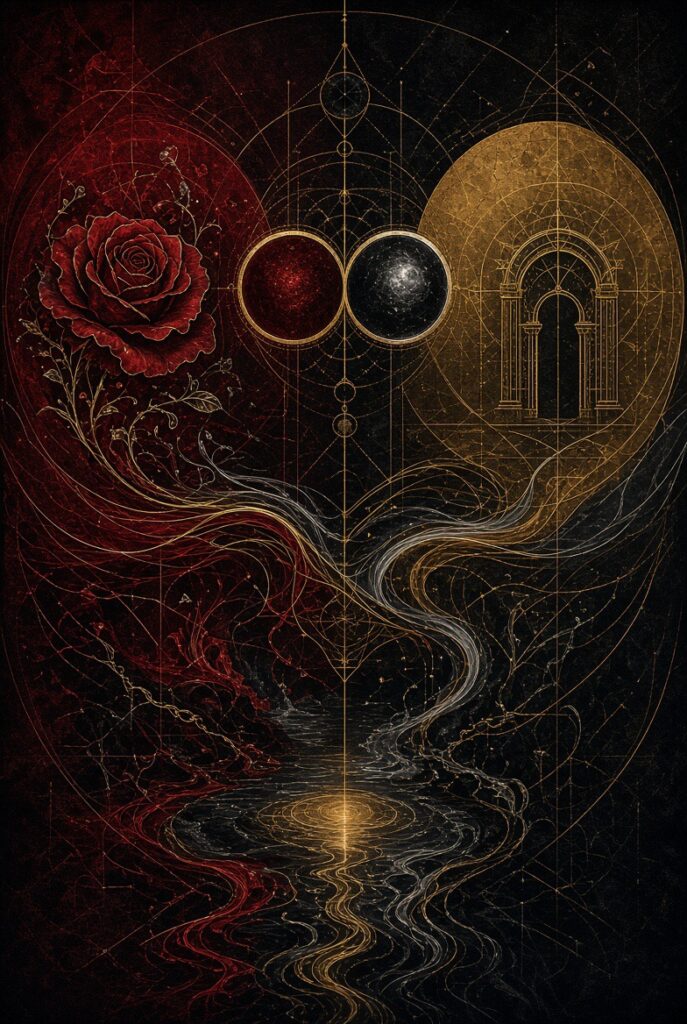
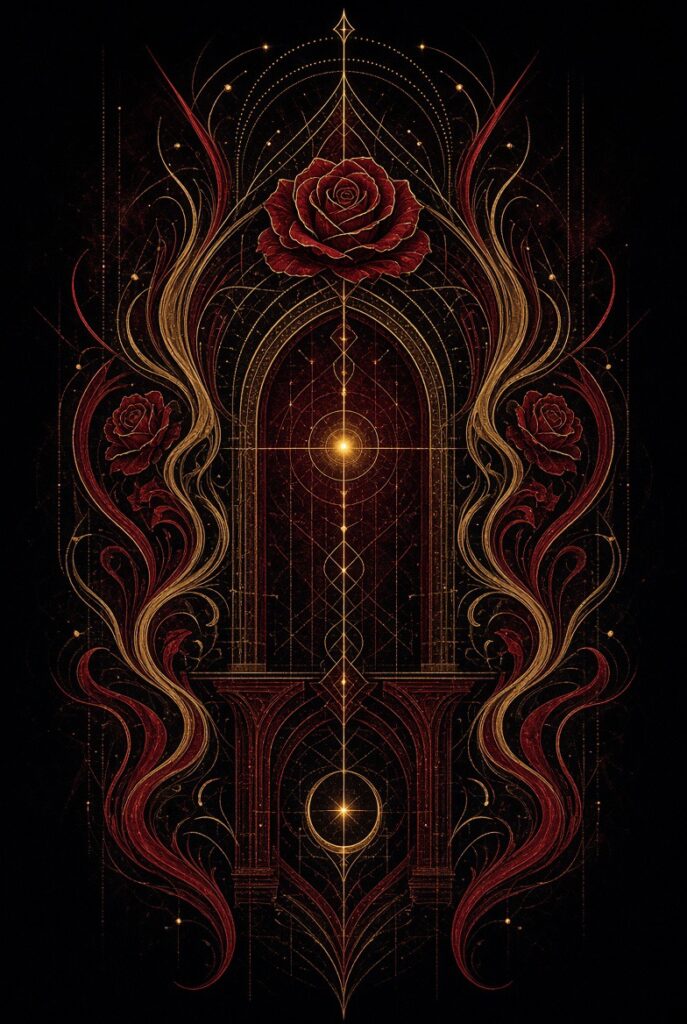
I see those possibilities in these images: roses beside doorways, contrasting spheres, streams gathering around light. They feel like stories waiting for characters.
Alchemy gives that fascination a history and a vocabulary.
An old language for change
The European alchemical tradition has roots in Greco-Roman Egypt, where work with materials met philosophical and religious ideas. Zosimos of Panopolis, active around 300 CE, described substances and apparatus. This was also an investigation of matter, contributing to the history of chemistry.
Arabic-speaking scholars developed that inheritance, which reached medieval Latin Europe through translations. Planetary correspondences connected gold with the Sun, silver with the Moon and lead with Saturn.
For a storyteller, such connections suggest how a fictional world might think. A metal can carry a cosmology. A royal crown can imply a relationship between earthly authority and the heavens.
The familiar colours—black, white, yellow and red—became nigredo, albedo, citrinitas and rubedo: blackening, whitening, yellowing and reddening. Historical schemes varied.
I can borrow that movement for a character: certainty breaks down, something becomes clearer, and a changed understanding emerges. The colours become a writing tool through my interpretation.
Jung, contradiction and the price of power
Carl Jung gave alchemical imagery an influential psychological reading in Psychology and Alchemy (1944), connecting it with individuation and engagement with the unconscious.
That interests me because believable characters carry conflicting desires. They want freedom and safety, intimacy and control. Their development depends on what they do when those wishes collide.
The alchemical coniunctio offers a suggestive image for this tension. In the Rosarium philosophorum of 1550, solar and lunar figures join and undergo transformation.
When I look at the touching spheres and braided streams, I see a narrative possibility: two people, loyalties or parts of a self meeting without the outcome being certain.
Modern fantasy borrows from alchemy explicitly. Rowling acknowledges the alchemical origins of the Philosopher’s Stone and its supposed promises of gold and an Elixir of Life. In Fullmetal Alchemist, two brothers attempt to resurrect their mother and suffer the consequences of forbidden alchemy.
The fascinating part is what the promise reveals about a person. How much will they sacrifice to defeat loss? When does devotion become possession?
Avalon and the story after the battle
Avalon draws me towards a quieter kind of transformation.
Geoffrey of Monmouth’s Historia Regum Britanniae, around 1136, is the earliest surviving text mentioning the island. His later Vita Merlini describes the Isle of Apples, where Morgen offers to heal Arthur’s wounds.
Here, the injured king must leave the battlefield and accept another person’s knowledge. Recovery becomes part of the story.
That is what resonates with me in the name Avalon. It holds space for the aftermath: what happens when strength fails, when care matters, when the person who knows the way forward is someone the hero must learn to trust.
The rose beside the doorway feels like an invitation into that story. I read the water as passage, the gate as possibility. Those are my associations with the artwork.
The High Priestess and what remains unsaid
The High Priestess draws me towards the storyteller’s other craft: deciding what to reveal.
In Waite’s description, she sits between contrasting pillars, with a crescent at her feet and a partly covered scroll. Its concealment suggests that “some things are implied and some spoken.”
A character’s withheld answer can change an entire scene. A symbol noticed in chapter one may acquire another meaning near the end. The reader participates by interpreting what is visible and sensing what is missing.
The card’s history is equally layered. Tarot is documented as a fifteenth-century Italian card game; claims of ancient Egyptian origins emerged in later occult interpretations and remain unproven.
Kabbalah contributes another distinct tradition. Its Jewish teachings include the ten sefirot, often understood as divine emanations. Christian and later Hermetic writers adapted kabbalistic ideas, while Waite invoked the Shekinah, the divine presence, in his interpretation of the High Priestess.
For me, these different histories make the image richer. Meaning changes as people inherit and retell it.
The magick of making meaning
That brings me back to language.
The figure of Hermes Trismegistus connects Greek Hermes with Egyptian Thoth, the god of knowledge and writing. Even the spelling magick carries a history: it appears in the 1651 English translation of Agrippa’s Three Books of Occult Philosophy.
As a writer, I am fascinated by what words make possible within a story. A name creates expectations. A prophecy redirects a choice. A promise gives someone a reason to return.
The images work similarly. The rose unfolds; the doorway invites a decision; the streams suggest that separate histories can meet. I can turn those impressions into characters, conflicts and consequences.
That is where alchemy, occult history and storytelling meet for me: in the work of imagining transformation carefully enough that a reader can feel its cost.