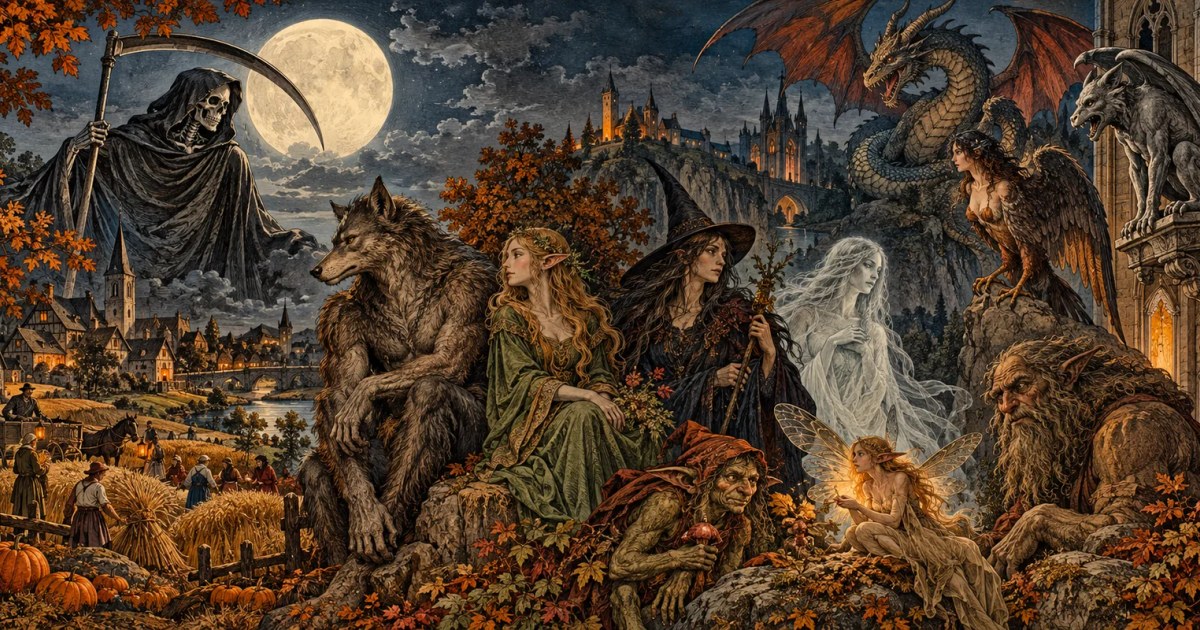
A skeleton carries a scythe. A witch flies through the night. A woman who knows too much becomes a demon. We recognise these characters instantly, yet their original stories are rarely the ones we repeat. Every Halloween, I return to a question: were these beings born monstrous, or did someone make them monsters by telling the story differently?
At the edge of the harvest
Halloween takes its name from All Hallows’ Eve, the evening before All Saints’ Day. Older Gaelic Samhain traditions also marked a seasonal threshold as harvest work ended and winter approached. Today’s holiday combines Christian observances, regional customs and much later inventions. [1][2][3]
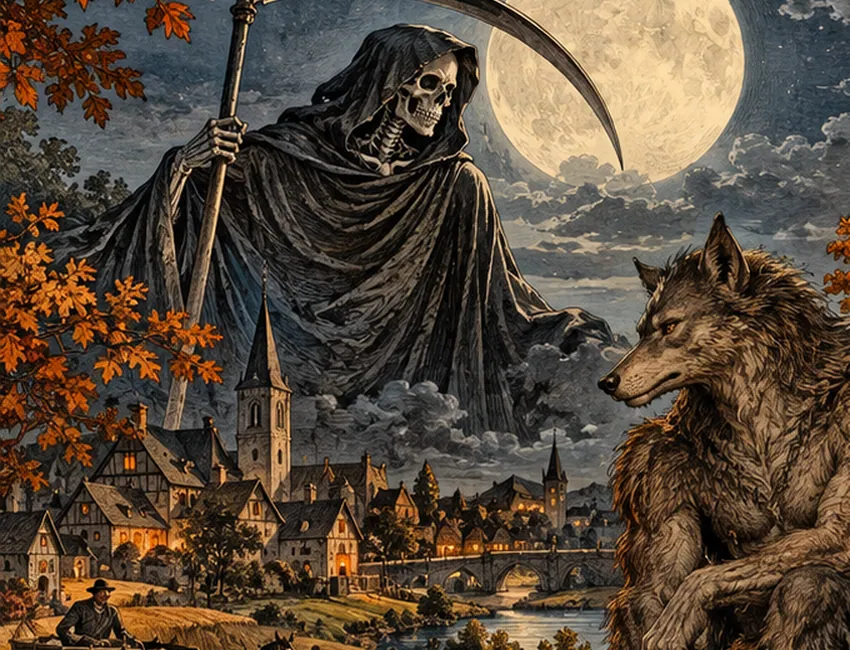
The Grim Reaper captures that threshold beautifully. A reaper cuts crops; in the late medieval Dance of Death, mortality claims everyone, from labourer to king. The skeleton and scythe turned death into a character readers could recognise. Yet the familiar Reaper is a personification, not a documented ancient Samhain deity. [4][5][6]
How fear becomes folklore
Consider the vampire. During Balkan panics in the eighteenth century, villagers exhumed bodies that appeared swollen, with dark fluid around their mouths. Those are natural effects of decomposition. When relatives died soon afterward, people could interpret the corpse as an active predator feeding by night. In a world without modern pathology or germ theory, an alarming observation became a compelling explanation—and then a terrifying narrative. [7][8]
Not every supernatural visitor meant harm. Medieval ghosts might ask the living for prayers; elves could bring illness or beauty; and Marie de France’s werewolf Bisclavret is more honourable than the humans who betray him. The story determines whom we fear. [9][10][11]
Before Halloween: gods, Egypt and the first alphabet
The roots of these stories lead far beyond medieval Europe. Ancient Israelite religion developed principally in Canaan, within a world of Levantine gods and traditions; Egypt, which ruled parts of Canaan, shaped its cultural environment. The Exodus became foundational Jewish sacred memory, while the historical events described in its biblical narrative remain debated. Judaism subsequently developed across many centuries, including the Babylonian exile and Second Temple period. [12][13][14][15]
Egypt’s influence on writing is more directly visible. At Serabit el-Khadim in Sinai and Wadi el-Hol in Egypt, early second-millennium BCE inscriptions show West Semitic speakers adapting signs inspired by Egyptian writing. Instead of representing whole words, a picture could stand for the first consonant of its Semitic name: alp, an ox, helped produce the ancestor of A; bayt, a house, the ancestor of B. Through Phoenician and Greek, those letter traditions reached Latin and modern English. The dates and exact route of invention are still discussed. [16][17][18]
Ox head
Early wordalp / aleph
Later letterA (alpha)
House
Early wordbayt / bet
Later letterB (beta)
Eye
Early wordayin
Later letterO (omicron), later Ω (omega)
Conceptual illustration of acrophony and Greek adaptation, not tracings of excavated signs. Greek omega developed centuries after the Sinai inscriptions.
The alphabet did not stop evolving with alpha and beta. The Phoenician ayin, “eye,” became Greek O, later known as omicron (“small O”). Greeks subsequently developed the letter omega (Ω), “great O,” for a long vowel. In the Book of Revelation, Alpha and Omega—the alphabet’s beginning and end—became an image of divine eternity. A small change in writing had become a powerful allegory. [80][81][82]
That symbolic afterlife reaches even the Great Pyramid. In 2020, independent researcher Robert Edward Grant reported scratches resembling A and Ω on the rim of the granite coffer in Khufu’s King’s Chamber. But an apparent resemblance is not an authenticated inscription. Khufu ruled around 2589–2566 BCE; Greek omega emerged roughly two millennia afterward. Whatever caused those marks, reading them as a message from Khufu’s builders goes beyond the available evidence. This is precisely why the history of a symbol matters as much as its shape. [83][84][80]
When a word becomes authority
Royal titles reveal how differently societies imagined power. English king, Dutch koning and German König probably reach back to Germanic *kuningaz, associated with kin. Latin rex and Sanskrit rajan belong to another Indo-European family linked with leading or directing. Hebrew melekh has Semitic roots; Egyptian pharaoh began as per-aa, the “great house.” Greek basileus, “king,” gave us basilisk: the “little king” of serpents. Their deeper histories are not equally certain. [19][20][21][22][23]
A name can grant authority, assign a role—or turn an unfamiliar being into a threat. The next question is who gets to stand at the top.
As above, so below: when heaven mirrors society
As above, so below appears in the Hermetic Emerald Tablet, transmitted in medieval Arabic and later Latin. Its correspondence between larger and smaller worlds offers a metaphor for authority. We call God Lord and King, just as earthly rulers preside over courts, households and subjects. From the cosmic scale to the intimate one, we keep imagining someone at the top. Does worship sometimes encourage us to see hierarchy as a natural order? [85][86]
Contrast this with modern Agile thinking: the Agile Manifesto values people, collaboration and adaptation, while Scrum teams manage their own work. Hierarchy has not vanished, and religions differ: Quakers deliberately worship without clerical ranks. Still, as organisations experiment with distributed authority, I wonder whether religious institutions are equally ready to rethink it. What happens to stories in which power always sits on a throne—and to the outsiders who challenge it? [87][88][89]
When new religions retell older stories
Christianity emerged from Judaism and eventually encountered older European religions. Conversion involved debate, adaptation and sometimes coercion. In 601 CE, Pope Gregory I advised missionaries to cleanse suitable pagan temples for Christian worship and redirect certain communal feasts. Familiar places and rituals could thus acquire new meanings. [24][25]
The vocabulary changed too. Latin paganus once described a civilian or rural person before pagan became a religious category; Greek hairesis meant a choice or school before heresy became doctrinal error. Church, through Old English cirice, traces to Greek kyriakon, “belonging to the Lord.” [26][27][28]
Most revealing is demon. Greek daimon could indicate a powerful spirit or distributor of fate, benevolent or threatening; its proposed deeper Indo-European root concerns allotting or dividing. Jewish and Christian usage increasingly associated demons with hostile powers. A changed label could alter the moral meaning of the same supernatural encounter. [29][30][31]
Why do powerful women so often become villains?
Myth repeatedly gives women authority over the threshold: birth and death, desire and freedom, healing and prophecy. The question is not whether every powerful woman was once adored; it is how later storytellers framed her power. Consider five very different histories:
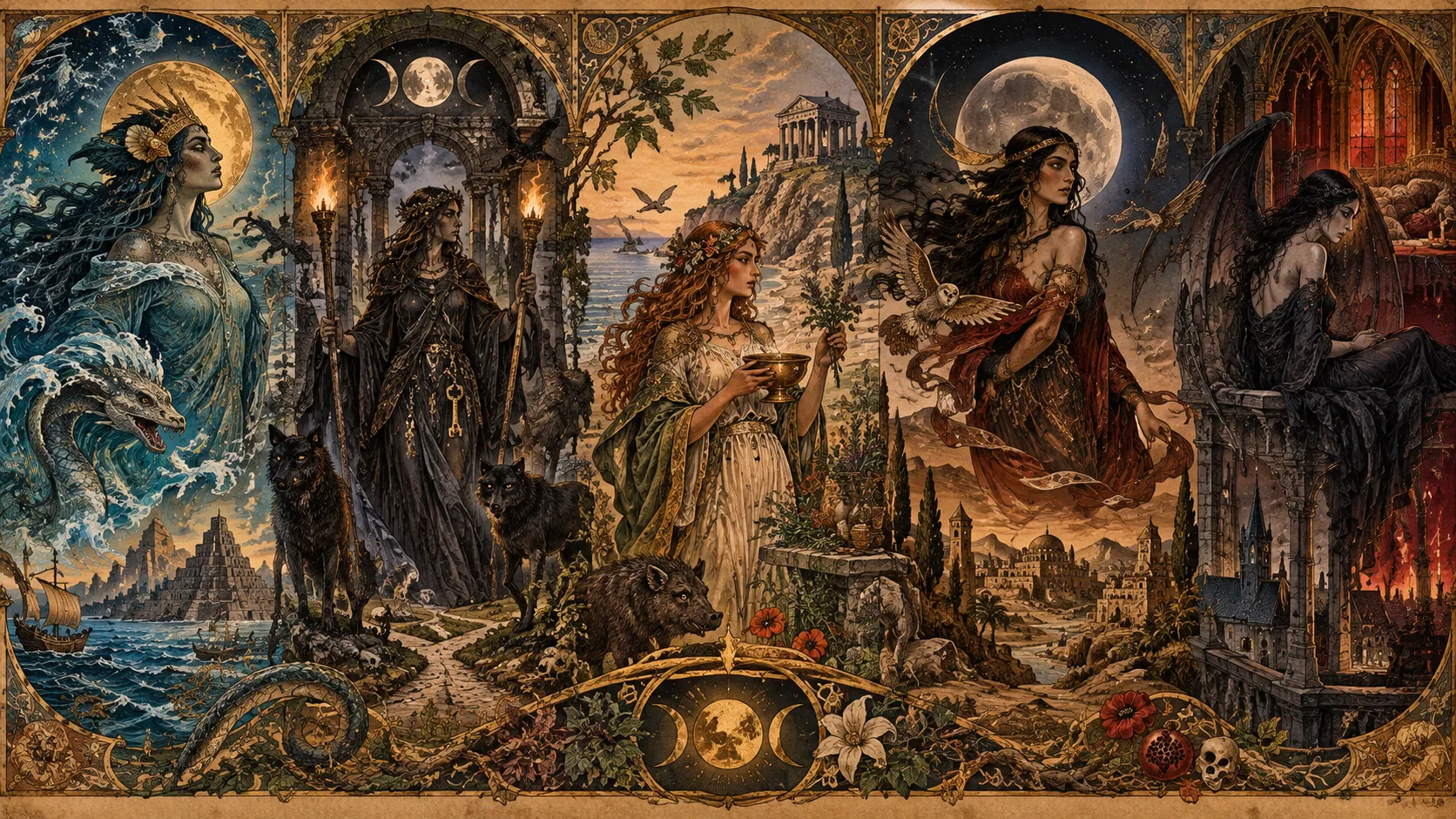
Succubus
A medieval night demon; Latin succubare means “lie beneath.” The male counterpart was the incubus. [32]
Circe
Homer’s enchantress changes sailors into animals but later restores them and guides Odysseus. Her Greek name may evoke a hawk. [33][34]
Hecate
An early Greek goddess honoured for protection and blessing; later associated with crossroads, spirits and magic. Her name’s older origin is disputed. [35][36]
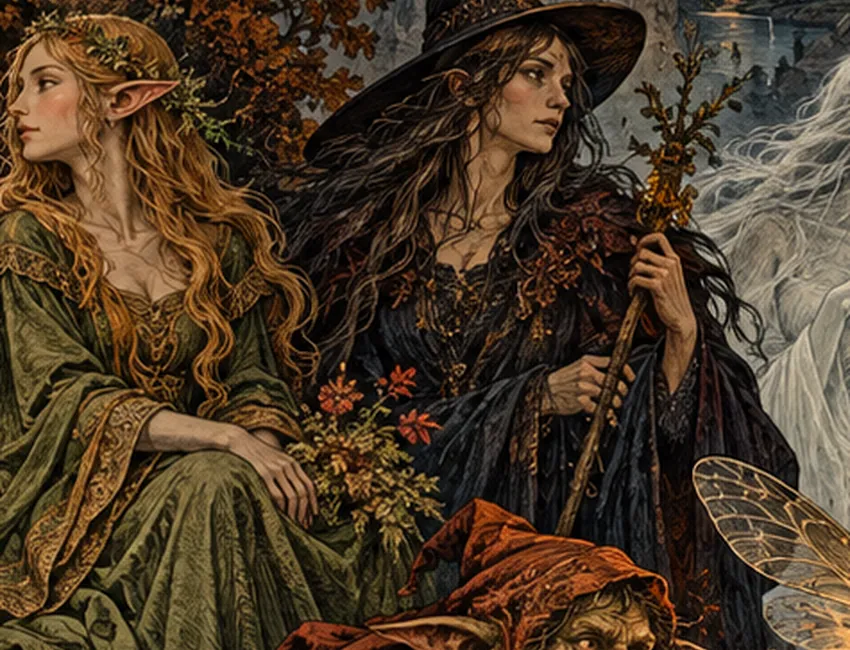
Across much of early modern Western and Central Europe, women formed the majority of people accused of witchcraft. The old English wicce and wicca referred to female and male magical practitioners; their prehistoric etymology remains uncertain. Fear of women’s independence intersected with illness, religious conflict and local grievances. Accused witches were real people, while the villains in stories were often imaginative composites. [41][42][43][44]
Spells, rituals and the power of allegory
Here language returns us to storytelling. Spell once meant speech or a narrative and later developed both magical and letter-by-letter senses. Write comes from a word for scratching or carving, while rite comes from Latin ritus, ceremony. Yet written oaths, blessings and laws can genuinely change social relationships: words perform actions because people agree to honour them. [45][46][47]
Allegory—Greek allegoria, speaking of something through another image—turns symbols into lessons. Freemasonry uses builders’ tools and Solomon’s Temple as moral imagery. Seventeenth-century Rosicrucian manifestos developed the Rose Cross and alchemical transformation into rich literary symbols. The medieval Knights Templar, suppressed in 1312, later inspired legends and ceremonies in other societies. A temple, sword or rose can outlive its first meaning through the stories attached to it. [48][49][50][51][52]
Twenty Halloween beings and the lore beneath their names
These cards show an earlier attested role and the linguistic path behind the modern name, including where the oldest root remains uncertain. These are different historical traditions, not a single medieval pantheon.
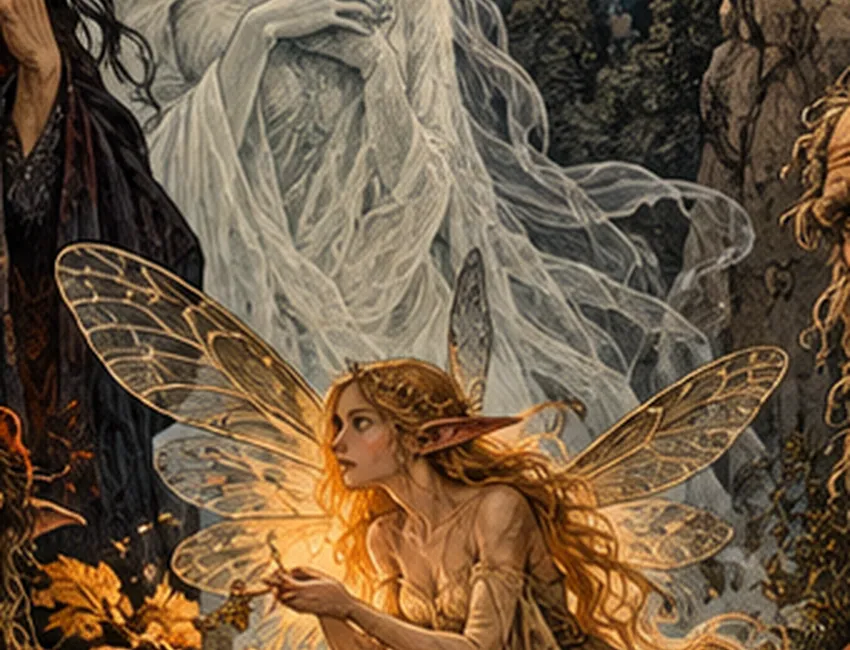
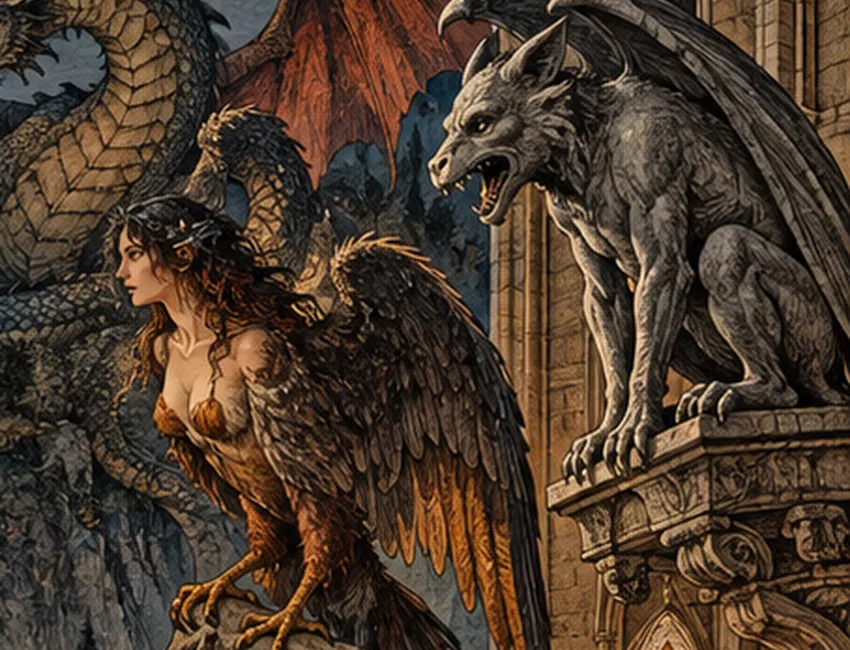
01 · Ghost
Ambiguous spirit · Germanic / Christian Europe
Original loreA dead soul might seek prayers, not revenge.
Name & linguistic rootsOld English gāst → Germanic *gaistaz; possible PIE “fear/astonishment.”[53][54]
02 · Grim Reaper
Personification · Late medieval Europe
Original loreDeath portrayed as an indiscriminate harvest.
Name & linguistic rootsGrim Germanic; reap Old English rīpan, “cut crops”; deeper root disputed.[55][6][56]
03 · Witch
Accused human · Anglo-Saxon / Europe
Original loreAn accused human, often blamed for misfortune.
Name & linguistic rootsOld English wicce/wicca; oldest derivation contested, not demonstrably “wise woman.”[43][57]
04 · Sorcerer
Diviner or magician · Medieval Latin / France
Original loreDivination by lots and the reading of fate.
Name & linguistic rootsFrench sorcier ← Latin sors, “lot/fate”; possible PIE “arrange.”[58][59]
05 · Demon
Spirit, then evil agent · Ancient Greece / Christianity
Original loreA guiding or dangerous supernatural power.
Name & linguistic rootsGreek daímōn, “apportioner”; proposed PIE root “allot/divide.”[29][31]
06 · Devil
Adversary · Jewish / Christian texts
Original loreThe accuser and adversary in sacred stories.
Name & linguistic rootsGreek diábolos, “slanderer”; Hebrew satan means “adversary,” separately.[60][61]
07 · Vampire
Feared revenant · Slavic / Balkans
Original loreA suspicious corpse blamed for later deaths.
Name & linguistic rootsSlavic upir/vampir; earlier source unknown, Turkic proposals disputed.[62]
08 · Werewolf
Sometimes a hero · Germanic / medieval France
Original loreSometimes a cursed person, sometimes a noble hero.
Name & linguistic rootsOld English wer, “man” + wulf, “wolf”; distinct PIE ancestries.[63][64]
09 · Goblin
Local haunting · Norman France
Original loreAn elusive and troublesome local spirit.
Name & linguistic rootsFrench gobelin; link to kobold or Greek kóbalos uncertain.[65]
10 · Elves
Otherworldly beings · Anglo-Saxon / Norse
Original loreSpirits connected with beauty, healing or illness.
Name & linguistic rootsOld English ælf ← Germanic *albiz; proposed “white” root uncertain.[66]
11 · Fairies
Enchantments and beings · Medieval France / Britain
Original lorePowerful negotiators between worlds, not tiny angels.
Name & linguistic rootsFrench fée ← Latin fata/fatum, fate, “what was spoken.”[67]
12 · Troll
Uncanny beings · Old Norse / Scandinavia
Original loreA broad category of uncanny Norse beings.
Name & linguistic rootsOld Norse troll; no secure reconstructed older root.[68]
13 · Dwarf
Maker, sometimes affliction · Norse / Anglo-Saxon
Original loreSupernatural smiths, occasionally bringers of illness.
Name & linguistic rootsOld English dweorg, Norse dvergr; older etymology uncertain.[69]
14 · Giant
Mythic opponent · Greek / Germanic
Original loreMythic opponents, ancestors or forces of wilderness.
Name & linguistic rootsGreek Gígas → Latin gigas → French géant; origin uncertain.[70]
15 · Dragon
Serpent and symbol · Greek / medieval Christian
Original loreThe fearsome serpent later adopted by saints’ legends.
Name & linguistic rootsGreek drákōn ← dérkomai, “see”; PIE *derk-, “look.”[71]
16 · Basilisk
Deadly serpent · Greek / Roman lore
Original loreA lethal crowned serpent, later a rooster-serpent.
Name & linguistic rootsGreek basilískos, “little king”; basileús already Mycenaean, deeper origin uncertain.[72][73][74]
17 · Siren
Dangerous singer · Ancient Greece
Original loreDeadly singer, originally represented as a bird-woman.
Name & linguistic rootsGreek Seiren; proposed Ugaritic “singers” connection remains hypothetical.[75]
18 · Harpy
Snatching wind-spirit · Ancient Greece
Original loreA violent snatcher, sometimes personifying winds.
Name & linguistic rootsGreek Hárpyia ← harpázō, “seize”; deeper origin debated.[76][77]
19 · Chimera / Kymera
Hybrid beast · Ancient Greece
Original loreA genuinely hybrid lion-goat-serpent of Greek myth.
Name & linguistic rootsGreek khímaira, “young she-goat”; linked to PIE “winter.”[78]
20 · Gargoyle
Architectural feature · Gothic Europe
Original loreStone waterspout, not an original living species.
Name & linguistic rootsFrench gargouille, imitating gurgling; connected with “throat.”[79]
Reconstructed words marked * are scholarly models, not inscriptions. Linguistic ancestry, the oldest attested myth, and later religious symbolism may be separated by centuries.
So who made the monsters?
We began with a skeleton cutting the last harvest. From an ox-head and an eye to Alpha and Omega, marks became letters; letters became sacred metaphors. A corpse became a vampire when fear supplied the plot. A goddess could become a villain when another voice took control. A scythe, crown, rose or name gathered power because generations agreed to remember it.
That is the power—and responsibility—of storytelling. Halloween lets us wear the monster’s mask for one night. History invites us to ask who placed it there, whose order the story protects, and what the creature might say if it finally told its own story.
Research notes and linked sources (89)
- Rogers, Halloween: From Pagan Ritual to Party Night, Oxford University Press
- Hutton, “The Celtic New Year and Feast of the Dead,” Folklore (2024)
- English Heritage: The history of Halloween, All Saints and All Souls
- PBS Monstrum: “The Macabre Origins of the Grim Reaper”
- Library of Congress: Heidelberg Dance of Death, c. 1480–1488
- Online Etymology Dictionary: reaper / Old English rīpan
- Smithsonian: “Decomposing Bodies in the 1720s Gave Birth to the First Vampire Panic”
- PBS News: Medical explanations of vampire folklore
- University of St Andrews: Medieval ghosts and purgatory
- Cambridge University Press: Elves in Anglo-Saxon England
- Cambridge University Press: Bisclavret, a sympathetic medieval werewolf
- Cambridge History of Religions: ancient Israelite and Judean religions emerged in Canaan
- Oxford Research Encyclopedia: Egypt in the Old Testament and Exodus evidence
- Oxford University Press: Mark S. Smith, Origins of Biblical Monotheism
- Cambridge Companion to Biblical Wisdom: Egyptian Amenemope and Proverbs
- Metropolitan Museum of Art: Alphabet Origins, from Sinai to Greek and Latin
- Israel Museum: The Invention of the Alphabet at Serabit el-Khadim
- Yale University: Darnell, Two Early Alphabetic Inscriptions from Wadi el-Hol
- Oxford University Press (2026): Anatoly Liberman, The kings of etymological rings
- University of Surrey, Morphology: Latin rex, Sanskrit raja and PIE root
- Metropolitan Museum of Art: ancient Egyptian kings and per-aa / pharaoh
- Cambridge Guide to Homer: basileus, wanax, Bronze Age pre-Greek titles
- Britannica: Hebrew melek, ancient Semitic royal terminology
- Pope Gregory I, letter to Mellitus (601), translation at Fordham University
- St Andrews Encyclopaedia: Christianity and Graeco-Roman Paganism
- Etymonline: Church from Old English cirice and Greek kyriakon
- Oxford Classical Dictionary: Pagan and paganus
- Oxford Advanced Learner’s Dictionary: heretic, via Greek hairetikos
- Oxford Classical Dictionary: daimōn
- Oxford Classical Dictionary: Demons in Christian thought
- Online Etymology Dictionary: demon from Greek daimon
- American Heritage Dictionary: succubus and Latin succubare
- Oxford Classical Dictionary: Circe in Homer and later literature (updated 2025)
- Behind the Name (LSJ): Circe / Kirke, possible connection with hawk
- Oxford Classical Dictionary: Hecate, early protector and later guardian of thresholds
- Hesiod, Theogony 410–452: blessings and honours granted to Hecate
- University of Pennsylvania ORACC: Tiamat, name meaning sea and ancient attestations
- Metropolitan Museum of Art: the Enuma Elish, Tiamat, and royal ideology
- TheTorah.com: medieval Alphabet of Ben Sira and Lilith as the first wife of Adam
- Jewish Encyclopedia: Lilith in Mesopotamian, biblical and rabbinic traditions
- Online Etymology Dictionary: ghost
- English Heritage: Eight myths about witchcraft
- Oxford University Press, Anatoly Liberman: The Oxford Etymologist goes Trick-or-Treating
- Gender & History (2025): women, labour and early modern witchcraft accusations
- Online Etymology Dictionary: origins of spell and spelling
- Online Etymology Dictionary: write and Proto-Germanic scratch / carve
- Online Etymology Dictionary: rite from Latin ritus
- United Grand Lodge of England: history and documentary origins of Freemasonry
- Brill academic study: the founding Rosicrucian manifestos of 1614–1616
- English Heritage: Knights Templar origins and suppression in 1312
- American Heritage Dictionary: allegory, through Latin and Greek roots
- Oregon State University: how allegory conveys meaning through story
- University of Texas Indo-European Lexicon: *gheis- (ghost, astonishment)
- Online Etymology Dictionary: ghost and Proto-Germanic *gaistaz
- Online Etymology Dictionary: grim, Germanic and proposed PIE root
- University of Texas Indo-European Lexicon: *rei- to cut / reap
- Wordorigins.org: disputed deeper etymology of witch / Wicca
- French Education Ministry: sors, magus and saga—the words for magic
- Online Etymology Dictionary: sorcerer, Old French sorcier and Latin sors
- Online Etymology Dictionary: devil from Greek diabolos
- Online Etymology Dictionary: Satan from Hebrew satan
- Online Etymology Dictionary: vampire and disputed Slavic origin
- Online Etymology Dictionary: wolf from Proto-Indo-European
- Online Etymology Dictionary: werewolf, Old English wer / wulf
- Oxford University Press: Anatoly Liberman on the mysterious goblin etymology
- Online Etymology Dictionary: elf and possible *albho- root
- Online Etymology Dictionary: fairy and Latin fata / fatum
- Online Etymology Dictionary: troll from Old Norse
- Online Etymology Dictionary: dwarf, Germanic root but uncertain older origin
- Online Etymology Dictionary: giant and disputed Greek origin
- Online Etymology Dictionary: dragon from Greek drakon / PIE *derk-
- Cambridge Guide to Homer: Mycenaean qa-si-re-u, ancestor of basileus
- Online Etymology Dictionary: basilisk and Greek basileus
- Classical Quarterly, Richard Janko (2014): proposed origins of basileus
- Luján Martínez & Vita Barra (2018), Glotta: Ugaritic etymology hypothesis for Greek siren
- Online Etymology Dictionary: harpy and Greek harpazein
- Ancient Greek harpazo: competing reconstructions and pre-Greek possibility
- Online Etymology Dictionary: chimera and Proto-Indo-European winter
- Académie française: gargouille from imitative garg- and Old French goule
- Oxford Classical Dictionary, “alphabet, Greek” (2015): Omega is a Greek addition developed from O
- Gerald L. Cohen, “The Origin of the Letter Omicron,” Kadmos (1981/1982): Greek O derives from Phoenician ayin
- Bible Gateway, Encyclopedia of the Bible, “Alpha and Omega”: first and last letters in Revelation
- Robert Edward Grant, 2020: his proposed A/Omega interpretation of marks on the King’s Chamber coffer (primary claim, not independent authentication)
- Egyptian Ministry of Tourism and Antiquities: The Great Pyramid of Khufu and the King’s Chamber
- University of Oxford, Cabinet: The Emerald Tablet, Arabic transmission and 12th-century Latin translation
- Vatican Catechism: The title “Lord,” Greek Kyrios, and divine sovereignty
- The Agile Manifesto (2001): Collaboration and responding to change
- The Official Scrum Guide (2020): Self-managing Scrum teams
- Quakers in Britain: Equality and non-hierarchical worship