
My brain can help untangle an IT incident while a sock seam quietly becomes the most unbearable part of my day. Both things can be true.
I hesitated to put this on my website. Would someone see a label before my abilities? Could discrimination affect current or future work? Yet awareness matters to me, whether in mental health, incident management or cybersecurity. It also means being honest about myself.
After Invisible Disabilities Week, 18–24 October 2026, I want to show what hidden disabilities can look like behind competence, creativity and a convincing smile.
I am autistic, have ADHD, and am gifted. AuDHD describes autism and ADHD occurring together; giftedness adds another layer. It is not synonymous with “high functioning”: capability does not erase support needs.
This is my experience, not everyone’s. Sometimes it feels like a superpower with a shadow: a hidden mental (dis)ability with real possibilities and limitations.
A Ferrari with a diesel startup and bicycle brakes
My brain is a Ferrari that starts like an old diesel car and brakes like a bicycle.
Starting can take time. Once something clicks, the engine roars. I investigate, connect ideas and disappear into subjects with extraordinary focus. But sudden turns need warning: those bicycle brakes were never designed for Ferrari speed.
I crave novelty and challenge while also needing clarity and predictability. Repetition can make my attention drift towards improving the process instead. Meaning is fuel: I want my effort to help people or contribute to something larger than myself.
A slow start does not tell you how far someone can travel.
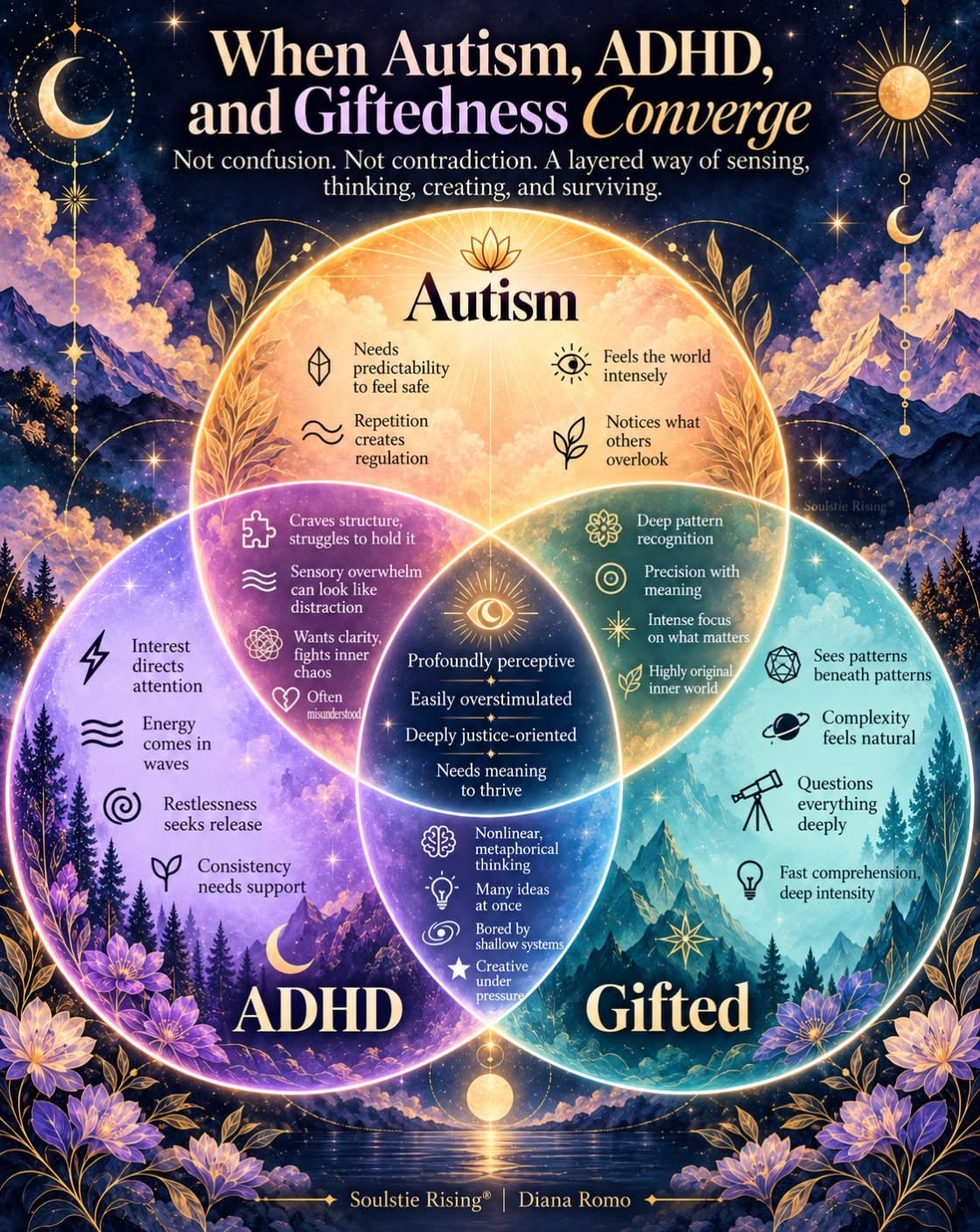
Autism, ADHD and giftedness: recognising the overlap
This illustration captures something I recognise: creativity, intensity and meaning alongside overwhelm. It is a conversation starter, not a diagnostic map. These traits are neither universal nor exclusive to those labels.
The world arrives in Full HD
I love mushroom and tomato soup. The texture of the pieces? Absolutely not. Sock seams demand attention. I notice fluorescent lights humming and high-pitched sounds from some animal deterrents and devices discouraging young people from gathering.
My nightmare: a crowded train, heavy perfume beside me and somebody conducting a phone call behind me. Long live the quiet carriage.
It feels like experiencing everything in Full HD, with a bonus “5D” upgrade nobody requested. “My filter is switched off” describes that feeling; it is a metaphor, not a literal neurological explanation.
Open-plan offices can create the same collision of conversation, keyboards and constant task switching. Some days I manage; other days the combination overwhelms me. Sensory tolerance can change with stress and energy levels. Yesterday’s capacity is not today’s guarantee.
The strengths behind the intensity
In IT troubleshooting, my tendency to think seven to ten steps ahead can become an asset. While one problem is being discussed, I may already be tracing dependencies, imagining consequences or looking for the issue underneath it.
I connect processes that seem unrelated. Reading widely and exploring obscure rabbit holes feeds that creativity. Sometimes a warning makes sense to others only when the problem returns. Still, a possible pattern is a reason to investigate, not proof that I am right.
Those connections feed my writing too. Metaphors make technical ideas understandable; questioning familiar processes can reveal a better user experience. I enjoy making complexity useful.
During incidents, urgency gives my attention direction. I often thrive coordinating several moving parts. Daily life already involves competing demands; in a crisis, that effort finds purpose. Recovery still matters afterwards.
Persistence comes with the package. Once I care, I care deeply. Fairness matters; double standards stick with me. My directness can be Dutch directness multiplied by ten. I would rather remove the plaster in one pull, although honesty still needs care in its delivery.
I also notice subtle changes in atmosphere. Friends have called me “Rosa the super sense detector”. It can feel like a sixth sense, but impressions need checking. Sensitivity is not mind-reading.
Why IT and defence employers value different minds
Some employers actively seek neurodivergent talent. Microsoft’s Neurodiversity Hiring Program offers an adapted interview process; SAP’s Autism at Work supports autistic candidates and employees.
In intelligence, GCHQ has highlighted an autistic employee’s ability to spot patterns and anomalies. In the Netherlands, Defence’s equipment and IT command, COMMIT, describes placing autistic colleagues in suitable roles with tailored support.
Individual abilities and needs differ. My takeaway: match the person to the work and make room for different minds.
Masking: the effort you cannot see
Masking can involve hiding discomfort and adjusting how we communicate to fit social expectations. Looking composed may conceal considerable effort. Managing that effort takes energy too: I am using the battery while calculating how much battery remains.
Unconscious discrimination can begin with ordinary assumptions. Comfortable clothes become evidence of lacking ambition. Extra processing time gets mistaken for low intelligence. A request for quiet becomes “being difficult”, while the competence masking helps display becomes an excuse to dismiss support needs.
That creates a painful loop: the more successfully someone hides their difficulty, the less others believe it exists.
Why I choose awareness over silence
At work, useful support can be practical: clear priorities, written agreements, advance notice of changes, quieter spaces and time to process. Ask what helps the individual. Judge contributions by their quality, rather than how effortlessly someone appears to deliver them.
These traits shape who I am: the strengths I value and the edges I keep refining. Some days, I joke that my factory settings came with a few glitches. Learning better ways to respond matters; pretending I can switch off my wiring helps nobody.
I share this hoping to inspire others to be honest about themselves and help break the stigma around abilities and needs that come with a label.
The Ferrari can go far with meaningful direction, enough fuel and room to brake. If telling my story helps someone see the person behind the label, that is awareness worth making visible.