Studying film, television and media changes how you watch a story. You follow the characters while noticing what guides your attention: a camera angle, an uncomfortable silence, a colour that keeps returning. You begin to recognise how a story creates meaning before anyone explains it.
My time at Cibap, with three years of video and three years of photography, shaped that perspective. Photography teaches you to read a frame; video adds movement, sound and the meaning created between images. A photograph can show someone standing alone. An edit can reveal who walked away.
This is visual literacy. When a work reflects on storytelling itself, there is a metatextual layer too. Understanding those layers makes me more appreciative of what works, more aware of what feels forced, and ridiculously excited about an obscure Easter egg.
The first two episodes of VisionQuest, released here on 14 October, invite that closer look. Following WandaVision and Agatha All Along, they return to a deeply human question: who are we when the things that once defined us have changed? [1]
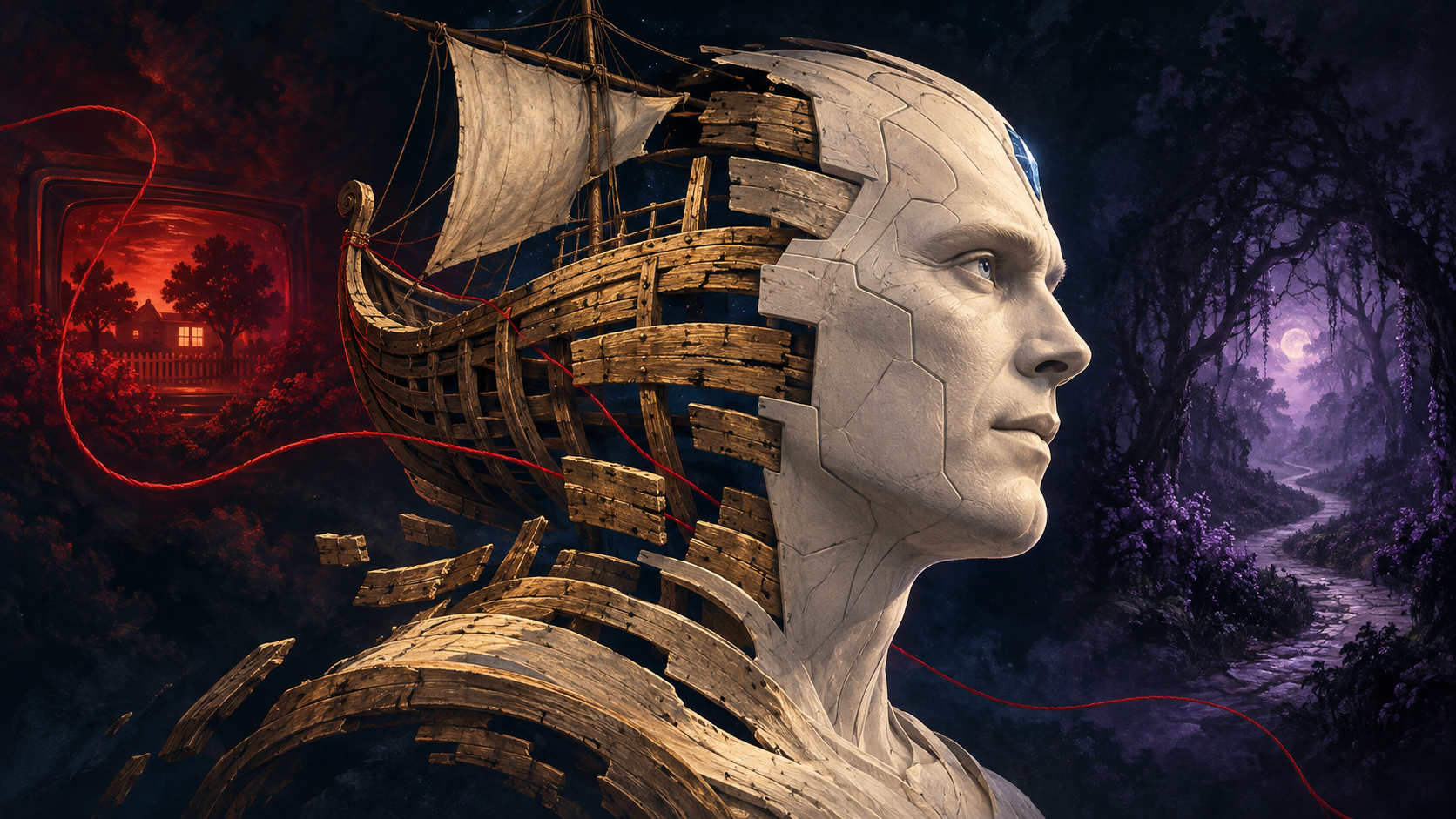
The Ship of Theseus gives that question a shape.
In Greek myth, Theseus enters the labyrinth in Crete and defeats the Minotaur, freeing the young Athenians sent there as tribute. Ariadne’s thread guides his escape. Plutarch later describes how the Athenians preserved Theseus’s ship by replacing its decaying timbers. Philosophers disagreed about whether it remained the same vessel. [2]
Imagine every plank eventually being replaced. Is it still his ship? Thomas Hobbes complicated the puzzle: suppose someone builds another ship from the discarded original pieces. One vessel preserves continuity; the other preserves the material. Which is the original? [3]
Applied to people, the question becomes more intimate. Are we our bodies, memories, relationships, or the continuity between them? Memory alone cannot settle personhood. We remain people even when our recollections change.
WandaVision makes this puzzle explicit through its two Visions. VisionQuest continues by separating access to memories from emotional connection to them. Knowing what happened does not necessarily mean feeling that it happened to you. [4][5]
Photography offers a familiar parallel. An old image can preserve your face and surroundings while leaving you strangely distant from the person you were. The record survives; your relationship with it changes.
The premiere also moves the philosophical question towards responsibility. Without revealing the circumstances, uncertainty about identity encounters a situation requiring action. My reading is that self-understanding cannot always come first. Other people encounter us through our choices, even while we are still figuring ourselves out. [4]
Paul Bettany has described combining Pinocchio’s wish to become real with Frankenstein’s questions about creation and belonging. This makes the opening title, “No Strings,” especially suggestive: freedom from a creator’s control leaves someone responsible for what comes next. [7]
WandaVision explored related territory through television itself. Its sitcom worlds offered familiar rooms, reassuring rhythms and the expectation that problems could be resolved within an episode. To me, that structure expresses the appeal of a life that can be made manageable.
Cinematographer Jess Hall explained how the production adapted different sitcom eras through lighting, framing and aspect ratio while serving the drama. He connected its visual approach to the difference between an original and a memory of it. [8]
That echoes Theseus again. Rebuilding a familiar room cannot guarantee the return of what made it home. Dialogue can insist that everything is fine while the image quietly suggests otherwise.
Agatha All Along takes this conversation onto the Witches’ Road. The journey gives inner change a landscape, while the coven challenges the idea of complete self-sufficiency. Jac Schaeffer identified community and reconnecting with personal power as central themes. [9]
She also cited The Wizard of Oz and The Dark Crystal when discussing practical effects. The cast could physically walk on the constructed Road. Those influences matter beyond nostalgia: tangible environments let performers inhabit the fantasy and give light real surfaces to describe. [9]
Through a photographic lens, that texture carries meaning. Worn fabric suggests a history. Shadows can make a welcoming space feel uncertain. A costume can communicate confidence while its wearer’s behaviour reveals fear.
VisionQuest offers a particularly satisfying detail: costume designer Sarah Young explained that Vision’s pinstripes contain code. Matalas described deliberately imperfect features in his internal house, including an incomplete banister. Familiar appearances become stranger under inspection. [6]
I read those choices as visual expressions of his uncertainty. Wanda’s red, Agatha’s purple and Vision’s pale reconstruction also establish distinct identities. Their meaning emerges through context and repetition; colours do not have one fixed translation.
This is symbolic resonance: different elements reinforcing a shared emotional question. The script, costume, music and setting can speak to one another without repeating the same information.
For me, the thread through these series is how people construct identity around love, loss and belonging. The stories we tell ourselves can offer shelter. They can also become restrictive, especially when maintaining them requires controlling someone else.
That ethical tension matters. Understanding a character’s pain does not resolve the consequences of their behaviour. Symbolism becomes powerful when it shapes a difficult choice.
As a writer, I recognise recurring patterns across stories: the dangerous creator, the uncertain identity, the journey through unfamiliar territory, the home that cannot be restored. Their effectiveness depends on the particular lives and consequences built around them.
An Easter egg rewards recognition. A meaningful motif deepens our understanding. Neither can replace an earned emotional moment, however beautiful the image or familiar the reference.
You also notice when this balance slips: dialogue explaining what an image already communicates, or music demanding an emotion the scene has not earned. Restraint gives the audience room to bring their own feelings.
Studying the craft also means distinguishing a creator’s stated intention from our own interpretation. A convincing reading should leave room for another viewer to see differently.
After two episodes, VisionQuest’s destination remains ahead. What interests me is how its ancient philosophical question opens onto everyday change. Looking at an old photograph, I recognise myself without feeling unchanged. Perhaps part of becoming ourselves is deciding what to carry forward.
Sources
1. Disney+ — VisionQuest release and premise
2. Plutarch — Life of Theseus, sections 15–23
3. Theoria — Hobbes’ Ship of Theseus and the gradual replacement of parts
4. Erik Kain, Forbes — VisionQuest episodes 1 and 2 recap (contains spoilers)
5. Fangirlish — VisionQuest episodes 1–2 review (contains spoilers)
7. The Walt Disney Company — Paul Bettany and James Spader on Vision’s journey
8. Rotten Tomatoes — Interview with WandaVision cinematographer Jess Hall
9. The Walt Disney Company — Making Agatha All Along with Kathryn Hahn and Jac Schaeffer