
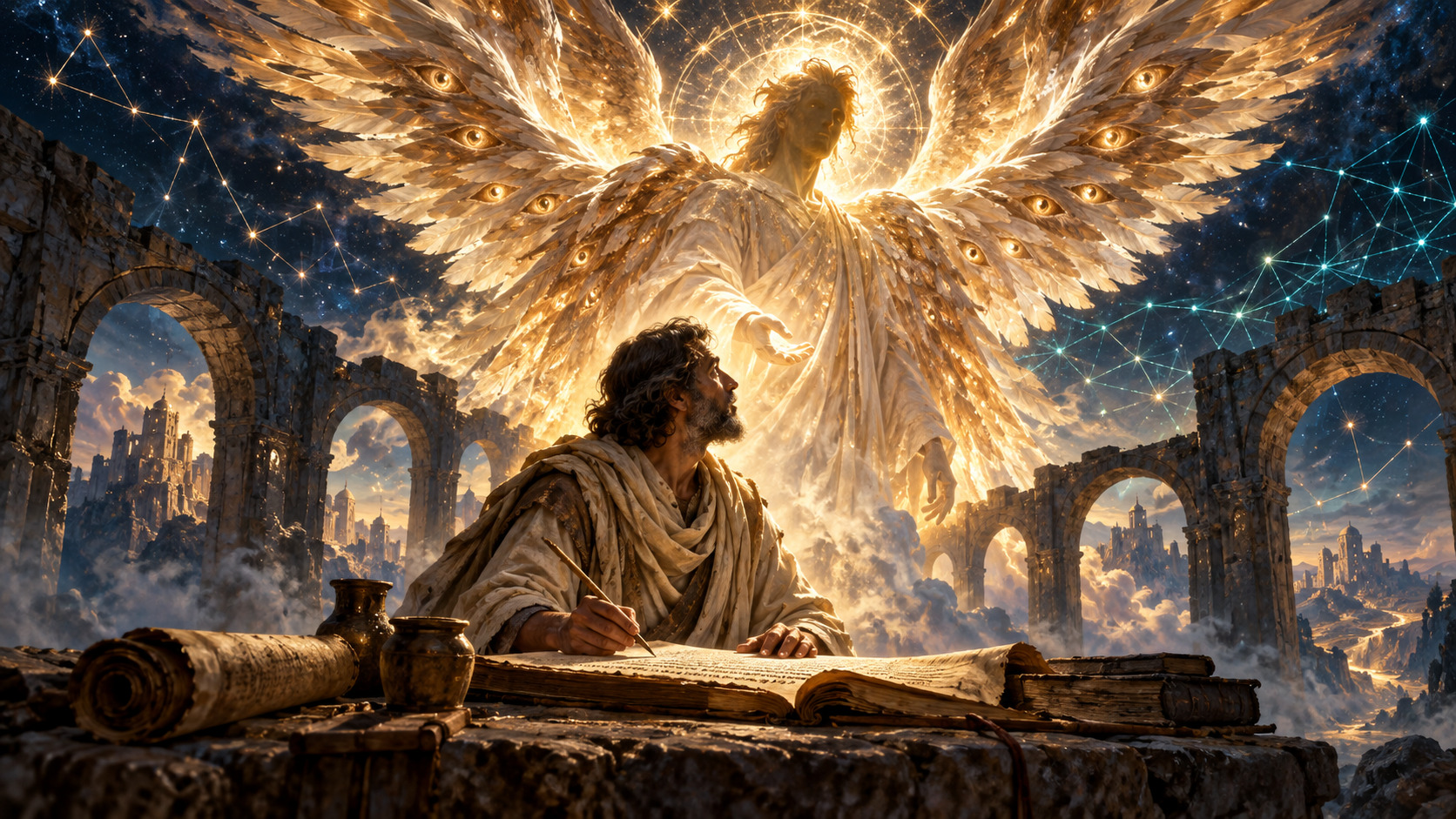
After watching Disclosure Day, I came across people on X making references to Enoch. Those connections made me curious enough to look more closely at the stories themselves.
As a writer, I’m interested in how ancient imagery enters modern conversations. What makes a story about heavenly beings, forbidden knowledge and human transformation feel relevant after watching a film today? What are we recognising in it?
That brought me to the three Books of Enoch and the figure of Metatron. I wanted to examine their storytelling: what the symbols do, why they stay with us, and how their themes might translate into everyday life—even IT.
The numbering needs some care. 1 Enoch, 2 Enoch and 3 Enoch are separate works with different histories. The explicit identification of Enoch with Metatron belongs to 3 Enoch. Reading them together means comparing traditions, rather than following one author’s trilogy. (Separate Enoch traditions)
And what about the description “forbidden book”?
For 1 Enoch, that label obscures an important distinction. A biblical canon is the collection a religious community recognises as scripture. Exclusion from that collection does not automatically mean a ban on reading. The Ethiopian Orthodox Tewahedo Church actually includes Enoch in its Bible. (Ethiopian Orthodox biblical canon)
Early Christian writers disagreed about its authority. Tertullian defended it while acknowledging that others rejected it. Centuries later, Augustine questioned the authenticity and transmission of writings attributed to Enoch and rejected their account of angels fathering giants. These are documented disagreements about authorship, trust and theology. (Tertullian, On the Apparel of Women I.3; Augustine, City of God XV.23)
Even the New Testament preserves a connection: Jude 14–15 quotes material from 1 Enoch 1:9. That demonstrates its influence without settling the status of the whole book for every community. (Jude 14–15 and source note)
The word “forbidden” adds another story around the text: the suggestion that its reader is approaching something hidden. As a storytelling device, that is powerful. Historically, we need to ask who restricted what, where and when.
The forbidden knowledge inside the narrative is a separate question.
In the Watchers story within 1 Enoch, heavenly beings descend, take human wives and teach arts including weapon-making, enchantments and adornment. Their giant offspring consume humanity’s provisions, then turn against people and other creatures. The earth cries out against the destruction. (1 Enoch, chapters 6–14)
The giants give consequences a body.
We know smaller versions of that pattern. A process grows until maintaining it consumes everyone’s working day. A platform demands increasing amounts of its users’ attention. A family secret requires more lies to keep it standing.
Something people brought into their world starts taking more than they can afford to give.
That is why a giant works so well in a story. We can picture its hunger and feel the moment when feeding it becomes impossible.
Before their descent, the Watchers also swear an oath binding them to their plan. (1 Enoch, chapters 6–14) Beneath the spectacle, I recognise a familiar social mechanism: a shared commitment can make wrongdoing harder to abandon.
Imagine a team agreeing to bypass a safeguard for a quicker result. Once everyone has participated, raising concerns also means admitting involvement. Loyalty becomes tangled with silence. The group protects the decision because the decision now implicates the group.
Through an IT lens, the Watchers suggest privileged access used irresponsibly. Being able to open a confidential file, change a system or release information does not resolve whether doing so is right. This is my modern analogy; the ancient narrative is concerned with violations of divine order.
Enoch occupies a different position. He acts as a scribe and intermediary, writing the fallen angels’ petition for forgiveness and carrying back the answer that it has been refused. (1 Enoch, chapters 6–14)
For a storyteller, that creates immediate tension: put a vulnerable witness between powerful parties and require him to report something unwelcome.
Anyone who has documented an incident may recognise the discomfort. An accurate record can threaten a convenient explanation. Writing down what happened makes it harder to replace events with the version that best protects someone’s position.
In 2 Enoch, the focus shifts towards ascent, revelation and transformation. Enoch travels through heavenly realms, receives instruction and records what he learns. Michael removes his earthly clothing, anoints him and clothes him in glory, making him resemble the heavenly beings. He later returns to instruct his children. (2 Enoch, chapters 22 and 44)
Changing clothes makes an invisible transition visible.
We understand that through uniforms, graduation gowns and access badges. Someone enters a new role, and other people begin treating them differently. Eventually, the role may change how they understand themselves.
The heavenly journey also resembles discovering how much supports an ordinary moment. A message appears on a screen in seconds. Behind it sit devices, cables, servers, electricity and human decisions. Understanding those layers changes what the apparently simple message means.
I read Enoch’s ascent as an expansion of perspective: each threshold enlarges the world he must understand.
Yet his teachings return to ordinary conduct, including respect for others, compassion for those who have been crushed and help for people in need. (2 Enoch, chapters 22 and 44)
That gives the extraordinary experience an earthly test. What changes when another person needs patience, fairness or help? In fiction, transformation becomes convincing when new understanding affects a choice.
With 3 Enoch, the relationship between traveller and guide changes again. Rabbi Ishmael encounters Metatron, who identifies himself as Enoch. The receiver of revelation has become a guide for someone else. (3 Enoch, chapter 4; Enoch as heavenly guide)
This belongs to a world of Jewish mystical traditions. There were restrictions around teaching certain mysteries: Mishnah Hagigah 2:1 limits instruction concerning the divine chariot to a suitably wise individual. That is evidence of restricted teaching, not a blanket ban on all three Enoch books. (Mishnah Hagigah 2:1)
Metatron’s appearance makes his transformation overwhelming. He has numerous wings and eyes; his body becomes fire. (3 Enoch, chapter 9; 3 Enoch, chapter 15)
I read the eyes as expanded perception, the wings as expanded reach, and the fire as change affecting the whole person. These images make an otherwise abstract transformation something we can see.
They also raise a question about identity. How much can someone change before others struggle to recognise them?
A colleague becomes a manager. A writer becomes a public figure. Someone who challenged an institution becomes responsible for running it. Their name remains familiar while their relationships change.
Metatron complicates the fantasy of unlimited promotion. In one episode, Aher sees him enthroned and concludes that there are two divine powers. Metatron is punished and made to stand, marking the limits of his position. (3 Enoch, chapter 16)
For me, that resonates with the danger of mistaking delegated authority for ultimate authority. A manager may confuse their position with personal superiority. We may treat a dashboard as the complete situation or an impressive answer as unquestionable truth.
A modern adaptation could follow an ordinary employee who discovers that trusted people have released something harmful. Asked to document the damage, they gain access to the organisation’s inner workings. Eventually, they receive responsibility for the system they once examined from outside.
The final test arrives when an inexperienced colleague brings them an inconvenient report.
Do they listen?
That is what draws me to these stories after encountering their echoes on X. A giant makes appetite visible. An ascent gives understanding distance and difficulty. A transformed body shows how deeply a role can alter its bearer.
And a scribe reminds us that someone must still write down what happened—even when the person on the throne would prefer a different story.