
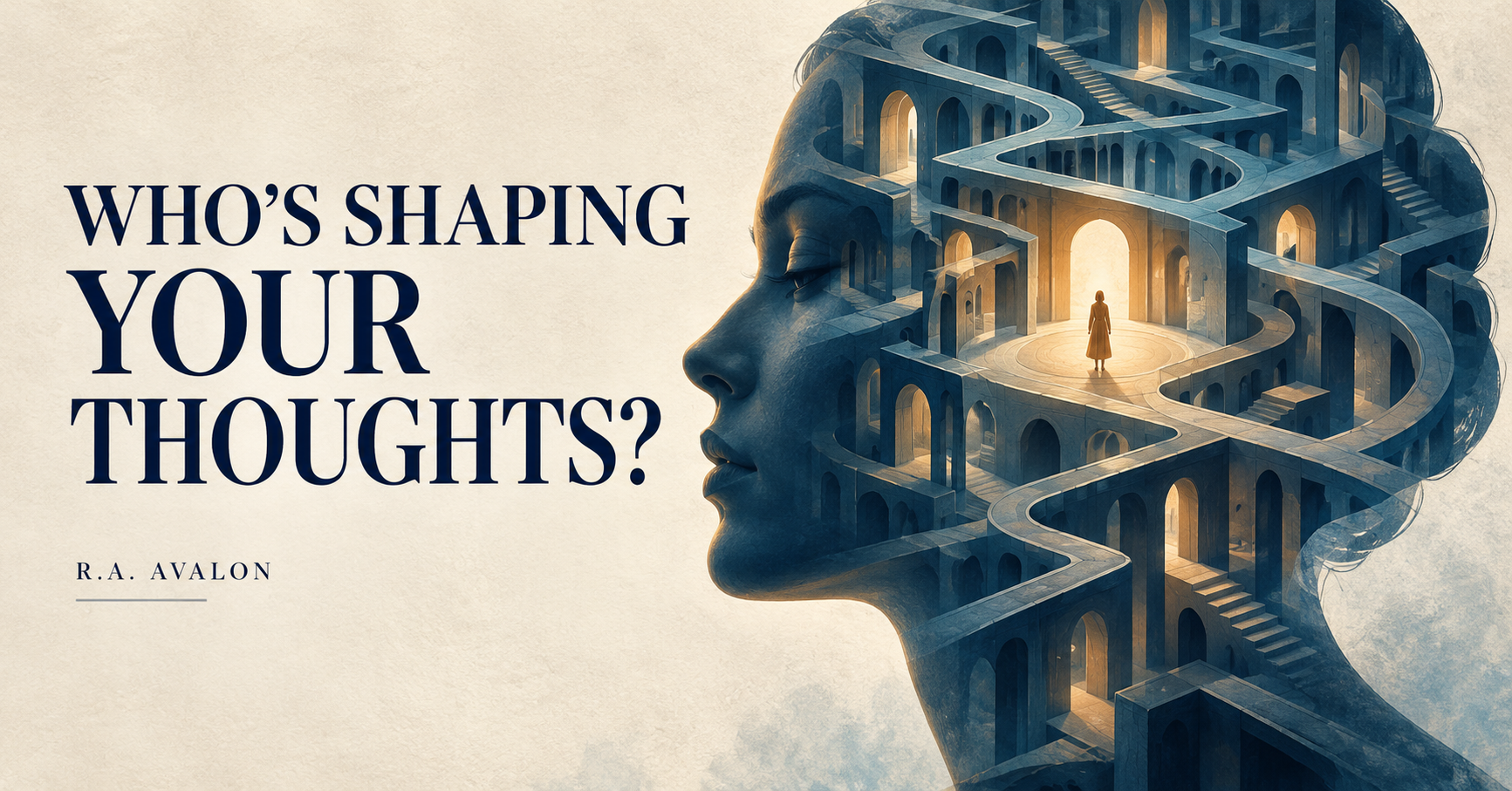
Experiencing an illness that makes you question your own thoughts changes the meaning of trust. You begin to notice the distance between feeling certain and having good reasons to be certain.
For me, that experience opened questions that reach far beyond health. Where do my opinions come from? Which beliefs have I examined, and which have simply become familiar? How much of what I call “my perspective” reflects the world around me?
I cannot separate these questions from how I now look at technology, politics and the organisations we build.
There is a name for examining your own thinking: metacognition. In everyday language, it means pausing to consider how you reached a conclusion. What happened? What meaning did I give it? What evidence would make me reconsider?
This can bring perspective, but it can also become tiring. Constantly questioning yourself is no comfortable place to live. I want to trust my judgement while allowing it to be corrected. I also want others to recognise that experiencing illness does not erase someone’s ability to contribute, understand or raise a legitimate concern.
That balance matters. Confidence deserves examination, whoever it belongs to.
My background in video and photography offers another way to understand this. A camera records what falls within its frame. Editing determines what follows what. The same material can tell different stories depending on what receives attention.
We encounter similar choices every day: in a news headline, a political speech, an organisation’s public image, or the version of ourselves we present online.
Influence is unavoidable. Manipulation becomes a concern when someone deliberately distorts the context or exploits our emotions to steer our judgement.
The challenge is recognising that without beginning to suspect everything. People can disagree honestly. A message can be upsetting and accurate. An explanation can feel reassuring and still be wrong.
Politics and geopolitics make these distinctions consequential. The European External Action Service has documented organised information manipulation across digital networks. Public perception is something states and other actors actively try to influence.
But awareness of manipulation should make us more careful with evidence, including evidence that challenges our preferred side. Otherwise, even critical thinking can become another way to protect what we already believe.
Meanwhile, information is almost continuously available. We carry world events, arguments, entertainment and professional expectations in our pockets. There is always another explanation to read, another crisis to understand, another opinion asking for a response.
Now we can ask AI.
As someone who loves connecting ideas, I find that remarkable. An unfamiliar subject becomes easier to approach. A question can lead into history, philosophy, technology or an entirely unexpected direction.
It can feel like having the world’s knowledge within reach. Yet an accessible answer still needs to earn our trust.
AI can invent facts and references, make reasoning errors and present an unreliable explanation fluently. Humans can also become attached to persuasive explanations and mistake confidence for accuracy.
The parallel interests me, although the mechanisms differ. A human hallucination is a perceptual experience; an AI “hallucination” refers to erroneous generated material. Similar language should not blur that distinction.
What connects them here is the question of how we assess reliability.
I want AI to expand my thinking, help me examine assumptions and offer perspectives I might have missed. Its usefulness depends partly on my willingness to question its answers, including the ones I enjoy receiving.
That brings me back to systems.
People create them, then adjust their behaviour to survive or succeed within them. Those behaviours influence what the system becomes. We are both its designers and its participants.
Working with IT processes makes this relationship familiar. Procedures can create clarity, protect continuity and help people receive support. They can also become detached from the problem they were meant to solve.
Closing a ticket does not always mean someone can work again.
If an organisation rewards the appearance of resolution, people may learn to produce that appearance. If difficult information creates trouble for the person reporting it, fewer problems may reach those making decisions.
Eventually, reassuring reports can hide an uncomfortable reality.
This worries me when reputation, commercial interests or administrative convenience appear to outweigh the people involved. A nonprofit purpose offers no automatic protection. Values still have to guide decisions when acting on them costs money, time or prestige.
The human connection is why healthcare matters to me. Behind the infrastructure are professionals supporting people, often during vulnerable moments. Technical work becomes meaningful through that connection.
My charity work with the 501st reflects the same motivation. Shared enthusiasm and creativity become a way to contribute something to another person’s day.
These experiences keep bringing me back to purpose.
Kant’s principle of treating people as ends in themselves offers a useful starting point. Someone’s worth cannot be reduced to how productive, profitable or convenient they are.
That should matter when we discuss innovation and national competitiveness too. Progress needs a human explanation: whose life improves, who carries the consequences, and who gets heard?
Security and economic stability matter. So does the freedom to question how they are pursued. A society should be able to examine its priorities without treating every uncomfortable question as disloyalty or every vulnerable person as a problem to manage.
I do not want uncertainty to make me cynical. I want it to make me more attentive, including to the possibility that I have misunderstood something.
Institutions need that capacity as well. Listening must lead somewhere. When concerns are raised, someone needs the responsibility and authority to investigate, respond and change what is failing.
Otherwise, asking people for their experiences becomes an exercise in collecting words.
I still believe in technology, public service and the possibility of building something better. My concern comes from caring about what those things could achieve.
But if we become better at maintaining systems while becoming worse at recognising the people inside them, we need to reconsider our definition of success.
What are we doing all this for?