A peacock opens its feathers. A screen lights up. Saturn carries its rings through space while people walk through a circular building on Earth. Different worlds, familiar forms: eyes, circles, triangles, spirals and branches.
Their recurrence fascinates me. Some connections arise from physics, others from cultural inheritance or interpretation. Following them brings nature, mathematics, religion and everyday perception into conversation. The question is what each relationship reveals about how we experience life.
Colour sits between the world and our experience. Eyes focus light like camera lenses, but seeing requires a brain. Most humans have three cone classes with overlapping wavelength sensitivities. Light has measurable electromagnetic frequencies; colour emerges through its interaction with our visual system. We see colours, although perception exceeds a direct frequency reading.[1]
Screens combine red, green and blue light additively: full RGB channels produce the display’s white; zero produces black. Printing’s CMYK works subtractively, using inks that absorb light, with black supplying depth and detail. Different physics produces different results. Symbolically, the connection is suggestive: what a combination creates depends on its surroundings.[2]
Black and white consequently make imperfect moral absolutes. Darkness shelters; light exposes. Red evokes blood, urgency and aggression, but also warmth. Blue suggests calm water or protection, but also coldness and danger. Red as offensive and blue as defensive works in some contexts. Colour psychology depends on circumstances and learned associations.[3][4]
Three invites further connections. Two distinct points define a line; three non-collinear points define a triangle, the simplest polygon. RGB, spatial dimensions and the Christian Trinity give three different roles. Their recurrence supports analogy without making their meanings identical.[5]
Alchemy gives triangles another vocabulary: upward for fire, downward for water; a horizontal bar makes them air and earth respectively. Each element holds opposing possibilities: warmth and destruction, nourishment and drowning, support and burial, breath and storm.[6]
Interlocking triangles produce a six-pointed star. An esoteric interpretation unites opposites, recalling the Emerald Tablet’s correspondence between levels of existence: “as above, so below.” The shape also carries distinct religious identities, including the Jewish Star of David.[7]
Egypt’s Dendera zodiac and China’s Dunhuang star atlas connect celestial observation with cultural interpretation. Egypt’s name itself travelled through Greek Aigyptos, generally traced to Hut-ka-Ptah, “House of the Ka of Ptah,” associated with Memphis.[8] Astronomy measures celestial phenomena; astrology interprets their significance. Cosmology investigates origins, scientifically or through religious accounts, with different methods and purposes.
Mathematics developed across civilisations. Newton and Leibniz shaped modern calculus in seventeenth-century Europe; centuries earlier, Madhava in Kerala studied infinite series.[9] Mathematics provides ways to compare relationships across disciplines, although similar equations need not describe identical processes.
Newton also studied theology and alchemy, translating the Emerald Tablet. Leonardo’s Vitruvian Man connected bodily proportion with the circle and square. Nature, geometry and questions about existence could occupy the same intellectual world.[10][11]
An architect borrows forms from branches and shells, creating spaces that direct movement and frame a view. Nature becomes design, then an environment that influences whoever inhabits it.
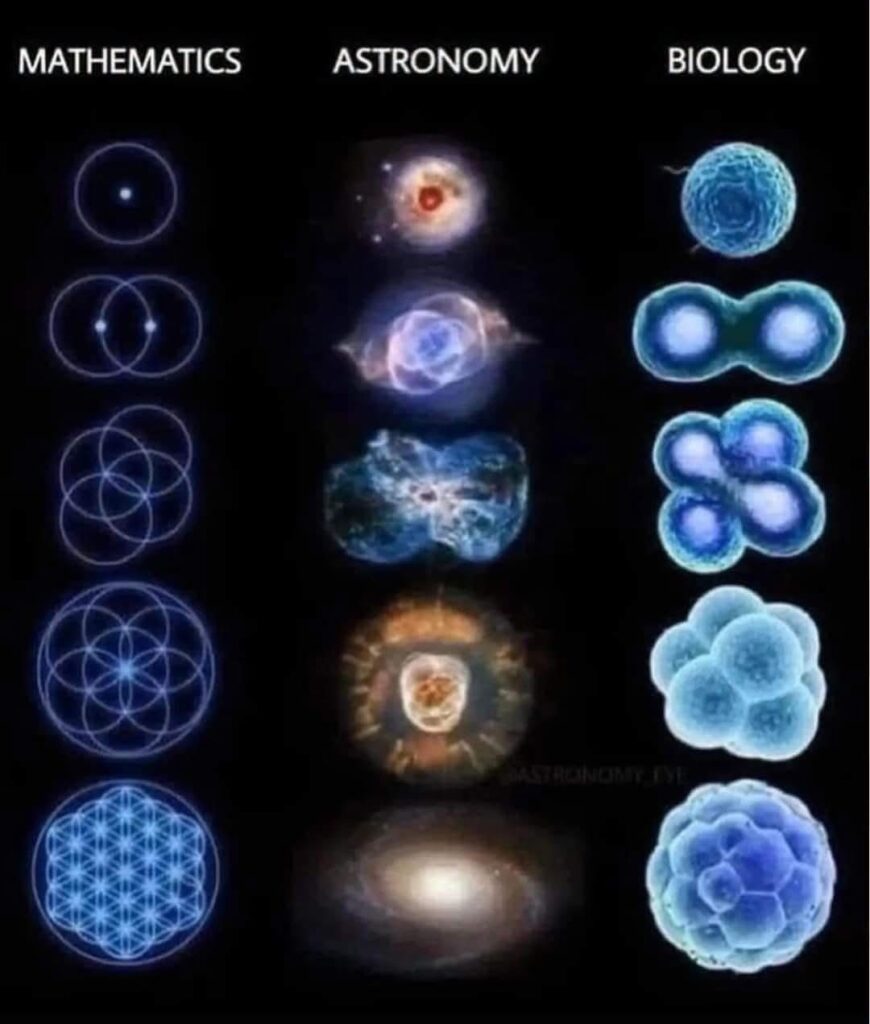
The comparison image labelled Mathematics, Astronomy and Biology makes this attraction visible. Its overlapping circles resemble constructions called the Seed or Flower of Life, ending in a network resembling Metatron’s cube. Two equal circles passing through each other’s centres form the lens called a vesica piscis.[12]
The biological sequence appears to depict embryonic cleavage: one fertilised cell becomes two, four and larger groups. Early human embryos increase cell number without corresponding overall growth. Real cells occupy distinct volumes; overlapping circles share space on paper. Similar silhouettes conceal different mechanisms.[13]
The astronomical column supplies no object names. It appears to combine nebulae with a galaxy, rather than successive stages of one object. Stellar winds can shape nebular lobes and rings, while viewing angle changes appearances. Telescope colours may translate filtered observations into visible information.[14][15]
The connection concerns organisation: parts forming wholes within boundaries. Resemblance opens an investigation; establishing a shared cause requires measurements and a mechanism.
Mandelbrot’s fractal work similarly illuminates recurring complexity. Repeated mathematical operations generate intricate forms; natural branching shows similarities across limited scales. Fractals are neither nature’s origin nor another name for entropy.[16] Order also belongs to nature: crystals form and organisms grow. Local organisation can increase while total entropy rises across a system and its surroundings.[17]
A cube connects dimensions with perspective. Its six faces can unfold into a cross-shaped net; viewed along a body diagonal, its outline can appear hexagonal.[18] A black box suggests concealed workings, and unfolding it becomes a metaphor for understanding. This geometry does not establish the origin of religious crosses.
Saturn’s polar hexagon is an atmospheric jet stream; its rings consist largely of orbiting ice particles.[19] Tolkien’s One Ring and Apple Park’s circular, loosely torus-like building provide cultural echoes. Direct inspiration from Saturn remains unproven. Voyager observed the hexagon decades after Tolkien’s novel appeared.[20][21] Symbolically, rings suggest unity, continuity and enclosure: every inside also creates an outside.
Modern brands make such associations familiar. Logos can resemble secular sigils: concentrated marks carrying accumulated meaning. Repetition connects a shape with experiences until recognition becomes almost immediate.
Apple’s bitten fruit can evoke knowledge, temptation or discovery. Designer Rob Janoff explained the bite as establishing scale and distinguishing an apple from a cherry. The original coloured stripes referenced the Apple II’s colour display. Apple’s earlier logo actually depicted Newton beneath an apple tree. Documented design choices coexist with meanings audiences supply.[22]
McDonald’s M developed from restaurant arches intended to attract passing motorists. Architecture became a portable symbol on packaging and signs.[23] Repeated encounters can associate its curves with familiar food, convenience or childhood. The meaning depends partly on memory.
Pepsi’s divided globe can recall yin-yang, although that resemblance does not establish a religious origin. PepsiCo explicitly describes movement and animation in its 2023 redesign through a blue and black “pulse.” The NS arrows similarly communicate rails, direction and circulation; designer Gert Dumbar acknowledged British Rail as an influence.[23]
Movement becomes a visual language for innovation. Arrows suggest a next step, curves carry the eye forward, pulses suggest continuing activity. Brands give an abstract promise of progress a recognisable form. Spirals, including triple spirals, can evoke wind, but so can bent reeds; waves suggest water, sound or light according to context.
Visual influence has experimental support. Research found circular and angular logos could evoke softness and hardness, affecting product judgements. Competing information changed those effects.[24] Symbols can influence impressions without controlling people.
A designer may choose a curve for clarity while a customer reads welcome or movement into it. Repetition strengthens associations; experience can change them. A familiar logo carries expectations.
Nature supplies imagery beyond geometry. Pinecones protect seeds and have represented fertility. The Vatican’s Roman bronze pinecone later stood beside bronze peacocks in a fountain at old St Peter’s.[25] Forms acquire new meanings as cultures inherit them.
The pineal gland resembles a pinecone; its established biological role involves melatonin and bodily rhythms. Reading it as a spiritual “third eye” does not establish ancient knowledge of its functions.[26] Kundalini’s rising serpent belongs to Indian Tantric teachings about the subtle body, a spiritual framework rather than a medical description.[27]
Such imagery invites reflection on awareness. “All is mind,” a teaching of The Kybalion from 1908, offers a philosophical perspective, not an established scientific conclusion.[28] Human creations nevertheless connect imagination with matter: nature inspires thought, thought becomes design, and design changes the environment others experience.
Language repeats this movement. “Enlightenment,” “roots” and “growth” translate natural processes into understanding and identity. Living in the present can mean noticing both our surroundings and the interpretations we place upon them.
Christian art associated peacocks with immortality and resurrection, their feather “eyes” suggesting divine watchfulness. Their iridescence also has a physical explanation: microscopic structures affect reflected light.[29] Biology, optics and religious meaning meet in one animal.
Egyptian Eye of Horus amulets expressed healing and renewal.[30] The Eye of Providence represents divine watchfulness; above the American Great Seal’s unfinished pyramid, it accompanies a structure historically associated with strength and duration, and interpreted as a nation still developing.[31]
An eye can suggest consciousness or universal awareness. Conspiracy theories reinterpret it as hidden rule, but recurring imagery does not establish a secret network. Jewish expectations of a Third Temple belong to a distinct religious tradition.[32] Comparing unfinished sacred and civic projects reveals an interest in completion without proving common ownership.
Seasonal light gives symbolism a calendar. Around the March equinox, daylight and darkness approach balance. The nine-month Christmas connection begins with the Annunciation on 25 March, nine calendar months before 25 December, rather than today’s astronomical equinox around 20 March. Historians debate Christmas’s origins, including Christian calculations and the Roman solar context.[33][34]
Northern daylight increases after the December solstice, generally around 21–22 December. The birth of light becomes a powerful metaphor, while the Southern Hemisphere experiences summer. Geography changes the relationship between calendar and nature.[33]
Constellations also depend on viewpoint: stars apparently forming one figure can lie at vastly different distances.[35] We connect dots from somewhere. The position matters.
A photograph or map selects what belongs in the frame. Noticing what it excludes helps us consider another viewpoint. The lens becomes a metaphor for mindset, although interpretation cannot alter underlying facts.
Human belonging follows shifting boundaries too. Kingdoms within kingdoms, islands within islands: individuals seek sovereignty within families, communities and nations. Rival football supporters unite behind a national team. The boundary of “us” expands.
A common enemy can encourage cooperation or deepen division.[36] Two rivals aligning against a third form a social triangle. Shared ideals and rituals can bind secret societies too; secrecy alone proves no conspiracy. The difficult question is whether unity survives when its enemy disappears.
The rebel called a freedom fighter may threaten someone dependent on the existing order. Perspective explains disagreement without erasing consequences. Whose freedom is protected, and who bears its cost?
Your left is someone else’s right when you face each other. From an eagle’s view, people become dots with recognisably shared needs. Yet distance also conceals unequal power. Understanding requires enough distance to recognise the pattern and enough closeness to see the person.
That is where these connections become fertile ground for storytellers. A ring can bind lovers or imprison a kingdom. An eye can promise protection to one character and surveillance to another. A returning season can become a culture’s account of death and renewal. Familiar forms acquire meaning through the people who encounter them.
For me, the inspiration lies in those relationships: how nature becomes belief, how belief shapes a city, and how someone challenges the order they inherited. Black and white open into gradients, without placing truth automatically in the middle.
Storytellers draw constellations of their own. We connect details across scales until a world feels inhabited and a character’s choice reveals its larger tensions. Something recognisable becomes something we can experience through another person’s eyes, with their fears, loyalties and unfinished hopes.
Sources and research notes
Numbered notes support the historical and scientific claims. Symbolic comparisons and personal readings are the article’s interpretations.
1. Colour perception and waves. National Eye Institute research; NASA electromagnetic waves.
2. Additive and subtractive colour. Adobe colour modes; DINFOS colour models.
3. Red blue and task context. Xia and colleagues 2016 experimental study.
4. Learned colour preferences. Palmer and Schloss 2010 ecological valence study.
5. Triangle geometry. Wolfram MathWorld triangles.
6. Alchemical notation. Unicode alchemical symbols.
7. Hermetic correspondence and interlocking triangles. Hallie Ford Museum on the Emerald Tablet; Museum of Witchcraft and Magic altar record.
8. Egypt and Chinese sky traditions. Tampa Museum of Art on Egypt’s name; Louvre Dendera zodiac; British Library Dunhuang Star Atlas; NASA observational cosmology.
9. Mathematical history. MacTutor historical overview; Development of calculus; Madhava and infinite series.
10. Newton’s religious and alchemical work. Newton Project archival overview; His Emerald Tablet manuscript.
11. Leonardo and human proportion. Royal Collection Trust on Leonardo’s anatomy.
12. Overlapping circles and sacred geometry names. Wolfram MathWorld vesica piscis; Wolfram MathWorld overlapping circles grids.
13. Embryonic cleavage and cell organisation. UNSW Carnegie stage 2; Human preimplantation development review; 2024 research on human embryo cleavage patterns.
14. Nebular shapes and viewing angle. NASA butterfly nebula and stellar outflows; Hubble research on the Ring Nebula’s three-dimensional structure.
15. Colour in astronomical images. NASA Hubble image colour FAQ; NASA worked example of filter and colour assignments.
16. Fractals and natural form. Mandelbrot’s 1967 coastline paper; Fractal Foundation natural fractals.
17. Entropy and local organisation. OpenStax second law and entropy.
18. Cube geometry. Wolfram MathWorld nets; Wolfram MathWorld cube.
19. Saturn’s hexagon and rings. NASA Cassini Hexagon in Motion; NASA Cassini ring science.
20. Tolkien’s stated influences and publication history. Tolkien’s 1951 letter to Milton Waldman; Tolkien Estate The Lord of the Rings.
21. Apple Park design. Apple’s account of the ring and landscape.
22. Apple logo intent. Interview with designer Rob Janoff; Second Janoff interview.
23. McDonald’s Pepsi and NS. McDonald’s architectural arches; Pepsi’s design account; NS interview on its logo.
24. Logo shape experiments. Jiang and colleagues 2016 Does Your Company Have the Right Logo.
25. Pinecone and peacock objects. British Museum pinecone and fertility; Vatican bronze peacocks and fountain history.
26. Pineal anatomy and physiology. NCBI pineal gland anatomy; NINDS Understanding Sleep.
27. Kundalini and the yogic body. British Museum What is Tantra; British Museum on Tantric symbolism.
28. Modern Hermetic philosophy. The Kybalion original text published in 1908.
29. Peacocks in Christianity and optical physics. Morse Museum Tiffany chapel reredos; Augustine City of God book XXI chapter 4; Zi and colleagues 2003 feather coloration research.
30. Eye of Horus amulets. Metropolitan Museum of Art wedjat eye amulet.
31. Eye of Providence and unfinished pyramid. US Department of State Great Seal history including the 1782 explanation; Grand Lodge of British Columbia and Yukon on eye imagery; State Department interpretation of the unfinished nation.
32. Third Temple belief. Chabad on the Holy Temple and future restoration.
33. Equinoxes solstices and daylight. Met Office equinox and solstice explanation.
34. Annunciation and Christmas dating. Vatican on 25 March and the nine months; Historian Andrew McGowan on the competing explanations.
35. Constellations and perspective. NASA Hubble on stars and apparent arrangements.
36. Group rivalry and the limits of common enemies. Between-group competition and human cooperation study; 2022 preregistered experiment on common enemies and polarization.