Sometimes I discover a story long before I realise I have been listening to one.
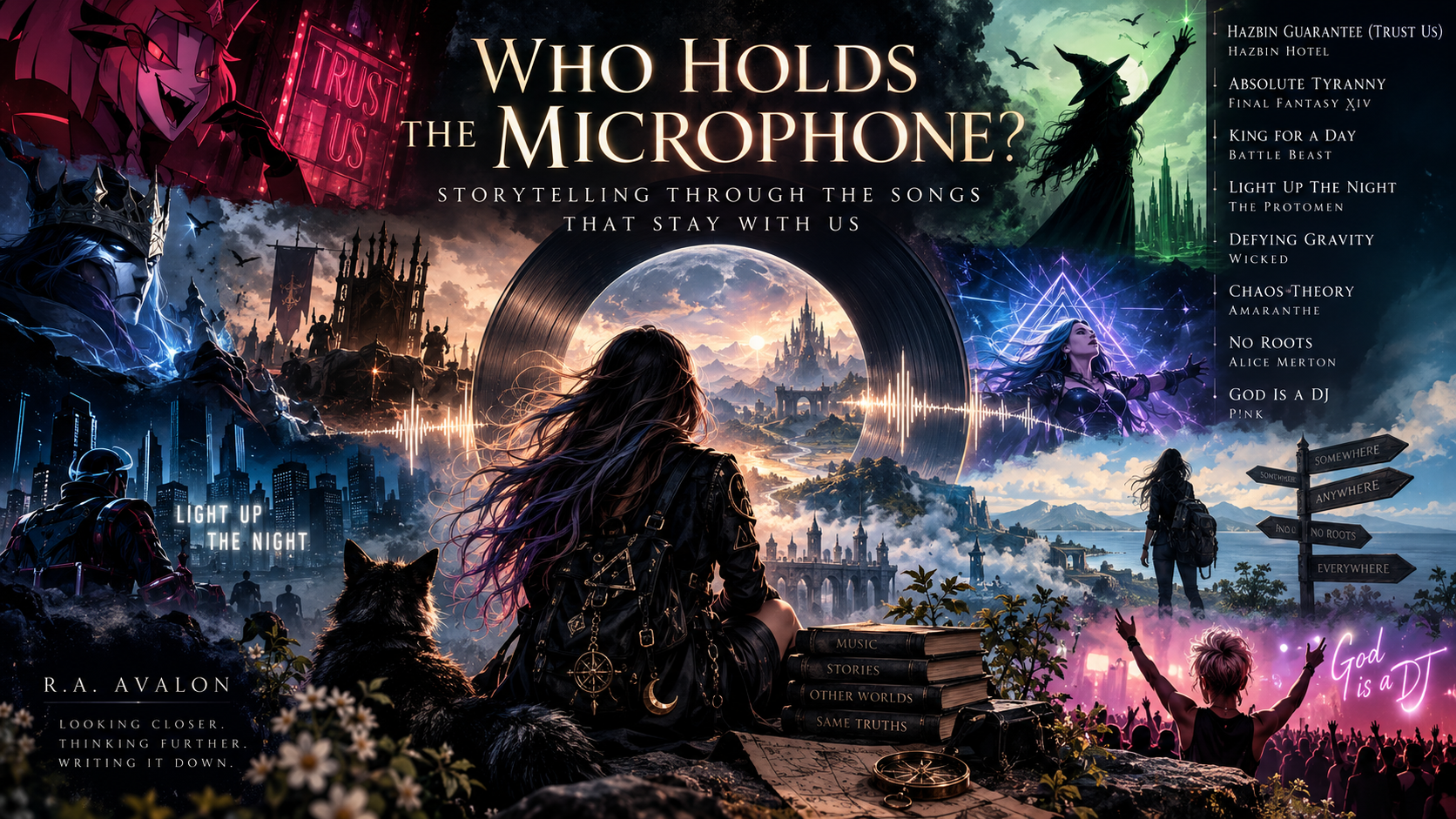
My playlists can look chaotic from the outside: The Protomen, Final Fantasy XIV, Amaranthe, Hazbin Hotel, Wicked, Battle Beast, Alice Merton and P!nk. Musically, they do not neatly belong together. Narratively, however, I think they do.
There is a thread running through Light Up the Night, Absolute Tyranny, Chaos Theory, Hazbin Guarantee (Trust Us), God Is a DJ, No Roots, Defying Gravity, and King for a Day.
It is a thread about power: the identities other people construct for us, the masks we construct for ourselves, promises that sound wonderful until we examine who benefits from them, rebellion, leaving, wandering, and eventually discovering that freedom means very little if we never learn what to do with it.
Perhaps that is why these songs appeal to me as a writer. A good story rarely begins with someone knowing exactly who they are. It begins when something makes them question the story they have been given.
Hazbin Guarantee: Every story starts with a promise
There is something inherently powerful about a promise. Come with me. Trust me. I can make your life better. I can make you important.
That is where Hazbin Guarantee (Trust Us) becomes interesting to me. Within Hazbin Hotel, Charlie offers the possibility of redemption through the hotel while the Vees offer something considerably more seductive: visibility, fame and reinvention. Both are selling a future, but they are not selling the same relationship.
The dangerous offer rarely introduces itself as dangerous. Nobody walks into a Faustian bargain because someone places a contract on the table labelled TERRIBLE DECISION. The offer has to contain something the character genuinely wants: recognition, belonging, power, security, love or purpose.
The interesting question therefore is not simply whether somebody is telling the truth. It is: What does accepting their promise require you to become?
Good storytelling lives in those uncomfortable spaces. So when someone tells a character, Trust us, my storyteller brain immediately asks another question: Why?
Absolute Tyranny: The character everyone thinks they know
Then there is Absolute Tyranny from Final Fantasy XIV. On the surface, subtlety is not exactly the Tyrant’s defining characteristic. This is spectacle, power and dominance: an enormous personality declaring itself to the world.
And yet FFXIV subsequently did something I particularly enjoy in storytelling: it allowed us to look behind the performance. The short story The Rise of a Tyrant complicates Arkose’s public persona. Masked Justice had been a heroic character who failed to capture the crowd. The Tyrant emerged from something much more aggressive and authentic, but even that intimidating persona does not contain the entirety of the man underneath it.
Characters exist at several levels simultaneously: who they are, who they think they are, who they want others to believe they are, and who everybody else has decided they are. Those four versions can be completely different.
It is one reason I dislike writing characters who are simply good or evil. Understanding someone’s motives does not automatically excuse what they do. It simply makes them human. Sometimes the most interesting question about a villain is not Why are they evil? but What does this person believe they are doing?
King for a Day: When the throne becomes the character
That leads naturally into Battle Beast’s King for a Day. Power itself is not automatically an interesting motivation. Wanting power because losing it would destroy someone’s identity can be.
There is a particular kind of character who no longer knows where the person ends and the throne begins. Their authority becomes their identity. Their followers become proof of their importance. Criticism becomes betrayal. Disagreement becomes an attack. Eventually preserving the system becomes more important than whatever the system originally existed to accomplish.
The castle changes; the psychology often does not. What makes these characters compelling is that they rarely wake up one morning and decide to become tyrants. There is usually a sequence of compromises: one exception because circumstances are difficult, one opponent who really is dangerous, one rule temporarily ignored, one lie that protects the larger mission. Until eventually the temporary measures have become the system.
Light Up the Night: The moment endurance becomes resistance
Every system eventually produces someone who refuses to accept it. That is where Light Up the Night by The Protomen enters my imaginary story.
The world of Act II: The Father of Death is technological, oppressive and deeply tragic. Machines, cities and power structures become intertwined until technological progress and control are difficult to separate. That alone probably explains part of why the story appeals to the IT side of my brain.
Technology is rarely just technology. Every system contains assumptions about the people using it. Who has administrator privileges? Who controls the infrastructure? Who understands how it works? Who is allowed to change it? Who becomes dependent upon it? Those are cybersecurity questions. They are also excellent storytelling questions.
What I particularly like is the transition from recognising a broken system to deciding to act against it. Those are not the same thing. People can recognise something is wrong for years while continuing to participate in it because leaving is dangerous, speaking is dangerous, and being the first person to say something is dangerous.
That creates one of my favourite moments in a character arc: the threshold. The moment when remaining where you are becomes more frightening than stepping into uncertainty.
Defying Gravity: Sometimes transformation means leaving
Few songs capture that threshold as effectively as Defying Gravity from Wicked. What makes it work for me is that liberation is not presented as emotionally free. Elphaba’s decision is empowering precisely because something is being sacrificed: friendship, reputation, safety, and the possibility of simply going along with what everyone else expects.
That is a very different form of power from sitting on the throne. One accumulates authority. The other rejects permission.
Characters do not always need to defeat the institution. Sometimes their victory is refusing to let the institution define them. They may still be misunderstood. They may lose people. Freedom may be considerably lonelier than they imagined. But they become the author of their next decision.
Resistance says: This cannot continue. Defiance says: Then I will change my relationship to it.
Chaos Theory: Breaking something is easier than rebuilding yourself
This is where Chaos Theory by Amaranthe becomes important. Transformation sounds beautiful when compressed into a chorus. Real transformation is usually messy.
If you remove an identity, relationship, institution or belief system that structured someone’s life, you do not automatically reveal a perfectly formed authentic self underneath. You create empty space. And empty space can feel like chaos.
Stories occasionally rush through this. The villain falls. The revolution succeeds. The protagonist escapes. The credits roll. But what happens on Monday morning? What happens when anger has been your fuel for so long that you no longer know how to move without it?
Anger can be extraordinarily effective energy. It can tell us that a boundary has been crossed and move a character who has remained passive. But anger makes a dangerous permanent identity. Eventually the character has to build something that does not require the enemy to remain present. Otherwise the enemy still controls the narrative.
That is the difference between winning the conflict and surviving the story.
No Roots: What if belonging is something you carry?
Then comes No Roots by Alice Merton. This one changes the story.
After everything above, the obvious narrative solution would be to give our imaginary protagonist a new home. Leave the bad kingdom. Find the good kingdom. Escape the wrong people. Find your real people. Lose one identity. Discover the correct identity.
Stories love destinations. Life is not always so accommodating.
That is what I find compelling about No Roots. We use roots as an almost universally positive metaphor. Roots mean history, family, culture, belonging and stability. But roots also keep a tree where it is. Humans can move.
That does not make relationships disposable. Quite the opposite. If home cannot always be reduced to coordinates on a map, perhaps the things we carry become even more important: memories, values, friendships, knowledge, stories, and the pieces of different places that slowly become part of us.
For storytelling, that creates a protagonist I find more interesting than the exile desperately searching for the kingdom where they finally belong: the wanderer who discovers that belonging and permanence are not necessarily the same thing.
God Is a DJ: Eventually, you have to live
Perhaps this is why God Is a DJ by P!nk feels like the right place for this strange musical journey to end.
After all the rebellion, masks, promises, power struggles and reinvention, I do not want the final image to be someone standing dramatically on a mountain staring into the distance. Eventually they have to come down from the mountain. Eat something. Meet people. Make mistakes. Laugh. Dance. Live.
I do not need to interpret the title as a literal theological statement to appreciate its metaphor. Life becomes music. The world becomes a dance floor. The individual is neither completely in control nor completely powerless.
You do not control every song that plays. You do control how you respond to it.
Agency is not omnipotence. A character with agency does not control the world. They make meaningful choices within it. And eventually there has to be something beyond fighting. Otherwise the thing you resisted continues to define your life long after you have escaped it.
Freedom needs somewhere to go.
So Who Holds the Microphone?
None of these songs were created to form one narrative. That is part of the fun. Storytelling does not only happen when an author deliberately writes Chapter One followed by Chapter Two. Our minds create connections between things. A lyric attaches itself to a character. A boss battle changes how we understand its antagonist. A pop song expresses something a fantasy novel takes eighty thousand words to explore.
For me, these eight songs become something like this:
Hazbin Guarantee asks me to inspect the promise.
Absolute Tyranny asks me to look behind the performance.
King for a Day asks what happens when power becomes identity.
Light Up the Night asks when endurance should become resistance.
Defying Gravity asks whether freedom is worth the cost of leaving.
Chaos Theory asks who we become after the structure collapses.
No Roots asks whether belonging really requires a permanent address.
And God Is a DJ asks perhaps the most important question after all the others: Are you actually going to live?
That is the thread I keep finding in them. Not rebellion simply for the pleasure of rebellion. Not independence because needing other people is somehow weakness. Not the assumption that authority is automatically wrong or that every outsider must secretly be right.
It is about agency: the ability to examine the story you have inherited before deciding whether you still want to play the character it assigned you.
Sometimes that means staying and trying to change something. Sometimes it means fighting. Sometimes it means discovering that the person everyone calls the villain has an entire story happening behind the mask. Sometimes it means recognising that a beautiful promise comes with an unacceptable price. Sometimes it means walking away.
And sometimes there is no grand revolution at all. You simply find yourself somewhere you never expected to be, carrying pieces of every place and every person that shaped you, and realise that despite everything—you are still you.
Perhaps that is why music is such a powerful storytelling tool for me. A novel can take hundreds of pages to build a character arc. A song sometimes finds the emotional core of one in four minutes.
Power. Anger. Fear. Departure. Chaos. Belonging. Joy.
Turn the volume high enough and they become almost mythological: kings and tyrants, gravity and gods, revolutions and burning cities. Yet underneath all that spectacle sits a surprisingly human question:
Who gets to decide who you become?
The world will certainly have suggestions.
Listen to them. Question them. And then choose your own song.