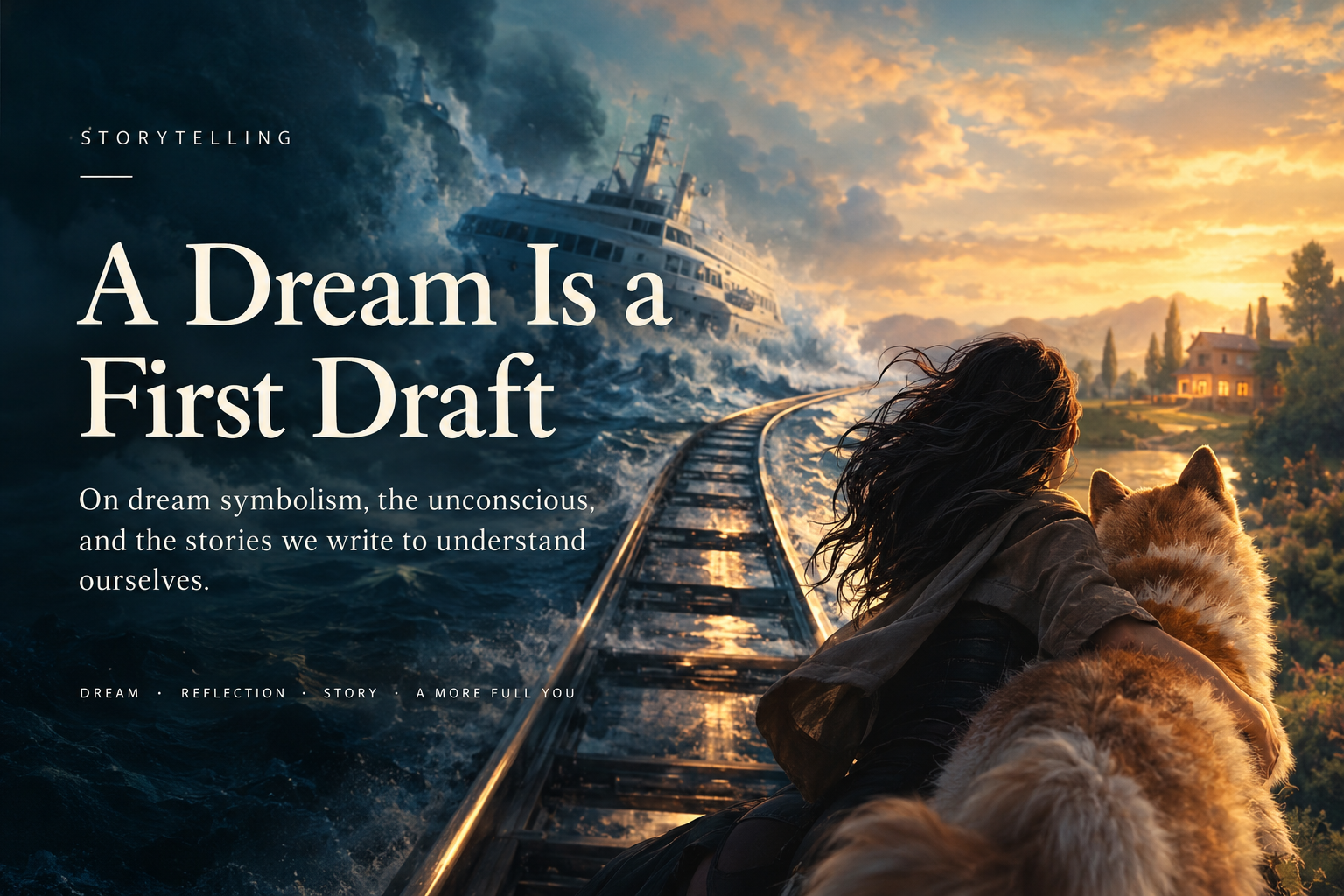
I woke up with a ship on rails in my head.
Not a plot, not a character. Just a feeling: the storm, the collision and the trials belonged to the same journey. What looked like open water had become a route I could not choose.
The images were strange. The feelings were not.
There was danger I anticipated, a pattern I learned to survive, and a transformation I had not consented to. There was anger, then protection. At the end, unexpectedly, there was joy.
My first question was not, Could this become a story?
It was, Why does something so impossible feel so familiar?
Resonance, not a secret code
I approached the dream through a Jungian lens, looking for what its images might reveal about feelings I had not fully articulated.
Not a diagnosis. Not a prediction. An invitation to look closer.
Rather than asking what a ship means in a dream dictionary, I asked what this particular ship meant to me. What had it promised? What changed when that promise failed?
That is symbolic resonance: the connections an image awakens between an experience, a feeling and a possibility.
Being carried can mean helplessness. It can also mean trust. Making yourself smaller can protect you. It can also become a way of disappearing.
Those contradictions gave me something to write towards.
The route I could not choose
The ship initially promised a holiday: rest, movement, someone else steering.
Instead, there was rough water and a collision. We briefly went underwater, then rose again. Afterwards, the ship seemed to run on tracks through successive trials.
I recognised the feeling of being caught in a process that continued regardless of whether I was ready.
That is an association, not evidence that anything in waking life was secretly arranged.
The darts sharpened it. They flew lower each round, and I survived by learning the pattern.
In the fictional version, I call the protagonist Noor:
Each round she made herself smaller: knees, then elbows, then flat against the deck, cheek on cold wood.
At first, I saw competence. Then I noticed the posture.
When does knowing how to survive become forgetting that you are allowed to stand?
Changed does not mean healed
Later, big cats attacked my leg.
The wound mattered because legs are how we stand, leave and move towards something. My association was: what happened affected my movement through life, but did not take it away.
Then came the bowl.
Someone pushed my face into something that turned my eyes red and gold and made me almost impossible to hurt.
Nobody asked.
I resisted the convenient interpretation that suffering makes us powerful. Becoming stronger afterwards does not make the harm necessary or justified.
The meaning I kept was this:
I did not choose everything that changed me. I still have choices about what I do with that change.
Red suggested anger, injury and life. Gold suggested dignity and worth. Together, they allowed strength and hurt to remain visible.
Noor had changed. Understanding that change was still ahead.
A face without a reflection
Afterwards, I could see my face and altered eyes in a small mirror. But in a full-length mirror, I was absent.
Inside the dream, I was not surprised.
Up close, the change was undeniable. Step back to see the whole person, and nobody appeared.
My reading was a mismatch: the changed face was visible, while the whole self had not returned to view.
Another resonance followed: others can see my strength without seeing the person carrying it.
In fiction:
She wasn’t surprised. She had felt unseen for longer than she’d had powers.
Writing that line gave me another question: what would becoming visible to herself require?
What power is for
The dream contained revenge. Removing it would have made the account more flattering, but less honest.
For Noor, the turning point comes when someone recoils from her:
Watching the woman press herself small against the wall, Noor recognised the posture.
She had not escaped the ship. She had become its weather.
The roles have reversed, but someone still decides what another person must endure.
Writing lets me acknowledge the anger without making it the story’s moral authority.
Then children face the trials.
They might resonate as vulnerable people, younger parts of myself, or a future that should not inherit the same harm.
Their presence changes the question from How do I survive? to Why should anyone else have to?
Noor goes first to protect them.
The trials do not become good because she does something good. Her response belongs to her.
Being carried by choice
The dream ended with me riding my shiba, Roxy, grown wolf-sized, towards my parents’ old house.
My arms were free. We moved like the wind.
It was not merely a wolf. It was Roxy: familiar, beloved, recognisable. Her size magnified her strength without making her a stranger.
The ship carried me along a route I could not choose. Roxy carried me somewhere I wanted to go.
The cats wounded my leg; she gave me speed.
I had crouched and braced. Now my arms were open.
Freedom did not look like controlling everything. It looked like trusting something.
What the story teaches back
I distinguish between what I remember dreaming, what I associate with it, and what I invent afterwards.
They inform one another without becoming interchangeable.
Fiction preserves the emotional movement while allowing the character her own choices and contradictions. Noor can misunderstand herself. Others can challenge her. The story can question the interpretation I initially preferred.
Sometimes the insight arrives not while interpreting the dream, but while deciding what the character does next.
That is what interests me: not decoding the unconscious once and for all, but giving an unresolved feeling enough shape to examine it.
A dream offers images. Reflection finds possible connections. Storytelling explores their consequences.
I woke up with a ship on rails in my head.
Writing let me ask where I wanted to go.