
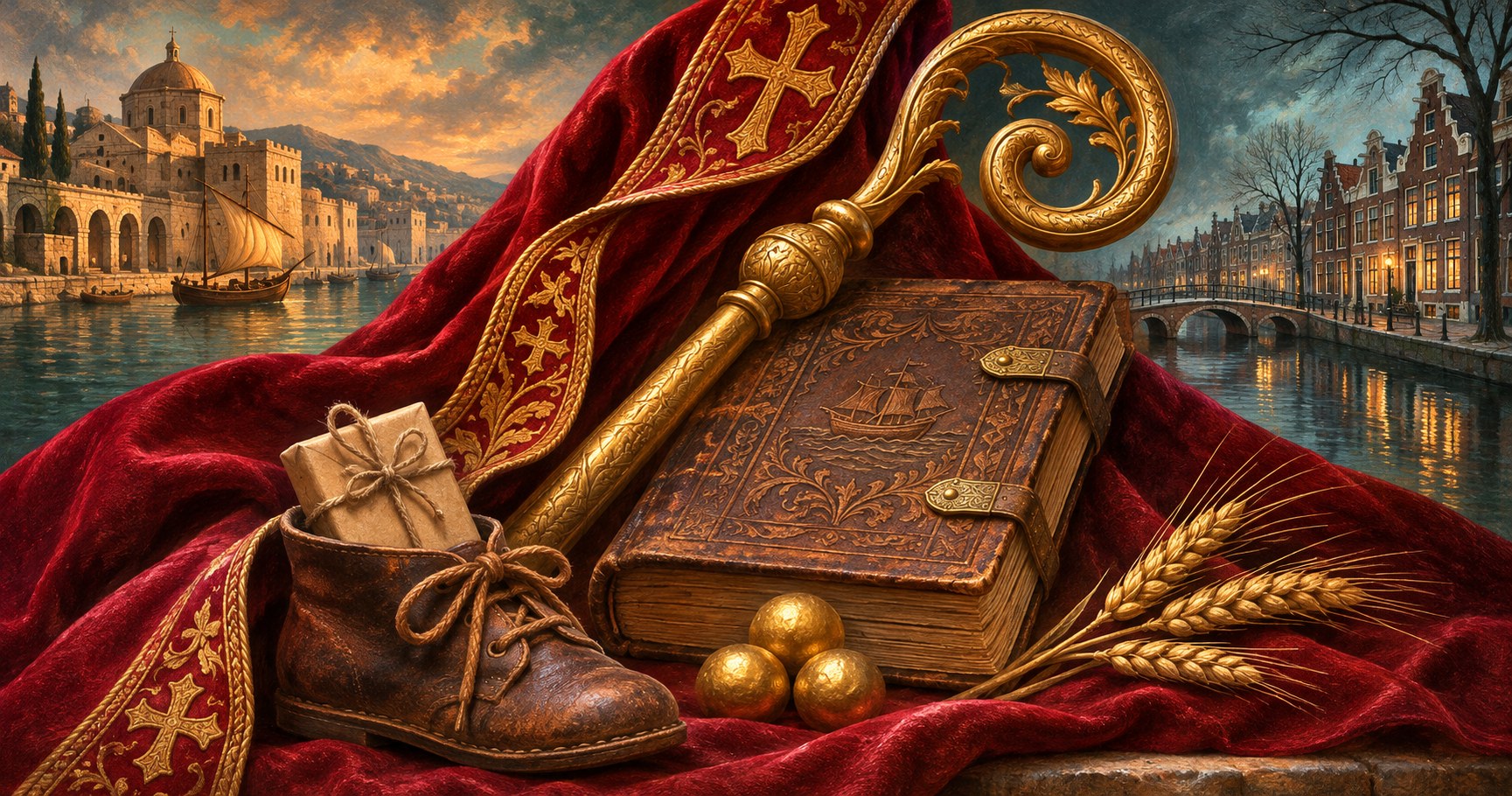
A curved staff, a red cloak, a shoe beside the fireplace. The origins of Sinterklaas reveal how stories become traditions, told through objects and gestures. Yet long before his familiar costume, Nicholas was already clothed in stories: generosity given a face, justice a defender.
Before Nicholas: generosity and power
Wealthy Greeks and Romans financed public meals and distributed food or money, gaining honour and influence. Early Christian charity developed within this world, emphasising people in need. Roman Saturnalia also combined December festivities and presents. Giving already carried social and religious meaning. 12
Saint Nicholas: history and symbolism, fourth–ninth centuries
Nicholas is traditionally identified as a fourth-century bishop of Myra, in Roman Lycia, now Türkiye. His surviving biographies appeared centuries later. An early rescue narrative, dated to the fifth or sixth century, already presents a miraculous protector. No complete contemporary biography survives. 321
These texts are hagiography: accounts of holiness intended to inspire devotion and conduct. Michael the Archimandrite describes an infant Nicholas following Christian fasting days, nursing only once on Wednesdays and Fridays. He explicitly compares Nicholas’s mother with John the Baptist’s mother. Sacred meaning shapes the story from birth. The author presents these signs as real miracles while explaining what they mean. 4
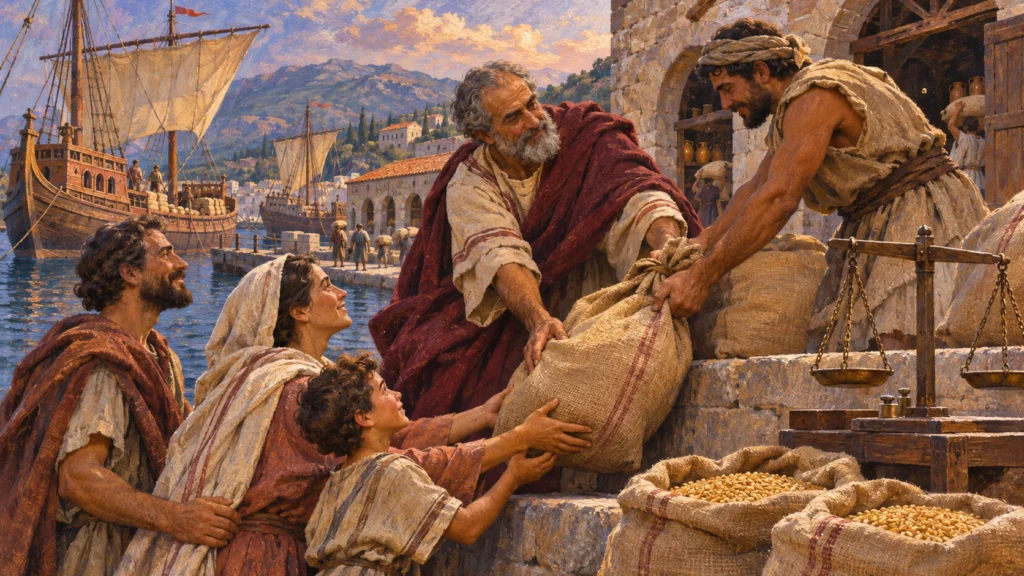
The famine legend follows this pattern. Nicholas persuades sailors to release imperial grain; their cargo miraculously remains complete, while the community receives food and seed. John the Deacon explicitly connects the miracle with Jesus’s promises about faith. Generosity becomes an expression of divine abundance. 429
Secret gold saves three impoverished sisters from exploitation. Intervention saves innocent men from execution. Historian Efthymios Rizos reads the latter narrative as a portrait of episcopal authority confronting corrupt government. Nicholas embodies what power ought to do. 421
Later biographies also absorbed episodes from the sixth-century Nicholas of Sion. The inherited figure gathers stories from more than one life. Symbolic meaning and historical memory became intertwined through retelling. 28
Sixth century–1500: stories become shared rituals
By the sixth century, Nicholas had a church dedicated to him in Constantinople. In 1087, men from Bari removed relics believed to be his from Myra to Italy, strengthening a pilgrimage centre. Sailors and merchants carried devotion across trading communities. 318
Children’s Nicholas celebrations appear in twelfth-century France. Medieval school festivities combined performance, rewards and discipline; boy-bishop customs temporarily gave a child ceremonial authority. 618
By around 1500, celebration extended beyond worship. Meertens describes fifteenth-century Dutch children from poor households placing shoes in church, where wealthy citizens filled them for distribution. A story about generosity had become something communities could enact. 7
Markets brought food and courtship. Sweet figures called vrijers and vrijsters could communicate romantic interest, echoing Nicholas’s association with marriage. 18
Why is Saint Nicholas Day on 6 December?
6 December is Saint Nicholas’s feast day, traditionally commemorating his death. In Christian belief, a saint’s death marks entry into eternal life: a heavenly birthday, or dies natalis. The date honours a completed life and an example that remains available to the living. 2324
It also falls during Advent, the preparation for Christmas. Remembering Nicholas through charitable giving connects spiritual expectation with practical care. His story returns annually, inviting people to perform the generosity they celebrate. 26
The custom of beginning a feast the preceding evening helps explain 5 December, Saint Nicholas’s Eve. Dutch pakjesavond developed around that evening; Belgian children traditionally find gifts on 6 December, after setting out shoes the night before. Anticipation and fulfilment belong to the same celebration. 2527
The meaning of Sinterklaas’s clothes and symbols
Some Christian vestments developed from Roman clothing. The white alb descends from the tunic and acquired associations of purity. The mitre identifies a bishop, although its Western medieval development came centuries after Nicholas. 228
The curved crozier represents a shepherd’s care; the ring, fidelity to the Church. The stole marks ordained ministry; the cincture, or waist cord, signifies self-control. His mantle resembles a ceremonial cope, while the cross declares Christian faith. 91011
His familiar red has no securely established single explanation; earlier Dutch Catholic depictions sometimes used pale vestments. Reading red as warmth or generosity is interpretation. The three golden balls in religious imagery recall the dowry gifts. 11125
1500–1800: household mystery
Reformation opposition restricted public saints’ festivals in many Dutch towns. Families continued indoors. Jan Steen’s 1665–1668 painting shows treats, shoes and a child receiving twigs. 1314
The shoe made giving personal. The chimney offered an entrance for an unseen benefactor; the dowry narrative used a window. Read symbolically, these openings connect household vulnerability with help arriving from outside. 4
Why does Sinterklaas come from Spain? 1810–1850
An 1810 New York print includes a Dutch verse sending Nicholas from Amsterdam to Spain, where oranges and pomegranates abound. An 1849 poem describes him coming from Spain. 16
Folklorist John Helsloot considers imported oranges and the rhyme between Spanje and appeltjes van oranje a plausible explanation. Bari’s connections with Spanish rule offer another hypothesis. Neither is proven. 16
Earlier customs included riders entering towns and unseen nighttime deliveries. Jan Schenkman’s 1850 picture book popularised the steamship, with a hot-air balloon for departure, replaced by a train in later editions. Even his horse was coloured grey-brown in the first edition. Tradition absorbed contemporary technology and imagination. 15
The book helped establish the Black servant who developed into Zwarte Piet. Its great book, rod and sack dramatised expectations about children’s behaviour through reward and punishment. 617
Twentieth century onwards: retelling the story
Postwar prosperity spread pakjesavond, while the disciplinarian softened into a grandfatherly friend. The Sinterklaasjournaal began in 2001. Following debate about racial caricature, the NTR completed its transition to soot-smudged Pieten in 2019. 181920
What was he, translated into modern terms?
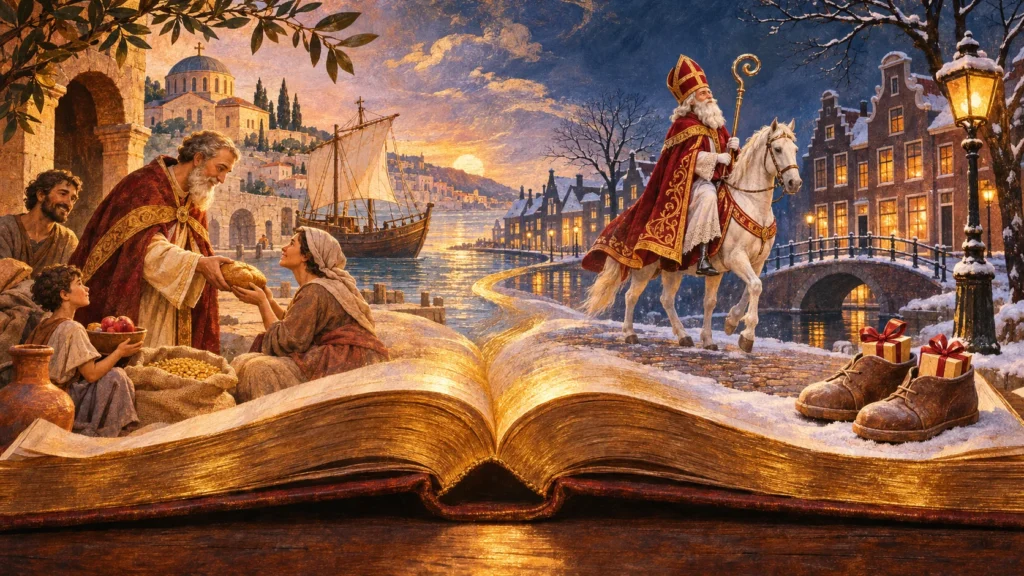
The Nicholas of the legends combines spiritual leadership with community advocacy, relief work and negotiation. His recurring purpose is protection when ordinary security fails: hunger, exploitation, injustice or danger at sea. 421
My reading of these stories is that they give hope someone to call upon. Later celebrations turn that hope into actions people can perform themselves: filling a shoe, leaving a gift, feeding another household.
Through repetition, an ideal becomes a tradition. Its invitation remains practical: notice another person’s need, and make generosity memorable.
Continue exploring how stories acquire meaning in Where My Stories Take Root and Who Made the Monsters?.
Sources and historical notes
The article distinguishes historical evidence, religious legends and symbolic interpretation. All three illustrations are AI-generated interpretations.
1. Ancient civic giving and Christian charity
2. Saturnalia and ancient gifts
3. Nicholas of Myra: historical evidence and spread of devotion
4. The Life of Saint Nicholas: dowries and famine relief
5. Nicholas’s three golden balls
6. Origins of the children’s festival and helpers
8. The medieval development of the mitre
9. The episcopal ring and staff
11. Sinterklaas’s clothing and uncertain choice of red
12. Variations in Dutch Catholic depictions
13. The domestic celebration after the Reformation
14. Jan Steen’s household celebration
15. Before the steamship, the horse’s colour, and later transport
18. Postwar prosperity, pakjesavond and changing discipline
19. Television and the Sinterklaasjournaal
20. The NTR’s 2014–2019 transition
21. Nicholas as protector against abuses of power
22. The Roman clothing behind Christian vestments
23. 6 December as Nicholas’s feast and traditional death date
24. Dies natalis: a heavenly birthday
25. Saint Nicholas’s Eve and feast day
26. Saint Nicholas in Advent and charitable giving
27. Belgian gifts on 6 December
28. The merging of Nicholas of Myra and Nicholas of Sion
29. The grain miracle interpreted through Christian scripture