

A child in a manger, a tree that stays green, a visitor carrying gifts: Christmas tells several stories at once. Its origins become more interesting when we separate the movements of the Earth from the meanings people gave them. The result is a festival continually rewritten around hope, belonging and renewal.
The winter solstice: what actually returns?
Earth’s axis tilts about 23.4°. As we orbit the Sun, that tilt changes daylight across the year. Around 21–22 December, the Northern Hemisphere reaches its shortest day. After this winter solstice, daylight begins increasing; in the Southern Hemisphere, December brings summer instead. 1,2
Solstice means “Sun standing still”. The Sun’s seasonal position changes so slowly near its turning point that successive sunrises can look almost identical. Mathematically, its seasonal position reaches an extremum: the north–south rate of change momentarily reaches zero. 1
Why is Christmas on 25 December?
A Roman calendar compiled in 354 records Christmas on 25 December, with evidence generally tracing the observance to 336. It also lists a celebration of the Unconquered, usually understood as the Sun. 3,4
Solar festivals offered a powerful setting; another explanation comes from Christian calendar calculations connecting Jesus’s conception with 25 March, then adding nine months. Christmas developed within a world already rich in seasonal symbolism. Calling it simply a renamed pagan festival loses the competing ideas that shaped it. 3,4
Why Christmas Eve, Christmas Day and a second day?
Three calendars overlap: religious observance, household traditions and public holidays. Beginning festivities on the eve reflects older ways of counting festivals from the preceding evening. The historic Christmas season also extended beyond one birthday towards Epiphany on 6 January. 3,5
| Culture | Typical emphasis |
|---|---|
| Netherlands | 25 and 26 December are Eerste and Tweede Kerstdag: two public holidays. |
| Germany | Gifts on 24 December; 25 and 26 December are public holidays. |
| Sweden | Christmas Eve, 24 December, is the main family celebration. |
| Poland | The Wigilia meal on 24 December traditionally begins when the first star appears. |
| United Kingdom | 25 December is followed by Boxing Day on 26 December. |
| United States | 25 December is the Christmas federal holiday; 26 December is not a regular second one. |
| Spain | Nochebuena centres on 24 December; Three Kings’ gifts traditionally arrive on 6 January. |
The second day is also Saint Stephen’s feast in the Western church calendar. Britain’s Boxing Day carries traditions of gifts and charitable giving. Some Orthodox communities celebrate on 7 January because their 25 December falls on that date in today’s Gregorian calendar. 12,13,16
Pagan festivals, evergreens and Christmas colours
Roman Saturnalia, beginning on 17 December, featured feasting, gifts and reversals of social hierarchy. Northern Yule supplied another seasonal vocabulary. Writing in 725, Bede described two English months called Giuli, explaining their names through the Sun’s turn towards increasing daylight. 14,22
Evergreens offer an immediately readable image: life persisting when other plants appear dead. Medieval Europeans decorated with greenery; the decorated Christmas tree developed in German-speaking lands, later popularised in Britain through royal example and illustrated print. Holly adds red berries; candles and gold evoke warmth and light. Christian art also associated green with life and red with blood or love. The colours accumulate meanings rather than reveal one secret original code. 15,16,17
How Sinterklaas became Santa Claus—and the Kerstman
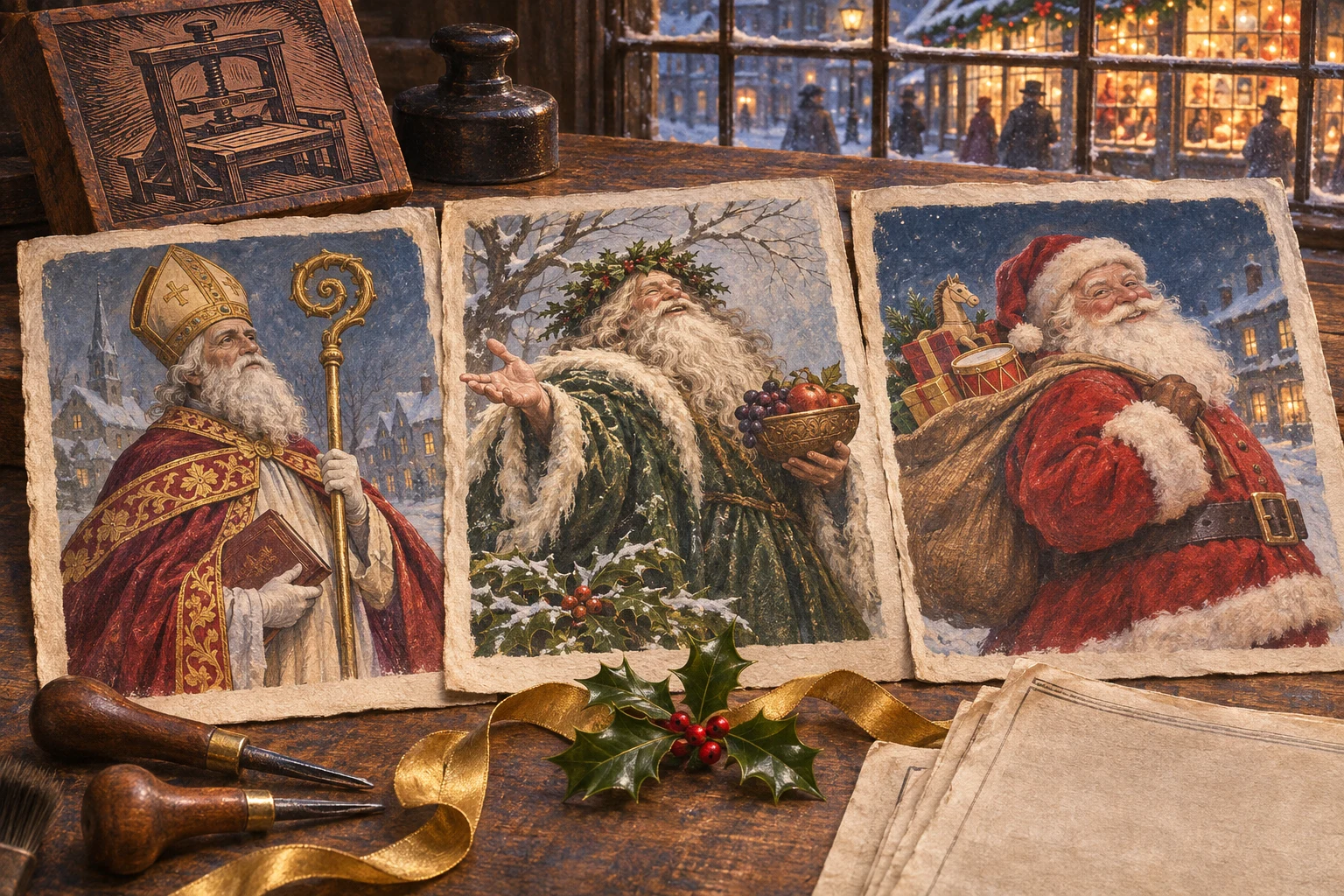
As explored in my Sinterklaas origins article, Saint Nicholas already carried stories of generosity and protection. The Dutch name Sinterklaas became Santa Claus in English, but the modern Christmas visitor emerged through repeated reinvention. 18
Washington Irving’s 1809 writing helped reshape Nicholas for American readers. The 1823 poem A Visit from St. Nicholas supplied a flying sleigh and eight reindeer. Thomas Nast’s illustrations developed the familiar figure further from the 1860s. English Father Christmas, previously associated with festive abundance, contributed another strand. 18,19
Advertising amplified the blend. Haddon Sundblom’s Coca-Cola paintings, beginning in 1931, helped standardise a warm, approachable Santa; the red suit already existed. From a storytelling perspective, marketing’s achievement was making a changing collection of stories feel like one consistent personality—and linking generosity with seasonal buying. 20
Why a baby symbolises returning light
The newborn Sun is more than a modern comparison. In his fifth-century Saturnalia, Macrobius describes the Sun as an infant at the winter solstice, gaining youthful strength towards spring and maturity in summer. His account shows how directly seasonal astronomy could become a story about human life. 21
Read symbolically, a baby embodies possibility before power: small, vulnerable and dependent on care. That makes an evocative image for returning daylight.
Christmas’s enduring storytelling power lies in this convergence: darkness turns, a life begins, greenery survives, gifts circulate. Across different calendars and cultures, people give renewal something visible to gather around.
Sources and further reading
1. Royal Museums Greenwich — When is the winter solstice?
3. Andrew McGowan — How December 25 became Christmas
4. Steven Hijmans — Sol Invictus, the Winter Solstice, and the Origins of Christmas (2003)
5. Nordiska museet — Christmas
6. Government of the Netherlands — Public holidays
7. Deutschland.de — How Germany celebrates Christmas
8. Culture.pl — Polish Christmas Eve traditions
10. U.S. Office of Personnel Management — Federal holidays
11. Spain’s official tourism portal — Christmas in Madrid
12. HISTORY — Why is the day after Christmas called Boxing Day?
13. Orthodox Church in America — A papal calendar
14. English Heritage — The Lord of Misrule
15. English Heritage — The history of Christmas greenery
16. The Royal Household — A history of royal Christmases
17. Fitzwilliam Museum — Colour and meaning
18. Library of Congress — A Visit from Santa, Who You Might Not Recognize
19. Library of Congress — Christmas Cousins: Father Christmas and Santa Claus
20. The Coca-Cola Company — Haddon Sundblom and the Coca-Cola Santas