Call someone cold-blooded and nobody expects scales. Describe a colleague as a predator, a friend as an angel, or an organisation as a hive, and people understand. We borrow creatures to explain behaviour.
Sometimes the metaphor becomes a literal belief.
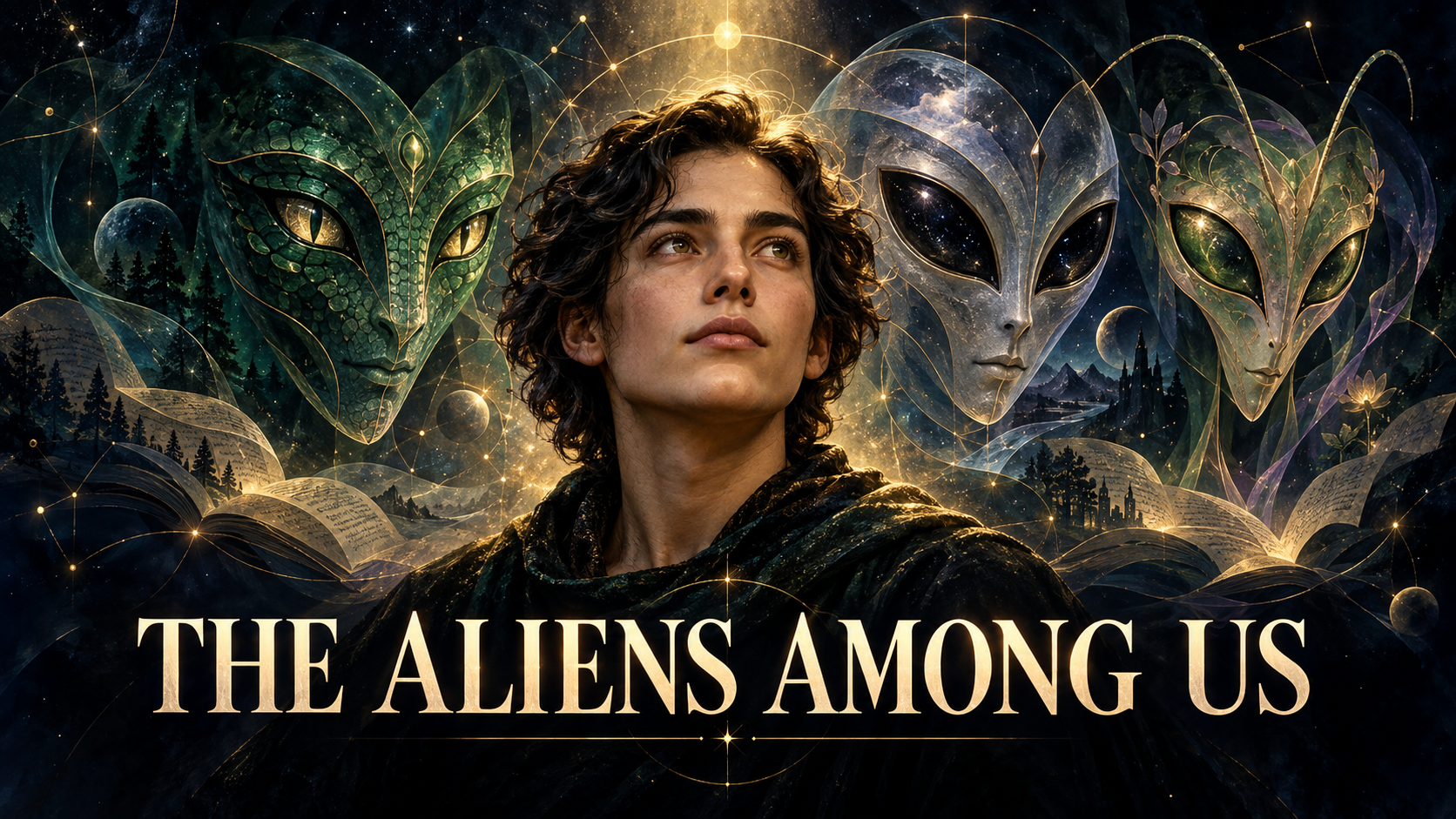
Reptilians supposedly control governments. Greys conduct experiments. Mantis beings observe or instruct. Benevolent visitors promise to help humanity evolve. As a writer, I find these stories interesting because their unfamiliar bodies carry familiar concerns: power, vulnerability, belonging, and whom to trust.
There is no verified evidence that these beings secretly inhabit human society. NASA likewise reports no credible evidence of extraterrestrial life. Their cultural existence, however, offers plenty to examine.
David Icke’s reptilian narrative gives cold-blooded power a body. Scholar David G. Robertson interprets it as a way of explaining why an anticipated better world has failed to arrive: hostile outsiders are preventing it. Suffering acquires an author; confusion becomes a plot.
Reading Icke critically also means recognising his use of antisemitic material, including The Protocols of the Elders of Zion. Understanding a narrative’s appeal does not validate its accusations.
There is no agreed alien catalogue. Different communities mix physical visitors, shapeshifters, hybrids, and “starseeds”—people who believe their souls originated elsewhere. These are different claims. Here are recurring families, with my own literary interpretations.
| Figure in the folklore | Possible archetype | Symbolic colour reading |
|---|---|---|
| Reptilians / Draconians: concealed rulers or infiltrators. | Tyrant, predator, opportunist. | Green: camouflage, envy, poison, renewal. |
| Greys: beings associated with examinations and abduction accounts. | Impersonal examiner; a person reduced to a specimen. | Grey and silver: anonymity, machinery, distance. |
| Mantids / insectoids: mantis-like contact figures. | Surgeon or oracle; precision and unreadable intentions. | Green: life, healing, the uncanny. |
| Nordics / Pleiadians: often idealised, human-looking visitors. | Beautiful saviour; reassurance and trust in appearances. | White, gold, blue: purity, prestige, calm. |
| Tall Whites: pale humanoids associated with Charles Hall’s claims. | Guarded outsider or distant aristocrat. | Pallor: refinement, fragility, estrangement. |
| Arcturians, Sirians, and related star-origin traditions. | Sage, engineer, ancestral teacher. | Blue and violet: contemplation, mystery. |
| Lyrans / feline beings: feline-human ancestry in some starseed beliefs. | Sovereign or guardian; pride and protection. | Gold and amber: warmth, confidence, royalty. |
| Blue Avians: spiritual messengers in Corey Goode’s accounts. | Messenger or liberator; freedom and perspective. | Blue: sky, distance, transcendence. |
| Hybrids and starseed identities: imagined human-extraterrestrial connections. | Outsider, bridge, chosen child. | Mixed palettes: divided loyalties or integration. |
These colour associations are possibilities, not a hidden code. Research across 30 nations found shared patterns alongside differences shaped by language and geography. A green forest and a green laboratory light tell different stories.
For writers, ambiguity is useful. Give the frightening creature tenderness. Let the radiant saviour demand obedience. Allow behaviour to overturn appearance.
The same caution applies to our “reptilian brain.”
The phrase is familiar shorthand for primal instincts, especially fight or flight. But the model of reptilian, emotional mammalian, and rational human layers is outdated. Defensive reactions emerge from interacting brain and body systems.
Those reactions are real. Perceived danger can prepare us to confront or escape, changing breathing, heart rate, and readiness for action. Freezing is another defensive response. These are protective reactions, not evidence of evil or weak character.
Social threats matter too. Experiments show that negative evaluation by others can provoke measurable stress responses. Public humiliation does not need teeth to affect a body.
Now add the spotlight effect: our tendency to overestimate how much others notice our appearance and behaviour. Gilovich, Medvec, and Savitsky demonstrated this in experiments involving conspicuous T-shirts and group discussions.
We inhabit the centre of our own attention and can mistake that position for the centre of everyone else’s. An awkward pause feels unforgettable to us; someone else may barely register it. Actual scrutiny still happens, but its extent requires evidence.
For a character, this creates a feedback loop. They expect rejection, interpret an ambiguous glance as contempt, respond defensively, and receive a colder response. Their story helps produce what looks like confirmation.
Spiritual traditions offer another way to explore the relationship between the individual and the whole.
The “soul hierarchy” illustrations move between individual consciousness, archetypal realms, universal mind, and “the One.” This resembles aspects of Plotinus’s hierarchy of One, Intellect, and Soul. Their “Over-Soul” language also echoes Emerson’s 1841 essay, which places individual lives within a greater spiritual unity. These are related motifs, not identical doctrines.
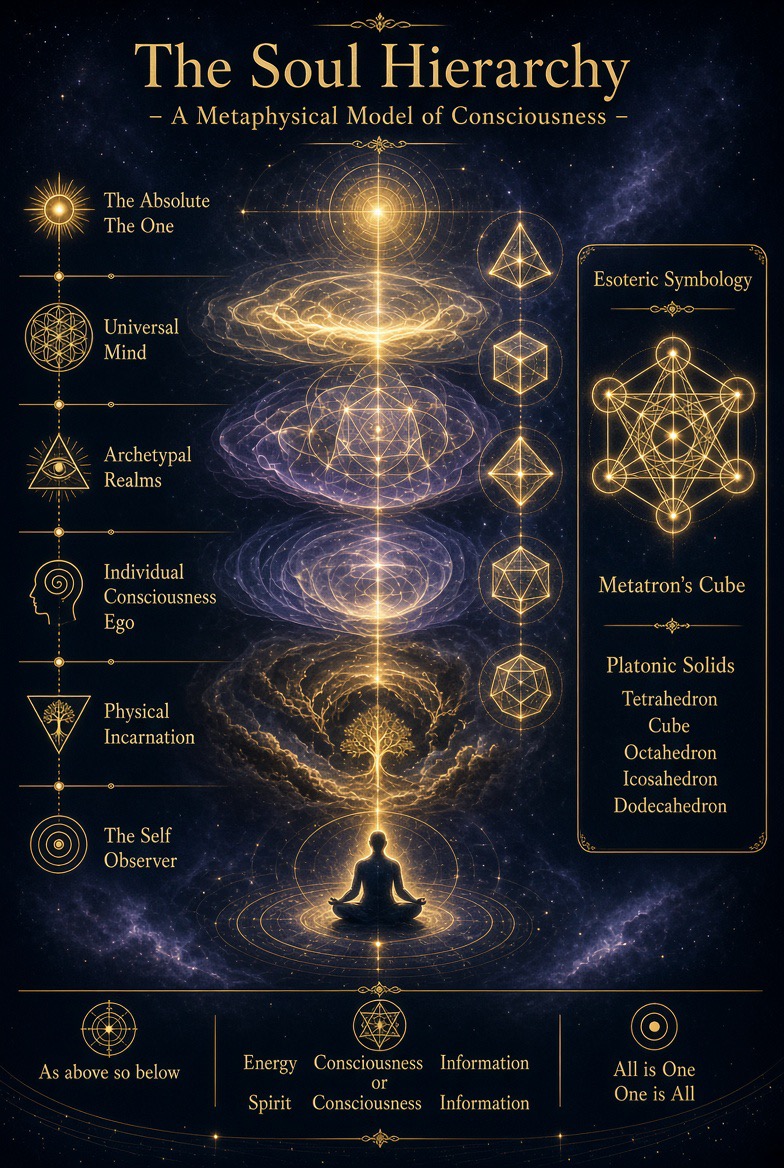
The geometry adds another historical thread. In Timaeus, Plato associates four regular solids with the elements and the fifth with the cosmos. The illustrations combine such imagery with Metatron’s Cube and contemporary spiritual language. I read their gold as illumination, violet as mystery, and connecting lines as belonging.
One illustration also borrows wavefunctions, entanglement, and quantum equations. Those symbols do not establish that souls occupy measurable energy levels or that human minds communicate telepathically. Its spiritual meaning can be explored without treating it as a physics result.
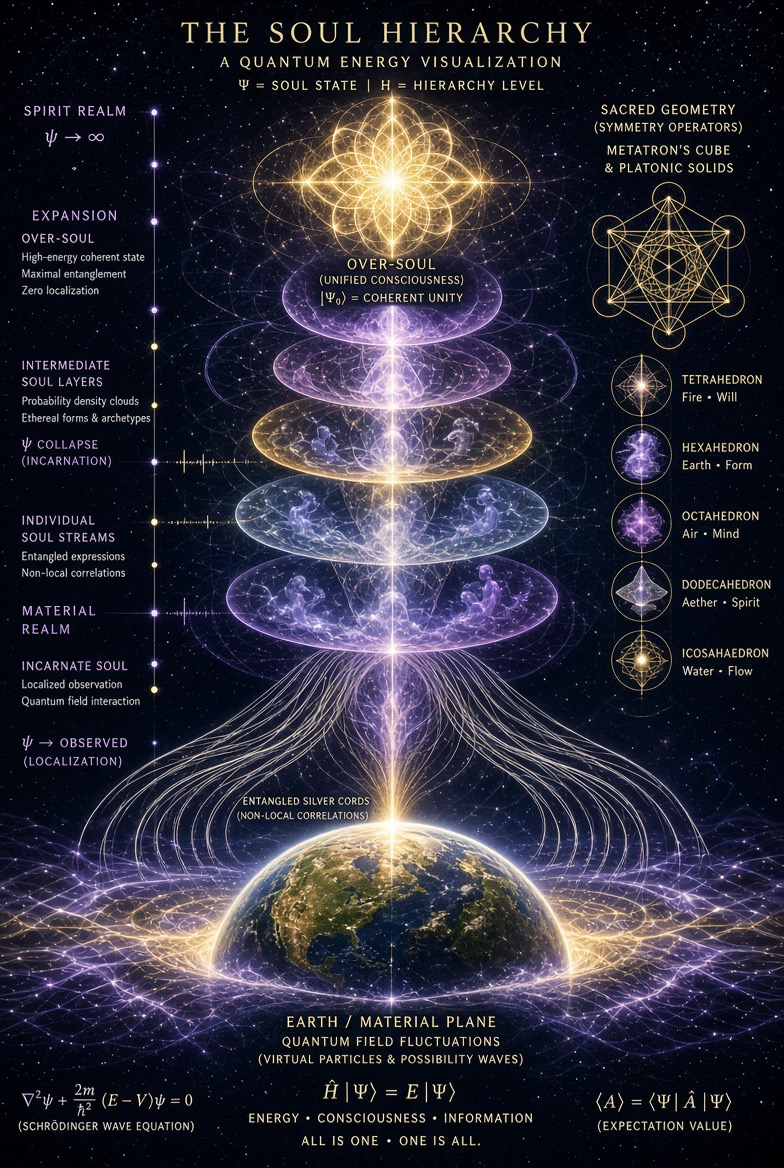
Read symbolically, the movement from ego towards unity asks whether our private story is the whole story. It can invite compassion: another person’s inner life matters as much as ours. A hierarchy becomes ethically troubling when “higher consciousness” turns into a claim that some people deserve greater power.
Dan Brown’s latest novel, The Secret of Secrets (2025), brings a related idea into a thriller. Its exploration of “nonlocal consciousness” includes the proposition that the brain receives consciousness rather than simply producing it. Brown discusses that receiver model in interviews; it remains a speculative premise, not an established scientific conclusion.
The hive-mind comparison raises a useful storytelling distinction. Shared awareness could represent empathy and connection. An enforced collective could erase privacy, disagreement, and consent. A spiritual sense of oneness and compulsory conformity are different possibilities.
A writer can make that difference the conflict: does joining the greater whole allow a character to become more fully themselves, or require them to disappear?
We already have an everyday analogue in shared knowledge. Language, libraries, science, and the internet let us think with information gathered by others. That does not make our private thoughts publicly accessible. A shared repertoire of stories does not require a single shared mind.
Mental health needs equally careful distinctions. Spiritual beliefs, unusual interests, and archetypal identification do not by themselves establish illness.
PTSD can involve persistent vigilance and emotional numbing. Depersonalisation and derealisation can make someone feel detached from themselves or make their surroundings seem unreal. These experiences may resemble descriptions of feeling “alien,” while having clinical explanations.
Grandiosity, exploitation, and difficulties with empathy can feature in narcissistic personality disorder. A callous act or resemblance to a fictional predator cannot establish that diagnosis.
Psychosis can involve hallucinations or strongly held false beliefs, and has several possible causes. Separately, sleep paralysis can produce immobility and a frightening sense of someone being present; it is a sleep phenomenon, not itself evidence of psychiatric illness.
Delayed recognition is real. NIMH notes that bipolar disorder can remain undiagnosed for years when hypomania goes unnoticed, and that psychotic symptoms commonly precede treatment by more than a year. That supports careful assessment, not assigning diagnoses to alien “types.”
The influence of stories extends into everyday institutions.
Once a colleague is labelled “difficult,” questions can sound hostile and silence can look resentful. Introduce the same person as “principled,” and they may receive a different hearing.
Money, professional status, national identity, and reputation depend partly on shared meanings. Institutions, incentives, habits, and sometimes force maintain those meanings. Stories help organise our social world; they do not suspend physical reality.
For storytelling, the revealing question is what an explanation permits.
Does imagining a hidden enemy excuse cruelty? Does being the chosen rescuer make consent seem unnecessary? Can someone revise their story when another person contradicts it?
An archetype gives a character a recognisable outline. Their choices give them a human life.
When I encounter stories about monsters, cosmic families, or universal minds, I want to ask what they help us recognise—and whose humanity they make easier to overlook.