
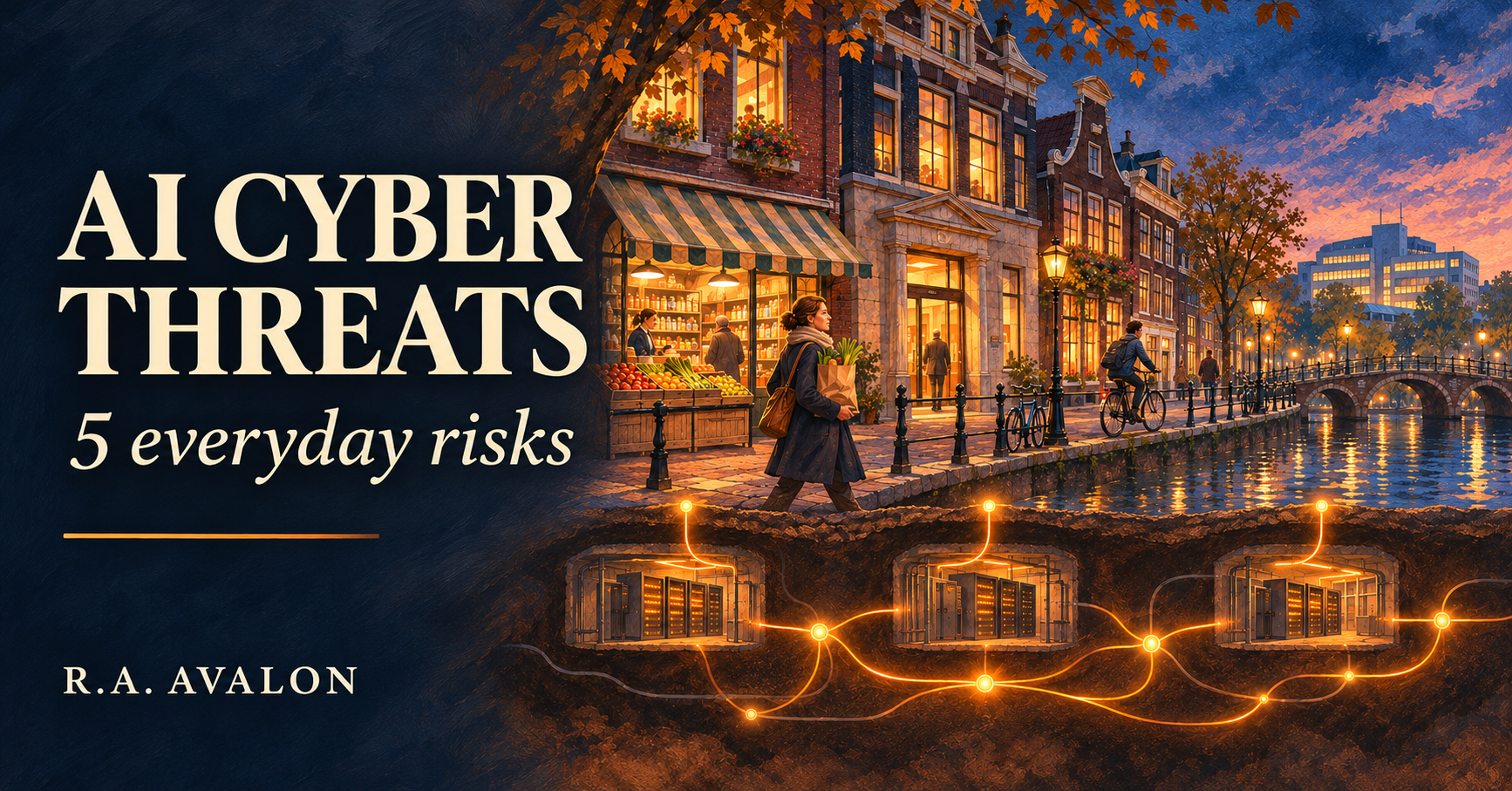

You tap your card. The payment clears. The lights come on. A hospital appointment appears in your inbox.
Every successful interaction quietly teaches us that the system works. Cybersecurity asks a less comfortable question: what is happening underneath while everything still looks normal?
AI cyber threats matter because the gap between finding a weakness and exploiting it is shrinking. The consequences can reach your wages, your kitchen, your medical care and your private life. Yet many people still picture a hacked website or an obviously suspicious email. [3]
Why different generations underestimate cyber risk
Some people remember banking as a building, paperwork and a familiar employee. Others have barely known a world without instant payments and always-on services. Those experiences can encourage different assumptions: institutions will protect us, or technology will simply keep working.
Both deserve questioning. Being comfortable with an app tells us little about the systems behind it.
Research on online identity theft found that participants tended to consider themselves less vulnerable than other people. In the study comparing age groups, age did not explain that optimism. The evidence points to a human blind spot that crosses generations. [1]
Repeated warnings can also become exhausting. NIST researchers documented security fatigue, including resignation and the belief that a bank or somebody more knowledgeable would take care of protection. [2]
My concern is what happens when that everyday trust reaches the boardroom. If the reward for resilience is an ordinary Tuesday, its value is easy to overlook. The cost becomes much easier to see after services stop.
What AI changes: finding the weakness and building the exploit
In July 2026, the European Central Bank warned bank CEOs that emerging AI models could identify software vulnerabilities and generate working exploits faster, reducing the time available to respond. [3]
The PHP vulnerabilities I covered in October illustrate the problem. Researchers reported using AI to uncover longstanding flaws and develop attacks against deployments including WordPress. The underlying weakness was in PHP, software powering those websites; HTTP requests were a way to reach it. PHP2Shell was already a serious warning. [4]
WordPress separately reported fixing more than 50 high or critical vulnerabilities since mid-July, while crediting AI with accelerating security research. That shows a defensive opportunity as well as a threat. [5]
We cannot count vulnerabilities nobody has discovered, or confidently claim thousands are worse. We can see that old, widely used software still contains serious weaknesses—and that AI can help make their exploitation practical. [4]
Nor does every attack need a new discovery. On 24 November, the UK’s National Cyber Security Centre reported a rise in AI-assisted attacks exploiting familiar weaknesses, including exposed credentials and misconfigurations. The observed tools were often noisy. Their advantage was speed, persistence and low cost. [6]
From a hidden flaw to a zero-day attack
A vulnerability is a weakness. An exploit is the method used to abuse it. A zero-day attack exploits a previously unknown vulnerability. Writing exploit code does not, by itself, make something a zero-day; attacks on known flaws that remain unpatched are dangerous too. [7] [8]
A malicious discoverer may keep a flaw secret or sell the knowledge or exploit instead of reporting it to the developer. A market for non-public vulnerabilities already exists. AI could shorten the journey from discovering a promising flaw to having something a buyer can use. [8] [3]
That creates a practical race. Developers must reproduce a problem, build and test a repair, then help customers deploy it. Attackers need a usable opportunity. Slow decisions can widen that window.
The breach can start long before the outage
The “seed” an attacker plants may be a stolen account, a concealed route back in or access disguised as ordinary administration. Some attackers study the environment and retain access before causing visible damage.
A 2024 joint security advisory reported indications that Volt Typhoon had maintained footholds in some victim environments for at least five years. That is a documented example of prolonged access, not a typical timeline for every breach. Patching the original flaw does not automatically revoke stolen credentials or remove another foothold established before the fix. [9]
A service working normally is therefore not proof that it is secure.
Five ways a cyberattack could reach your everyday life
The historical incidents below show what disruption can mean. They are not presented as AI-driven attacks or a prediction that all five scenarios will happen together.
1. Banking and SWIFT: your money exists, but a payment cannot move
Imagine an overseas payment stuck while banks check whether instructions can be trusted. A business waits for money, a supplier holds a shipment, and cash-flow problems spread.
SWIFT carries messages between financial institutions; it does not hold everyone’s money or itself settle transactions. In 2016, criminals stole $81 million from Bangladesh Bank through fraudulent payment instructions. SWIFT’s core network was not breached: the attackers compromised the bank’s environment. [10] [11] [12]
A serious disruption to messaging or connected banking systems could delay international transfers and business payments. If institutions cannot trust transaction records, checks and recovery could become slower still. The effects would depend on which systems were affected; a SWIFT incident would not automatically disable every Dutch card payment.
2. Electricity: the outage reaches beyond the lights
Your heating stops. The fridge begins warming. Your phone battery becomes a countdown.
Cyberattacks disrupted Ukrainian electricity distribution in 2015, cutting power to hundreds of thousands of people. Attackers reached systems that controlled physical electrical equipment. [13]
In a prolonged outage, problems can spread to communications, refrigeration, heating and water supply. The Dutch government’s preparedness guidance explicitly describes these dependencies. People relying on powered equipment or assistance can face particular difficulty. [14]
The scale depends on what attackers can reach and how operators contain the incident. Backup power, separation between systems and practiced recovery can limit the harm. A compromised office laptop does not automatically give someone control of a national grid.

3. Healthcare: a missing result becomes a delayed treatment
A hospital may still have doctors, beds and medicines while losing access to a service needed to deliver care safely.
The 2024 ransomware attack on pathology provider Synnovis delayed more than 11,000 outpatient and elective procedure appointments. In a July 2026 parliamentary answer, the UK government stated that the attack contributed to a patient’s death. [15]
For a patient, the impact may be a postponed operation, a missing blood-test result or uncertainty about when treatment can proceed. At its most serious, disruption becomes a patient-safety issue. Restoring computers is only part of recovery; postponed care still needs to be delivered.
4. Fuel and deliveries: a digital problem becomes a physical shortage
The delivery has not arrived. The petrol station is waiting for a tanker. A small business loses another day’s income.
Colonial Pipeline proactively shut down its pipeline system during a ransomware incident in May 2021. The US government coordinated efforts to move fuel to affected areas. Operations can therefore stop because a company takes protective action during an attack. [16]
A comparable disruption to ordering, warehouse or dispatch systems could delay food and other essentials even when goods physically exist. If disruption lasts, missed deliveries can create shortages and additional costs. The severity depends on available alternatives, stock and recovery time.

5. Stolen personal data: the consequences outlast the incident
A service returns. Your information may already have been copied.
The Dutch privacy regulator describes risks ranging from convincing phishing to identity fraud and extortion involving medical information. An exposed address can create physical danger for someone facing stalking or domestic abuse. The harm depends on which details leaked and how they are combined. [17]
AI adds another layer. The FBI has warned about cloned voices impersonating relatives, convincing fraudulent messages and fabricated intimate images used for extortion. Such abuse can use publicly available material too; it does not always begin with a breach. [18]
The worst outcomes can include financial loss, fraudulent contracts, blackmail or threats to physical safety. That does not follow from every leak: an IBAN alone, for example, does not let someone log into your bank account. [17]
A password can be replaced. A medical history or a private fact cannot be made secret again simply by restoring a server.
Taking AI cyber threats seriously means preparing
For organisations, the response needs to be practical: know which systems are exposed, fix weaknesses quickly, limit access, watch for intrusion and rehearse recovery. The ECB’s warning places responsibility with bank management, including resources, clear ownership and stronger detection and resilience. [3]
From an incident-management perspective, one question deserves an answer before a crisis: who can authorise action when waiting becomes the greater risk?
At home, use different passwords and stronger sign-in protection, and independently verify urgent requests for money. Follow the Dutch government’s advice to prepare for the first 72 hours of an emergency, including a household plan and basic supplies. [17] [18] [19]
The aim is to preserve ordinary life: being paid, staying warm, receiving care and keeping control of our identities.
The lights being on today should be a reason to prepare while we still can.
Sources and references (19)
[1] Betts et al. — Comparative optimism for judgements about online identity theft. 2024.
[2] NIST — Security fatigue. 4 October 2016; updated 3 February 2025.
[3] European Central Bank — Addressing AI-enabled cybersecurity threats. 7 July 2026.
[4] Wiz Research — PHP2Shell. 21 October 2026.
[5] WordPress Security Team — The Core Security Initiative: two months in. 29 October 2026.
[6] UK NCSC — Familiar weaknesses, exploited faster. 24 November 2026.
[7] NIST — Zero-day attack glossary. Accessed 26 November 2026.
[8] UK NCSC — Understanding vulnerabilities. Accessed 26 November 2026.
[9] Joint CISA, NSA, FBI and international partners advisory — Volt Typhoon persistence. 8 February 2024, Australian Signals Directorate publication.
[10] SWIFT — Fighting illegal financial activities. Accessed 26 November 2026.
[11] SWIFT — Customer security issues. 13 May 2016.
[12] US Treasury Office of Financial Research — 2016 Financial Stability Report, page 40. 2016.
[13] US Department of Energy — CyberStrike and the 2015 Ukraine power-grid attacks. 7 December 2023.
[14] Dutch government, Denk vooruit — Geen stroom. Accessed 26 November 2026.
[15] UK Department of Health and Social Care — Parliamentary answer on Synnovis patient safety. 3 July 2026.
[16] US Department of Energy — Colonial Pipeline Cyber Incident. May 2021 incident.
[17] Autoriteit Persoonsgegevens — Slachtoffer van een datalek?. Accessed 26 November 2026.
[18] FBI/IC3 — Criminals Use Generative Artificial Intelligence to Facilitate Financial Fraud. 3 December 2024.
[19] Dutch government, Denk vooruit — Voorbereiden voor 72 uur. Accessed 26 November 2026.