
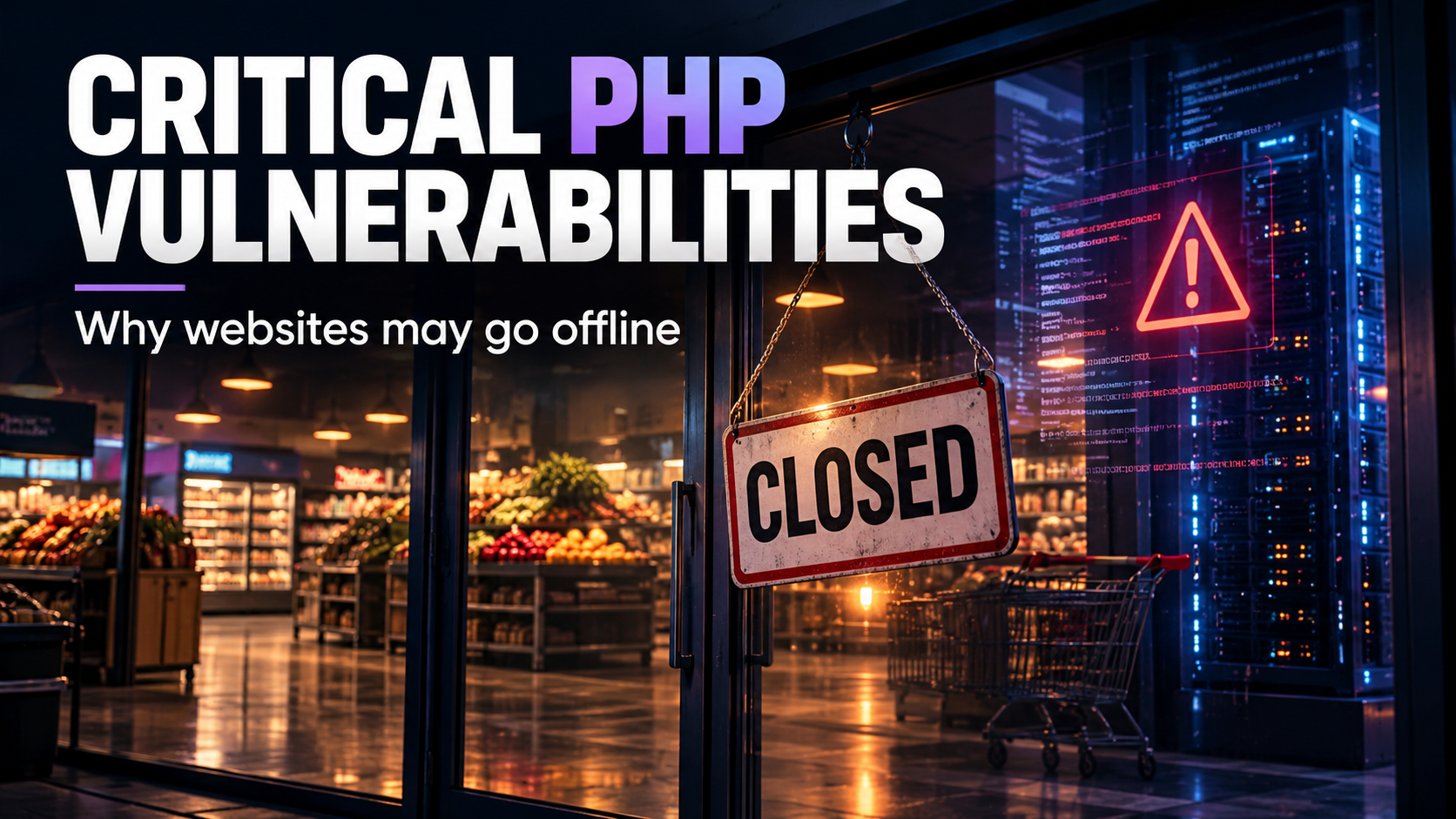
What happened on 21 October 2026, how hackers could exploit a specially crafted HTTP request, and why organisations are taking precautions.
Imagine arriving at your local supermarket, only to discover that it is closed.
The shelves are full. Employees are present. Nothing appears broken.
Yet the manager has discovered a serious weakness in the computer system. A weakness that could potentially allow criminals to interfere with operations or access sensitive information.
Nobody knows whether someone has exploited it, but the risk is serious enough to temporarily close the doors.
Something similar is happening across the internet today.
What is PHP?
PHP stands for PHP: Hypertext Preprocessor. It is a programming language that powers many websites and applications behind the scenes, including WordPress.
Think of a supermarket:
- HTML: The shelves and signs customers see.
- CSS: How the supermarket looks.
- JavaScript: The interactive self-checkout.
- PHP: The computer system processing requests behind the counter.
- Database: The secured vault containing important information.
- HTTPS: The protected route through which information travels.
Together, these technologies help websites function. But what happens when the system behind the counter has a serious weakness?
What happened on 21 October 2026?
Security researchers discovered two critical vulnerabilities in PHP: CVE-2026-109618 and CVE-2026-109619. Both received a severity rating of 9.2 out of 10.
PHP developers originally planned to release security updates on 22 October. Selected organisations had been informed privately under an embargo, allowing developers to prepare repairs before publicly revealing the vulnerabilities.
However, information leaked onto social media on 20 October. Consequently, the emergency security release was brought forward to 21 October at 16:00 Dutch time.
Early information suggests that PHP versions dating back to at least PHP 5 may be affected, although the full technical scope had not yet been officially confirmed at the time of writing.
How could hackers exploit this?
The vulnerabilities reportedly allow attackers to exploit PHP through a specially prepared HTTP POST request.
That sounds complicated, but it is surprisingly easy to understand.
Whenever you submit a login form, send a message or complete an online purchase, your browser may send an HTTP POST request. Essentially, it tells a server: Here is some information. Please process it.
Normally, the server handles that information according to its programming. But imagine a criminal sending a specially crafted request that triggers a weakness in the software.
Instead of simply processing the information, the vulnerable server might execute instructions it was never supposed to accept.
This is called Remote Code Execution (RCE).
Depending on the system’s configuration and security protections, attackers could potentially steal information, manipulate records, install malware or gain control over parts of the server.
Importantly, this does not mean every PHP website has been hacked. A vulnerable system and a successfully compromised system are two different things.
What is a zero-day?
A zero-day vulnerability is a security weakness exposed before defenders have an available fix, or one exploited before the responsible vendor knows about it.
Imagine discovering that the supermarket’s security system is defective, but the manufacturer has not yet delivered replacement parts. You know the danger exists, but cannot immediately repair it.
That is why coordinated security disclosures matter. Researchers and developers try to prepare fixes before criminals learn how to exploit a vulnerability. When information leaks early, organisations may suddenly have to protect themselves without a permanent repair.
Why does this affect more than websites?
PHP is not limited to blogs and online shops. It can also power company portals, helpdesk systems, customer databases, monitoring interfaces and administrative tools. Some network appliances also contain PHP-based components.
Older applications present an additional challenge because unsupported PHP versions may no longer receive security updates.
Sometimes fixing the problem means upgrading an entire application or waiting for a manufacturer to provide an update. And not every organisation can do that immediately.
Why are services temporarily going offline?
Back to our supermarket. If the manager cannot repair the vulnerable system immediately, temporarily closing may be safer than continuing business as usual.
Organisations face similar decisions. Firewalls, access restrictions and temporary security rules can reduce exposure, but they cannot always guarantee protection.
This is called risk mitigation: reducing the likelihood or impact of an attack while preparing a permanent solution.
For some organisations, temporarily restricting access to a vulnerable service may therefore be necessary. Of course, shutting down essential services can also create risks. In healthcare and other critical sectors, cybersecurity must be carefully balanced against operational continuity.
Is PHP itself unsafe?
Not inherently. Developers may prefer alternatives such as Python, JavaScript or Go, but every programming language can contain vulnerabilities.
The bigger concern is often outdated software, vulnerable dependencies and insufficient maintenance. A well-maintained PHP application may be considerably safer than an outdated application written in another language.
Good security depends on maintenance, not simply the programming language.
What should website owners do?
A patch is a software update that repairs a vulnerability. Organisations should identify affected PHP installations, check their software versions, prepare backups and install verified security updates as quickly as safely possible.
For WordPress users, an important detail is that updating WordPress does not automatically update PHP itself. Your hosting provider usually manages the PHP environment on shared hosting.
If you are unsure whether your website is affected, contact your hosting provider and ask about the security updates.
Sometimes security means closing the doors
Cybersecurity is not always about keeping every system available. Sometimes protecting information, customers and employees means accepting a temporary interruption.
A few hours of downtime may be inconvenient. A successful cyberattack could lead to stolen data, financial damage and weeks of recovery.
And that brings us back to our supermarket. The shelves are full. The employees are ready. Nothing looks broken. But the doors remain closed until the security weakness has been repaired.
Not because the manager has forgotten about the customers, but precisely because the manager is protecting them.
Security release status and affected versions: see the official PHP security announcement for the latest information.