
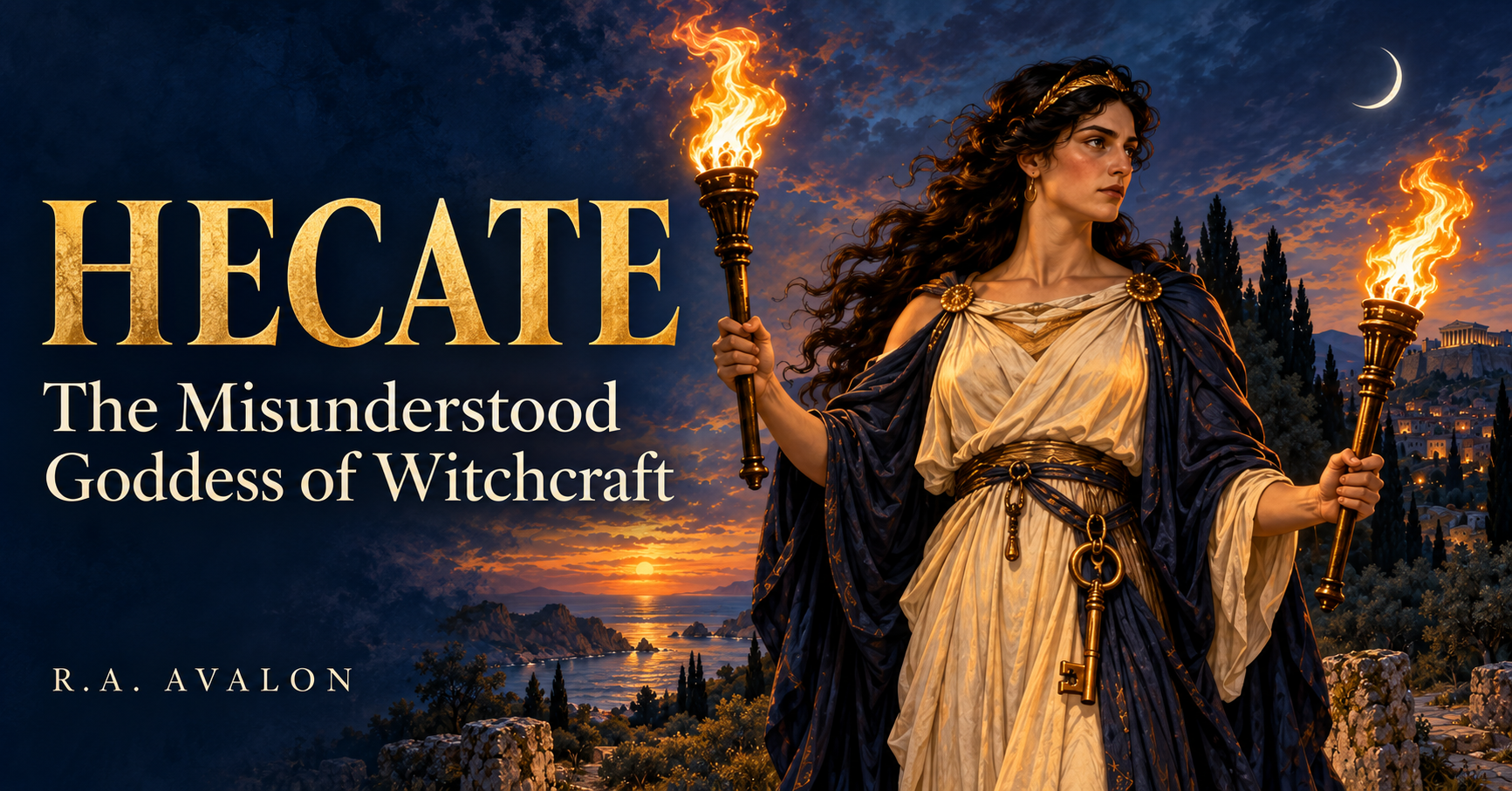

You reach a crossroads after sunset. A woman stands between the paths, holding torches. Is she the danger, or the person who can help you through it?
Hecate, the Greek goddess associated with witchcraft, ghosts and crossroads, invites precisely that question. Follow her history beyond the frightening image and another figure emerges: a protector, a witness to suffering and a companion through uncertainty. Yet recovering her benevolence means accepting her complexity. Her story survives across centuries of poetry, worship and reinterpretation, rather than in one definitive myth.
Where did Hecate originate?
Our first threshold is geographical. Hecate’s origins remain debated, although Caria, in southwestern Anatolia, now Türkiye, is a leading candidate. The Oxford Classical Dictionary cautiously describes her as possibly Carian. A major sanctuary alone cannot establish where a deity first appeared.1
At Lagina, near the ancient city of Stratonikeia, Hecate received monumental worship during the Hellenistic period. Inscriptions, sculpture and civic festivals reveal a public guardian whose cult helped express community identity and political alliances. Here, she was represented with one body. The familiar threefold witch-goddess was never her only identity.2
What does the name Hecate mean?
Hekate transliterates Greek Ἑκάτη; Hecate is the familiar Latinised spelling. Her name is commonly connected with Hekatos, an epithet of Apollo. Traditional explanations include “the far-darting one”; the Greek lexicon LSJ also records “she who works her will”. These are competing explanations, not a securely recovered original meaning.1, 3, 4
The linguistic trail therefore ends in uncertainty. A Greek-looking name does not settle the geographical origin of its worship, and a confident deeper root would overstate the evidence. Her name opens a question; her earliest surviving story gives us firmer ground.
Before the witch: a goddess of ordinary hopes
In Hesiod’s Theogony, composed around 700 BCE, Hecate is the daughter of Perses and Asteria. Zeus honours her and preserves her privileges across earth, sea and heaven. She can favour people in assemblies, warfare and athletic contests, increase livestock, and bring fishermen a successful catch.5
Hesiod also makes her a nurturer of the young. Her concerns reach into livelihoods, households and growing lives. Nevertheless, she can withhold prosperity as readily as grant it. Divine generosity comes with agency; she is no endlessly obliging wish-machine. Both the reassurance and the uncertainty are already present in this early portrait.
Following the torch: Hecate and Persephone
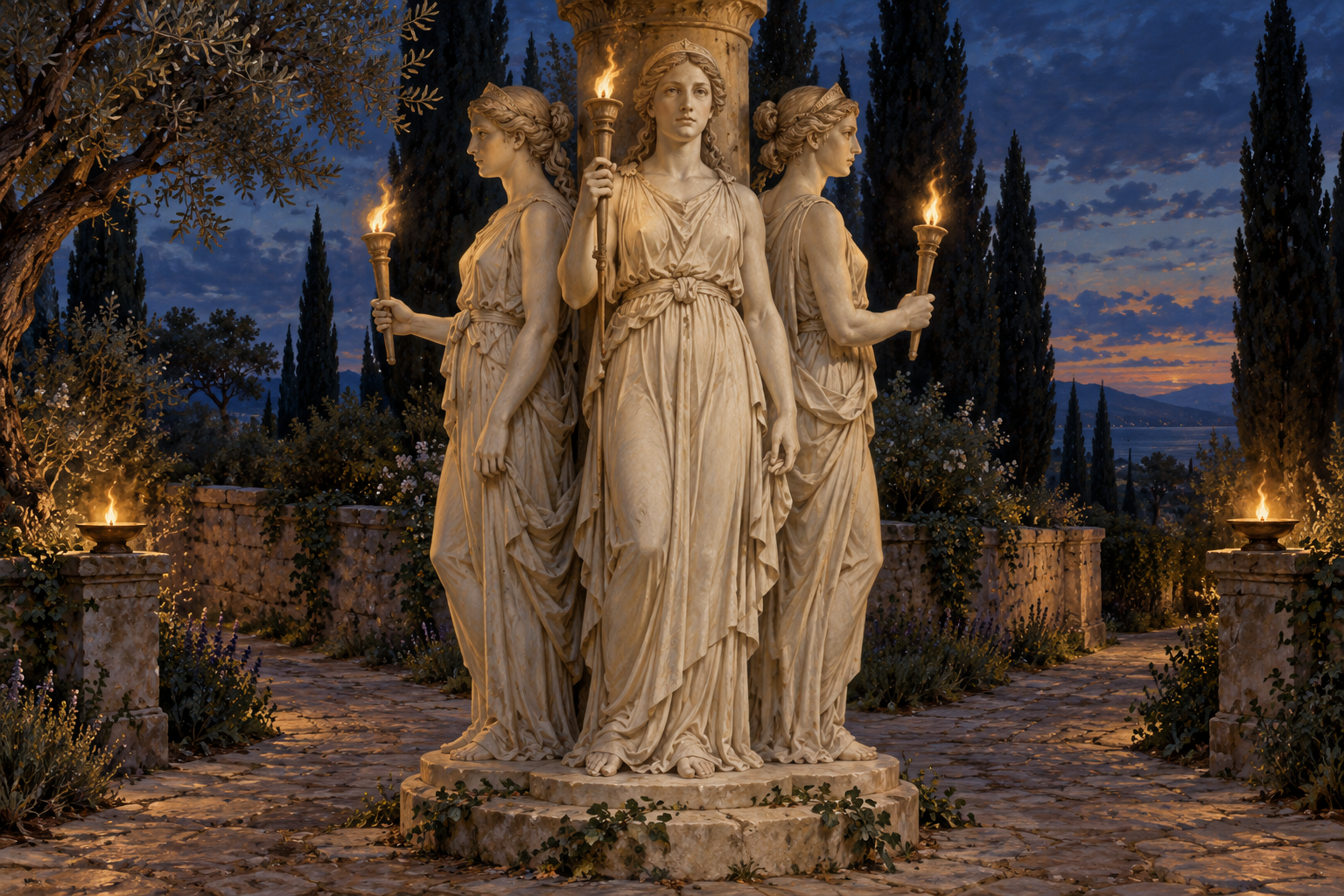
The emotional centre of her story appears in the Homeric Hymn to Demeter. Hades abducts Persephone with Zeus’s permission. Hecate hears the girl’s cry. Later, carrying a torch, she meets the searching Demeter and explains that she heard what happened but did not see the abductor.6
That distinction matters: she offers what she knows without pretending to know everything. She accompanies Demeter to Helios, who identifies those responsible. When mother and daughter reunite, Hecate embraces Persephone and becomes her attendant and companion.
Read through a modern hero’s-journey lens, she occupies the role of guide. She neither causes the ordeal nor single-handedly resolves it. Her contribution is presence: listening, accompanying and remaining after the crisis. This is a literary interpretation, grounded in what the hymn actually depicts.
Why crossroads, torches and three bodies?
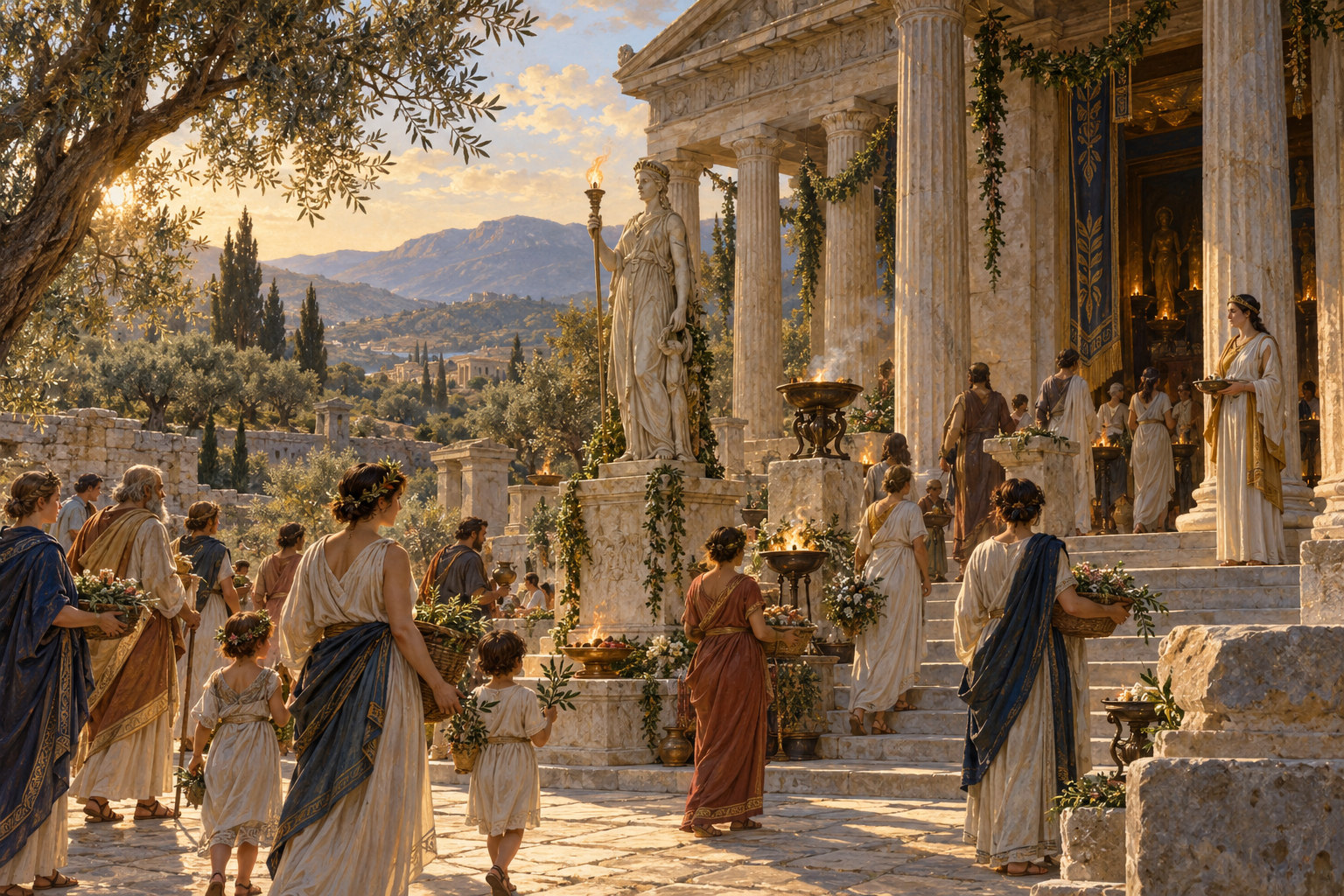
Doorways and crossroads are places of transition: between home and outside, one route and another. Hecate’s images stood at entrances and intersections, where protection mattered. Her connection with such boundaries helps explain how guardianship and encounters with frightening forces could belong to the same goddess.7
Worship also involved food. In Wealth, Aristophanes jokes that wealthy people send Hecate a meal each month, while poor people take it. The passage brings her into the everyday world of hunger and offerings. It is evidence for a familiar religious custom, but a comic remark alone cannot establish that the rite was designed as organised charity.15
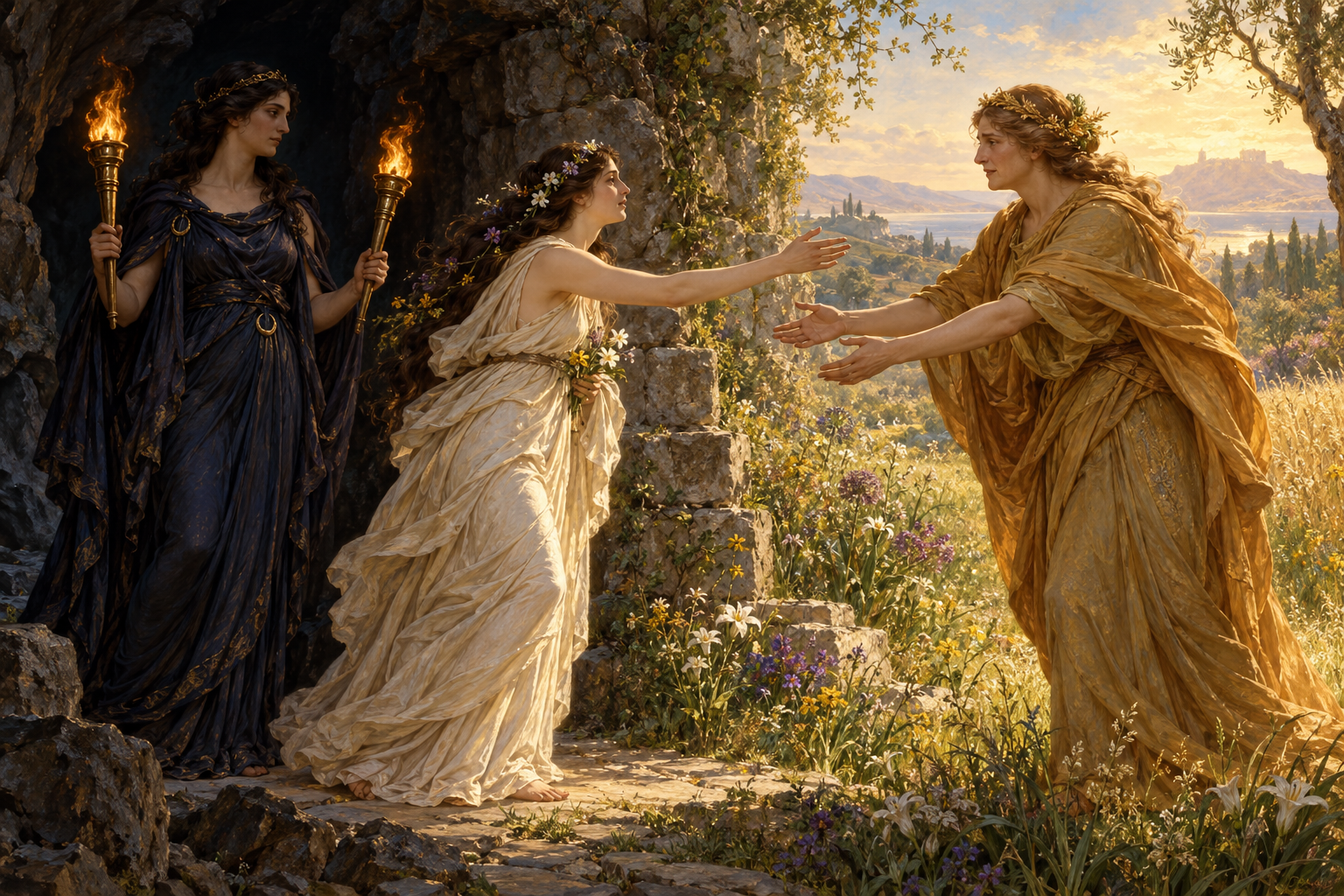
Pausanias credits the fifth-century BCE sculptor Alcamenes with joining three Hecate figures together. The threefold image suits a crossroads guardian, although interpretations varied. It should not automatically be read as the modern Maiden–Mother–Crone framework, whose development belongs to a much later religious and literary history.7, 8
Artemis, Circe and Medea: women in her mythic world
Several female figures illuminate Hecate’s background. Their connections differ; they cannot all be reduced to one original goddess.
| Figure | Connection and complexity |
|---|---|
| Artemis and Selene | Later traditions associated or identified them with Hecate. Their overlapping identities help explain her lunar imagery, without proving identical origins.7 |
| Circe | In the Odyssey, she transforms men into pigs but later helps Odysseus continue his journey. Dangerous power and practical guidance coexist.9 |
| Medea | Euripides’ heroine invokes Hecate as her chosen divine ally. She has helped Jason, yet commits terrible murders: sympathy for her betrayal cannot erase her victims.10 |
Diodorus even records a version making Circe and Medea Hecate’s daughters, while portraying Hecate herself as cruel. This is one alternative genealogy, not a universal family tree. Ancient storytellers were already arguing, through their stories, about what such female power meant.11
Why was Hecate demonised?
Her frightening reputation developed before Christianity. Greek literature connected her with nocturnal magic and the dead; protective and threatening portrayals coexisted. A power capable of keeping danger away could also be imagined commanding it.7
Christian polemic added a different judgement. In the fourth century CE, Eusebius’ Preparation for the Gospel places Hecate within an argument about evil spirits and deceptive pagan worship. This was part of a broader attack on competing religions, rather than a campaign directed only at powerful women.12
Later theatre preserved the sinister image: in Macbeth, Hecate directs the witches’ harmful plans. Gender is a useful lens for reading these portrayals, but cannot alone explain centuries of changing theology and storytelling.13
Returning with a different understanding
Meanwhile, the Chaldean Oracles and later Neoplatonic philosophy gave Hecate an exalted role mediating between cosmic realms. Scholarship on Hekate Soteira, Hecate the Saviour, explores this life-giving and religiously transformative dimension, while debating its precise philosophical meaning.14
Calling Hecate a positive deity therefore has historical grounding: she nurtures, protects and accompanies. Calling her exclusively benevolent would flatten the evidence again. Her value as a symbol lies in her ability to face what people fear.
We return to the crossroads with a changed question. Before fearing the woman holding the torch, ask whom she is helping through the dark.
Sources and research notes
1. Oxford Classical Dictionary, “Hecate”
Scholarly reference. The accessible extract supports cautious treatment of her origins, name and changing attributes.
2. Amanda Herring, “Hekate of Lagina: a goddess performing her civic duty” (2022)
Anatolian Studies 72. Archaeological and epigraphic research on the sanctuary’s civic role and single-bodied goddess.
3. Liddell–Scott–Jones Greek–English Lexicon, Ἑκάτη
Lexical entry via Perseus Scaife ATLAS. Its alternative glosses are not proof of a settled original etymology.
4. Lewis Richard Farnell, The Cults of the Greek States, “Hekate”
Historical scholarship, used for the traditional far-darting explanation and its acknowledged uncertainty, not as the sole authority on origins.
5. Hesiod, Theogony 404–452
Ancient primary text; H. G. Evelyn-White translation. Parentage, honours, livelihoods and nurture of the young.
6. Homeric Hymn to Demeter 19–89, 438–440
Ancient primary text; H. G. Evelyn-White translation. Hecate hears the cry, accompanies Demeter, and remains with Persephone.
7. Galleria Borghese, “Statue of a Triple-Bodied Hecate”
Museum catalogue: protective and threatening aspects, entrances, triple imagery and associations with Artemis and Selene. See also Pausanias 2.30.2 for Alcamenes. The hymn itself controls the account of Persephone above.
8. Ronald Hutton, “Hecate: Mistress of Magic” (2025)
Gresham College lecture. Used here for the later reception of triple-goddess symbolism; its categorical origin claims are not adopted.
9. Homer, Odyssey, Book 10
Ancient primary text; A. T. Murray translation. Circe’s transformations and her subsequent guidance for Odysseus.
10. Euripides, Medea (431 BCE)
Ancient primary text; E. P. Coleridge translation. Hecate invocation at lines 395–398, and the tragedy’s wider account of aid, betrayal and violence.
11. Diodorus Siculus, Library of History 4.45–46
Ancient primary text; C. H. Oldfather translation. An alternative account treating Hecate as a cruel queen and mother of Circe and Medea.
12. Eusebius, Preparation for the Gospel, Book IV, especially chapter 23
Christian polemical primary text; E. H. Gifford translation. Evidence of religious argument, not neutral description of pagan worship.
13. Macbeth, Act 3, Scene 5 — Folger Shakespeare Library
Primary literary evidence for Hecate’s sinister theatrical reception. Folger notes that most scholars question Shakespeare’s authorship of this scene.
14. Joseph DeFilippo, review of Sarah Iles Johnston’s Hekate Soteira (1991)
Bryn Mawr Classical Review. Used as a scholarly discussion of the 1990 monograph; the monograph was not consulted in full. Explains both the mediation thesis and disagreements.
15. Aristophanes, Wealth (Plutus), lines 594–597
Ancient comic primary text on monthly offerings. The joke should not be mistaken for a complete account of the rite’s purpose.