
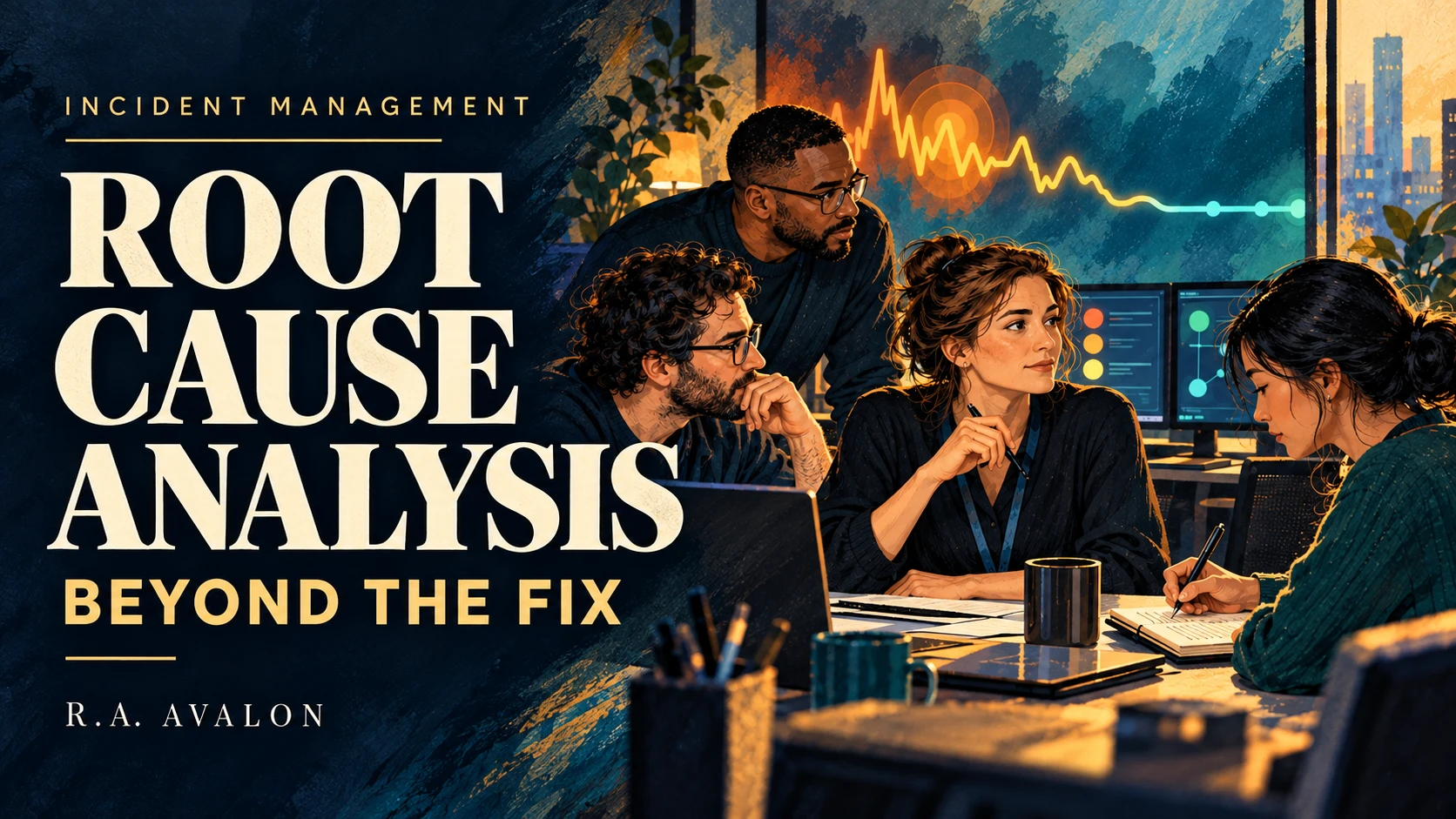
The dashboard turns green. The incident call ends. Someone says, “Good work, everyone,” and the team returns to its overflowing inboxes. But one colleague is still replaying a sharp remark. Another knows a warning disappeared into a private chat. Neither appears in the technical report.
If the system has recovered, has the organisation learned?
Good root cause analysis in incident management examines why a failure happened, how people responded, and what needs to change. That includes communication, coordination and the human aftermath. Restoring a service is an achievement. Understanding the whole incident is what makes the next response better.

What makes a good root cause analysis?
Root cause analysis, or RCA, investigates the conditions behind a problem. A post-incident review brings that analysis together with the impact, response and lessons learned. Agree beforehand which incidents warrant one: major disruption, data loss, failed detection or recurring problems, for example. Significant near misses can also offer valuable lessons.1
A strong report contains an incident summary, affected services and users, a supported timeline, causes and contributing factors, mitigation, recovery evidence, lessons and follow-up actions. Separate a temporary workaround from a permanent fix. Record uncertainty rather than turning an attractive theory into a fact.2
There may be several interacting causes. “Someone deployed a faulty change” leaves questions unanswered: why did testing miss it, why was the impact so wide, and why was reversal difficult? The 5 Whys technique can help explore these questions, but each answer needs evidence.3 Follow multiple branches where necessary. Do not force a complex incident into one convenient culprit.
Google’s blameless approach asks what made people’s decisions understandable with the information available then. Hindsight makes uncertainty look much simpler than it felt on the call.1
What to record during a high-priority incident
The best RCA starts while the incident is happening. Appoint a scribe: someone responsible for capturing key events and decisions while others coordinate or troubleshoot. PagerDuty explicitly separates this responsibility so the record does not depend on the busiest engineer remembering everything later.4
Use one shared incident record. Keep entries brief, timestamped and linked to evidence. This checklist combines incident-record guidance with practical prompts for the later review:4, 5, 6
| Capture | What belongs in the record |
|---|---|
| Impact and timing | Incident ID, priority and changes to it; affected users and services; first symptoms, detection, escalation, mitigation and verified recovery. State the time zone and mark estimated times. |
| People and ownership | Who joined or left, their role, who led, who communicated, who performed each action, and who accepted responsibility at handover. |
| Communication | Calls, chat channels, tickets, emails and vendor contacts; important decisions made elsewhere; who received updates, when, and when another update was promised. |
| Decisions and actions | What was proposed, approved, attempted or rejected; by whom, why, expected outcome, actual result and next checkpoint. Include unsuccessful attempts. |
| Knowledge and obstacles | Facts versus hypotheses; evidence links; missing access, unavailable expertise, unanswered requests, conflicting instructions, approval delays and duplicated work. |
| Working conditions | Time on duty, breaks, relief, workload and observable communication difficulties. Note helpful interventions too; keep sensitive personal concerns in an appropriate restricted record. |
| Recovery and handover | Who verified recovery and how; remaining impact, monitoring, temporary changes, outstanding risks, next owners and stakeholder closure messages. |
Capture consequences as well as timestamps. Consider this illustrative entry: “14:12 UTC: vendor confirms rollback availability by phone. Shared channel updated at 14:24; investigation continued during the gap.” That reveals a communication delay worth understanding.
A message being sent is different from it being acknowledged. Record both when that difference affects the response. Distinguish when something happened from when the team discovered it, and leave gaps visible until verified. Otherwise, the finished timeline can accidentally give responders knowledge they did not yet have.
Summarise decisions from side conversations in the shared record. Preserve relevant evidence before it expires, but exclude credentials and unnecessary personal data. Audio recording is not a prerequisite; follow organisational rules if using it. Documentation should support recovery without obstructing it.
Review the response, including what went well
Reconstruct what people knew at each decision point. Was leadership clear? Did a request for help reach someone empowered to act? Did repeated management questions interrupt the same engineer? Google’s incident-response guidance treats coordination and communication as core responsibilities.6
Invite the people who saw different parts of the incident, including service desk staff, communicators and relevant suppliers. Share the timeline beforehand and allow written corrections. A facilitator should make room for quieter voices and distinguish observations from interpretations.
Record successes precisely: a clear handover, an early escalation, an accessible runbook, or someone noticing that a colleague needed relief. Identify what made those successes possible. A review should teach the team what to repeat as well as what to change.2

Aftercare: the service is restored, but people may not be
During an urgent incident, adrenaline is high and patience can run thin. A dismissive comment may seem small to the person who said it and remain with the person who heard it. Repeated incidents can fill a bucket: an interrupted explanation, public criticism, another night without proper rest. Eventually, the final drop gets blamed for the overflow.
Managers should notice that accumulation. Pressure can explain behaviour; it does not erase its impact. HSE’s workplace-stress guidance explicitly includes relationships, unacceptable behaviour and manageable demands. Those belong in organisational learning too.7, 8
My practical recommendation is a brief check-in the next working day, after adequate rest. Ask what remains unresolved, whether workload needs adjusting, and whether anything in the interaction needs attention. Do not wait months for a formal review before offering support. Schedule the fuller RCA promptly; PagerDuty’s own process uses days, although complex investigations can take longer.9
If the team says, “We’re fine,” keep the opportunity available. Make operational learning routine, while allowing personal discussion privately or later. Do not assume silence proves either distress or wellbeing. Acas recommends sensitive, private conversations and practical changes such as rest breaks or help prioritising work.10
Useful questions include: “What made your job harder?” “Was there a point when you could not get heard?” and “What would help today?” Offer another trusted contact when the manager was part of the difficulty. Explain confidentiality boundaries and offer occupational-health or employee-support options where needed.
When a remark caused harm, repair should be specific: acknowledge what was said, listen to its effect, apologise without making pressure an excuse, and agree what will change. Managers should model that themselves. A generic “things got heated” can leave the person affected carrying the entire burden of moving on.
This is supportive management, not compulsory emotional disclosure or therapy. NICE advises against psychologically focused debriefing to prevent or treat PTSD; that is different from an operational review or a voluntary supportive conversation.11 Take concerns about harmful conduct seriously through the appropriate process, separately from the shared learning discussion.
Turn the RCA into changes people can see
“Communicate better” is difficult to implement. “Assign a communications lead at declaration and publish the next update time” gives the team something observable. Each agreed action needs an owner, priority, deadline and a way to check whether it worked. Link it to a tracked task and revisit progress.12
Include technical safeguards, clearer escalation, better handovers and realistic responder cover. Share an appropriate summary with affected colleagues or customers: what happened, what is restored, what remains uncertain and what happens next. Keep personal disclosures out of it.
Check whether earlier reviews identified the same weakness. If improvements repeatedly remain unfinished, investigate capacity, priorities and ownership.3 Lessons only become organisational learning when someone has the time and authority to act on them.
The dashboard turning green tells us something important about the service. A good RCA asks what happened around it: which decisions helped, which barriers delayed recovery, and whether the people involved can face the next incident with more trust. That is where incident management becomes lasting improvement.
Related reading: IT Incident Management: More Than Fixing IT.
Sources & further reading
Primary guidance consulted on 29 October 2026. The checklist and next-working-day check-in are practical editorial recommendations, not a universal timetable or clinical protocol. HSE and Acas are cited for workplace practice, not as statements of Dutch law.
- Google SRE — Postmortem Culture: Learning from Failure
- PagerDuty — Postmortem Template
- Atlassian — Incident postmortems: causal analysis and recurrence
- PagerDuty — Different Roles — including the scribe
- Google SRE — Managing Incidents
- Google SRE Workbook — Incident Response
- Health and Safety Executive — Management Standards: Relationships
- Health and Safety Executive — Management Standards: Demands
- PagerDuty — Postmortem Process
- Acas — Supporting workers with work-related stress
- NICE — PTSD guideline NG116, recommendation 1.6.5
- Google SRE Workbook — Postmortem Culture: Learning from Failure
Both illustrations were created with AI for this article and depict fictional colleagues.