
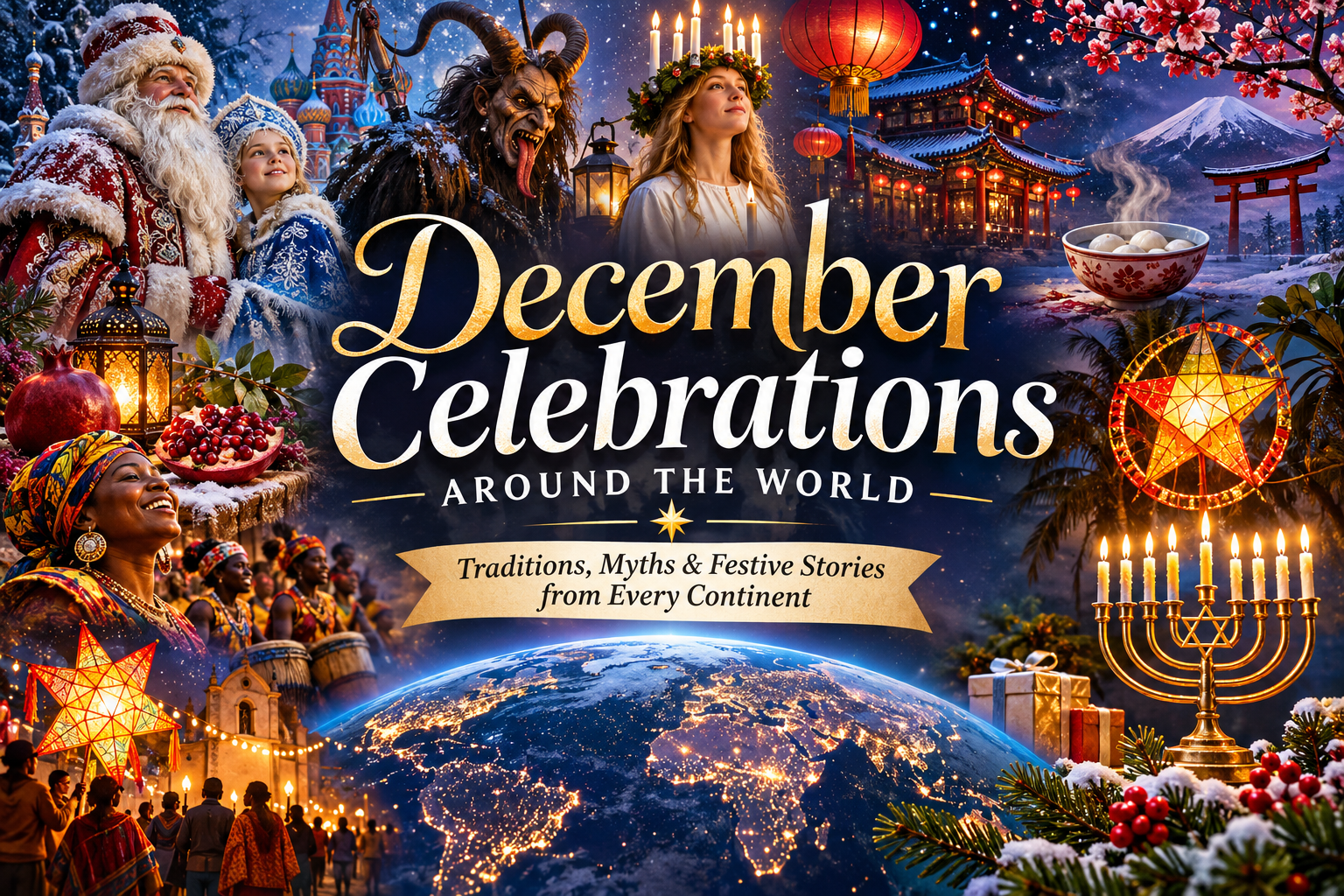
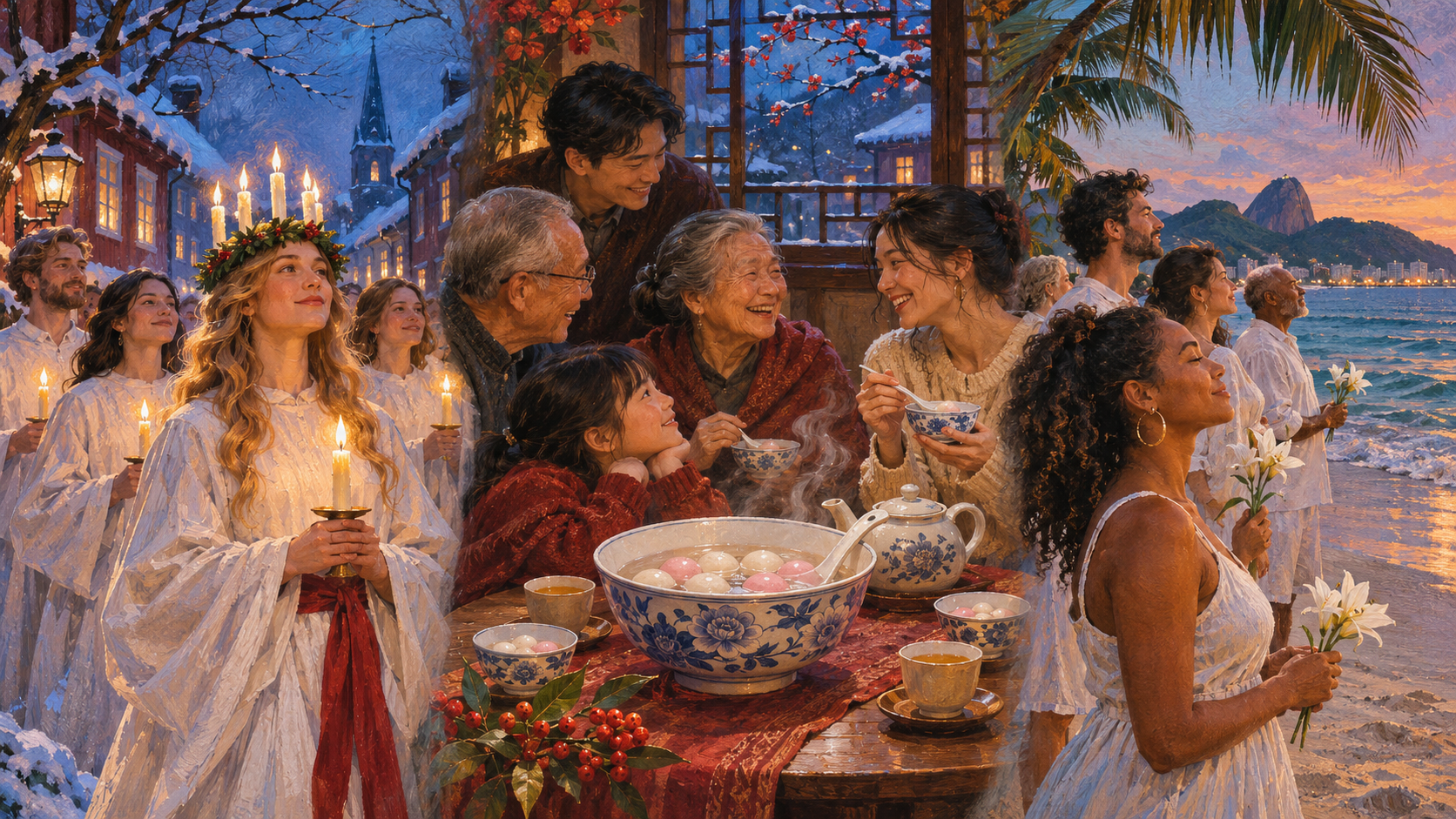
Imagine following December around the Earth, carrying a lantern from one doorway to the next. In one street, a horned creature rattles its bells. Elsewhere, a family shares sweet rice balls, or leaves flowers beside the sea. December celebrations around the world open onto different histories, beliefs and seasons. What draws me in is how a story becomes something people can taste, carry, sing or offer.
Europe: saints, shadows and candlelight
Our journey begins in Europe. Dutch families exchange Sinterklaas gifts on 5 December, celebrating Saint Nicholas. One legend tells how he secretly gave gold to save three impoverished daughters from a desperate future. In Austria, around 5–6 December, the saint’s kindly presence is shadowed by Krampus: a horned, bell-ringing figure who threatens misbehaving children. The folklore gives generosity a frightening companion, although Krampus’s precise origins remain uncertain. 1, 2, 3
Further north, Sweden’s Lucia processions bring candles and song on 13 December. The celebration bears the name of Saint Lucy of Sicily, whose legend tells of flames that could not harm her. Older Swedish tales also filled Lucia night with dangerous supernatural visitors. Today’s white robes and candle crowns belong to a tradition shaped by several influences. Its image stays with me: someone steps forward, carrying light for others. 4
Russia: winter becomes a gift bearer
In Russia, the great gift-giving visitor belongs chiefly to New Year. Ded Moroz, Grandfather Frost, arrives with a magical staff and Snegurochka, his granddaughter, the Snow Maiden. Folklore and literature helped shape them; Soviet celebrations established their familiar public partnership. Winter becomes a character who can reward and enchant. Russian Orthodox Christmas follows on 7 January, extending the festive season beyond December’s final page. 5, 6
Iran and Afghanistan: keeping the longest night
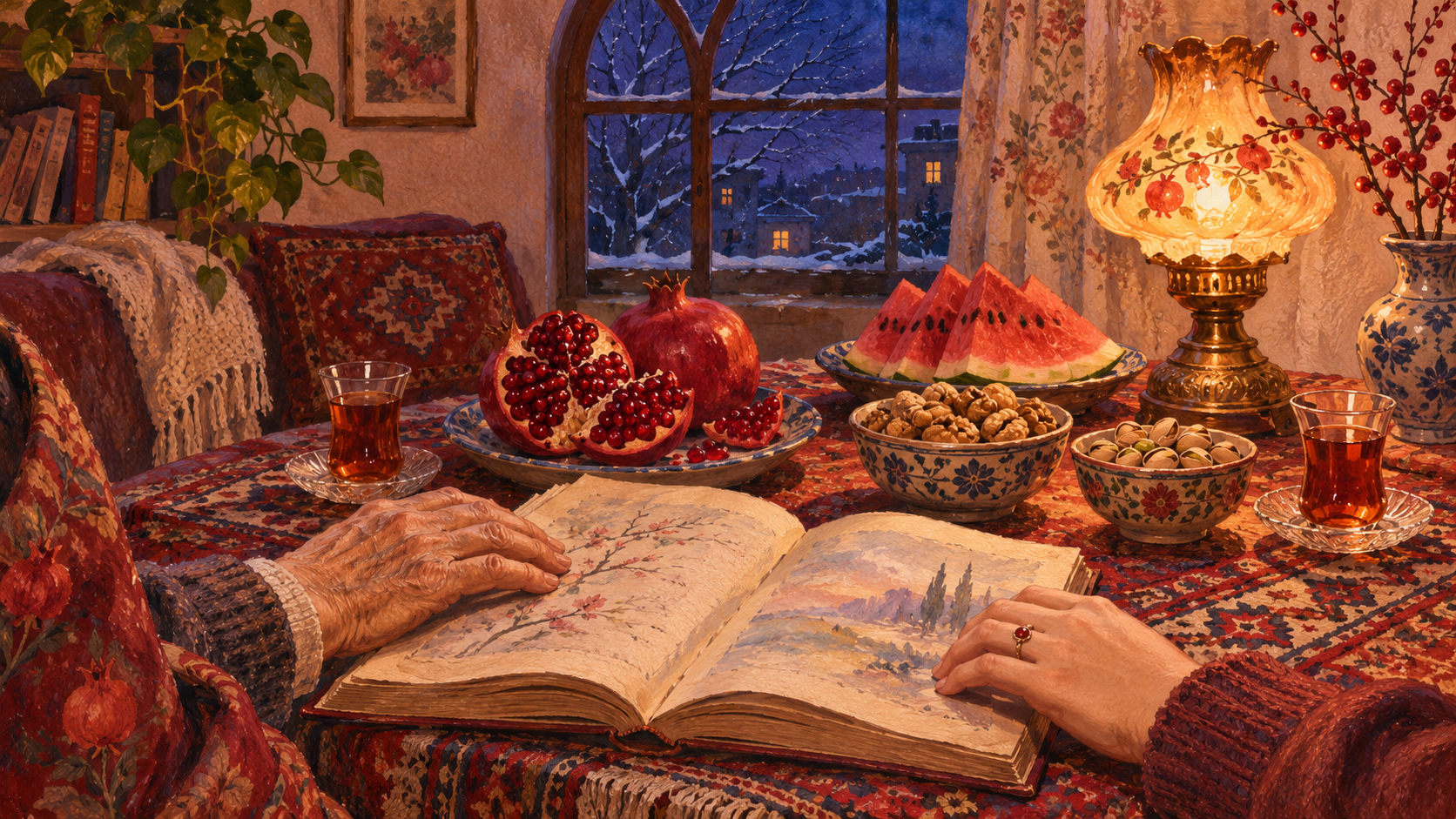
In Iran and Afghanistan, Yalda gathers families through the longest night. Lamps, red pomegranates and watermelon fill the table; poetry and stories pass between generations. In Iranian homes, Hafez is often read aloud. The celebration honours sunlight and life’s warmth. Its symbolism gives darkness a limit: however long the night, morning returns. Sometimes the most powerful response to uncertainty is to sit together until it passes. 7, 8
China and Japan: reunion and renewal
At Dongzhi, the northern winter solstice, families in southern China share tangyuan, round rice balls associated with reunion. One folktale tells of a father and daughter who divide a rice ball before separating, promising to eat a whole one together when reunited. Their small meal holds an entire hope. Chinese cosmology associates the lengthening days with returning yang: renewal expressed through the sky and the family table. 9, 10
Japan closes December with Ōmisoka. Around midnight, Buddhist temple bells sound 108 times, symbolically releasing worldly desires. Separately, New Year preparations welcome Toshigami, the Shinto New Year deity believed to bless the household. A swept floor, a decorated doorway and a bell’s fading note make room for another beginning. 11
The Philippines: following the star
In the Philippines, the guiding light becomes a star. Parol lanterns recall the Star of Bethlehem in the Christian Nativity story. Simbang Gabi brings worshippers together for nine dawn Masses from 16 to 24 December. The journey towards Christmas takes the story into the neighbourhood: people leave their beds before sunrise and walk towards a gathering glow. 12, 13
Hanukkah: the flame that lasted
Jewish households worldwide light the hanukkiah during Hanukkah, which begins in November or December, depending on the year. The festival recalls the rededication of Jerusalem’s Temple. According to Jewish tradition, oil sufficient for one day burned for eight. Each evening adds another light. The story invites us to imagine hope beginning with an amount that seems too small. 14
Ghana and Ethiopia: stories in motion
In Ghana’s Takoradi, the Ankos carnival fills Christmas with masquerades, brass bands and dancing, alongside church services and carols. Costumes tell cultural, historical and spiritual stories, carrying local memory through performance. Here, the streets themselves become a stage. 15
Further east, Ethiopia’s season continues into January. At Genna, usually on 7 January, Lalibela’s clergy sing from cliffs and courtyards, representing the angels and shepherds of the Nativity. The story of Jesus’s birth becomes a shared act of worship among churches carved from rock. 16
Mexico: opening the door
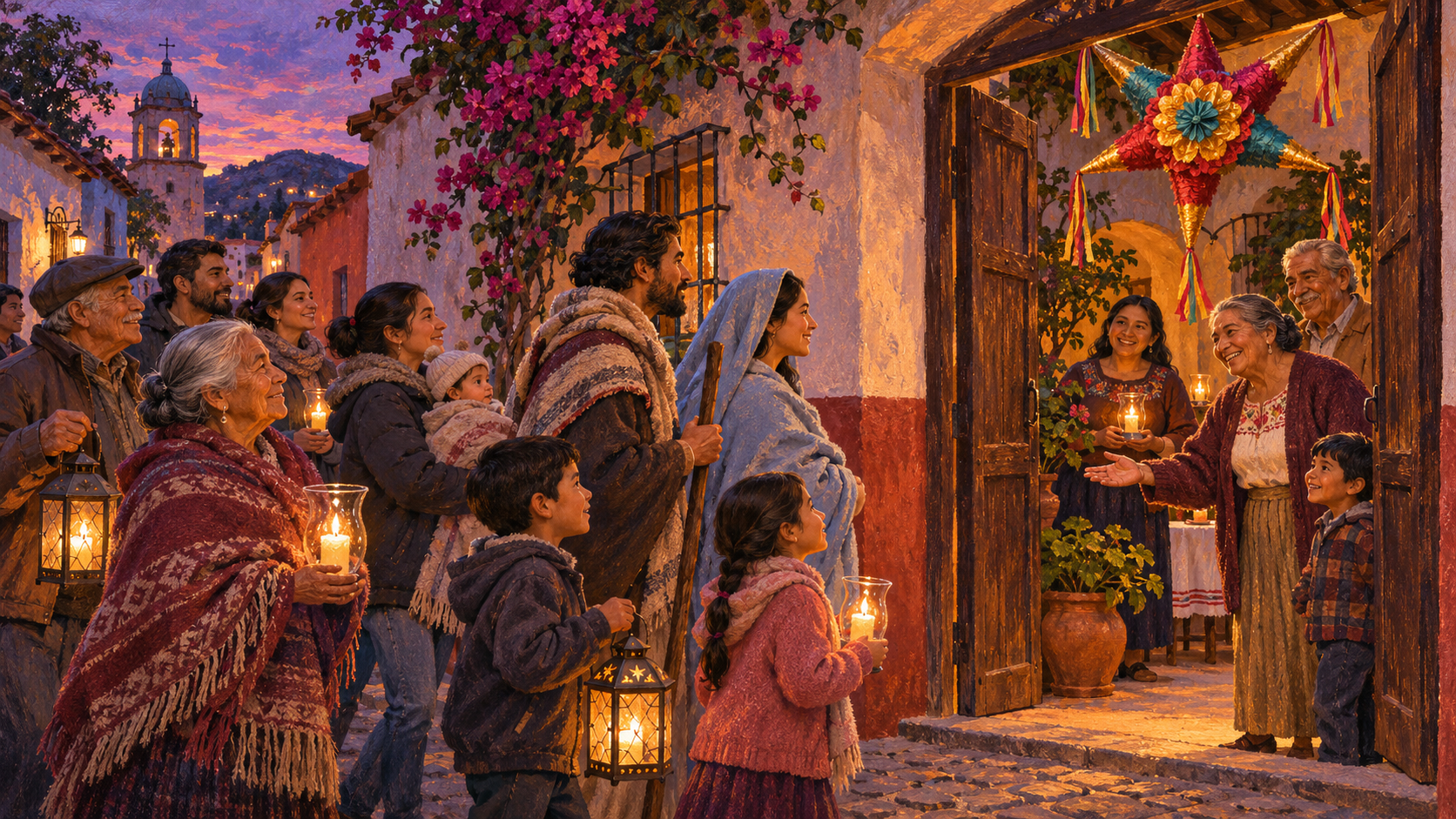
From 16 to 24 December, Mexico’s Las Posadas reenacts Mary and Joseph’s search for shelter in Bethlehem. Songs lead the travellers towards a welcoming door. A traditional seven-pointed piñata carries a Catholic interpretation: its points represent the seven deadly sins, overcome when it breaks. Beneath the colour and sweets sits a demanding question: when someone needs refuge, who opens the door? 17, 18
Brazil: flowers for the sea’s mother
Across much of Brazil, the year ends in summer. Along the coast, year-end flower offerings honour Iemanjá, the sea deity, or orixá, revered in Afro-Brazilian religions. In one sacred narrative, she becomes a river to escape her husband. When he becomes a mountain to block her, Xangô splits it with lightning, allowing her to reach the ocean. Knowing that story changes the scene: flowers beside the waves can speak of protection, gratitude and a mother’s power. Meanings and practices vary between communities. 19, 20, 21
The United States: flying reindeer and seven candles
In American Christmas folklore, Santa’s flying reindeer carry gifts through the night. The familiar flight appears in the 1823 poem A Visit from St. Nicholas: a reminder that written stories can become shared seasonal imagination. 22
In the United States, Kwanzaa lights seven candles between 26 December and 1 January. Created by Maulana Karenga in 1966, it honours African heritage through principles including unity, shared responsibility and creativity. Its meaning comes from cultural memory and deliberate renewal. Here, a community writes a tradition into being, then asks people to live its values beyond the celebration. 23
What will we carry forward?
What stays with me is the gesture: sharing food, opening a door, remembering a story, making room for someone else. These celebrations have distinct histories and sacred meanings. Seen together, they invite a question that belongs in every storyteller’s notebook: what do we want the next generation to carry forward? Perhaps December’s most lasting gift is the chance to answer.
All three images are original AI-generated editorial illustrations.
Sources and further reading
- Holland.com — Sinterklaas and the Dutch festive season
- The Golden Legend, via St. Nicholas Center — The three daughters and the secret gifts
- Austria Tourism — Krampus and Saint Nicholas
- Nordiska Museet — Lucia’s many historical influences
- Russian Commission for UNESCO — Ded Moroz and Snegurochka
- Presidential Library — Russian Christmas traditions
- UNESCO — Yaldā/Chella, heritage of Iran and Afghanistan
- ECO Cultural Institute — Yalda, poetry and symbolism
- Singapore Chinese Cultural Centre — Winter Solstice Festival
- Singapore Chinese Cultural Centre — Dongzhi and the tangyuan folktale
- Japan Society — Ōmisoka, the temple bells and Toshigami
- City of Las Piñas — Parol lanterns and the Star of Bethlehem
- Cultural Center of the Philippines — Simbang Gabi
- Jewish Museum London — Hanukkah’s eight lights and story
- Ghana News Agency — Takoradi’s Ankos / Westside Carnival
- Ethiopia Ministry of Culture and Tourism — Ethiopian Festivals, Genna (page 8)
- Mexico’s Secretaría de Cultura — Las Posadas and the search for shelter
- TURISSSTE — Posadas dates and the seven-pointed piñata
- Visit Brasil — New Year traditions and Afro-Brazilian heritage
- Rio de Janeiro City Hall — Year-end offerings to Iemanjá
- Fundação Cultural Palmares — Iemanjá’s sacred narrative
- Library of Congress — Santa Claus in nineteenth-century American print
- Smithsonian NMAAHC — Kwanzaa and its seven principles