Hearing that New York City mayor Zohran Mamdani had referenced Avatar: The Last Airbender sent my thoughts towards the Order of the White Lotus. Social posts describe him quoting Jeong Jeong: “Water brings healing and life.” The occasion was a Central Park water project, officially announced on 26 October. A fictional world had found its way into a conversation about caring for a real one.1 2 3
That connection interests me as a storyteller. Avatar gives its ideas objects we can remember: an arrow, a scar, a small flower engraved on a tile. The White Lotus is particularly compelling because its meaning unfolds gradually. Something that initially looks like an old man’s favourite game becomes a sign of allegiance to a much larger responsibility.
What is the Order of the White Lotus?
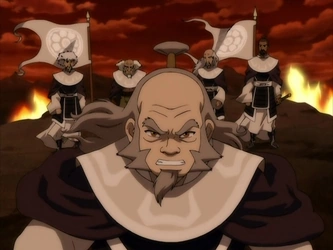
The Order brings together people whose nations are at war. Iroh, Bumi, Pakku, Jeong Jeong and Piandao belong to the same secret society, which values philosophy, beauty and truth across national boundaries. Their cooperation suggests that knowledge becomes more useful when people allow it to travel beyond the borders of their own group. Piandao’s presence is especially telling: a swordsman without bending belongs among these masters because their fellowship recognises more than elemental power.4
That principle has consequences. Iroh’s loyalty eventually leads him to help liberate Ba Sing Se from the Fire Nation, the country he once served as a general. His wisdom carries the weight of that earlier life. He understands conquest from within, and chooses to use his abilities differently.4
© Nickelodeon · Source: Avatar Wiki

White lotus symbolism: purity and awakening
The lotus offers a fitting image for this transformation. In Buddhist symbolism, the flower represents purity because it emerges from muddy water without being defiled by it. The Metropolitan Museum of Art describes that association explicitly. The mud matters: the image places the possibility of growth inside an imperfect world.5
White adds another layer. Buddhist teaching resources associate the white lotus specifically with mental purity and spiritual perfection. Within that tradition, the colour strengthens the flower’s connection to awakening. Applied to Avatar, it invites a reading of clarity: learning to recognise inherited prejudice, ambition and anger before allowing them to determine your actions.6
I read Iroh through that symbolism. His past remains part of him, yet it does not exhaust what he can become. The flower suggests an ethical direction rather than a certificate of innocence. This is an interpretation supported by the symbolism and his story; it does not establish exactly what the creators intended.
Pai Sho, white lotus tiles and the chess connection
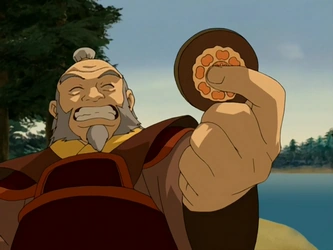
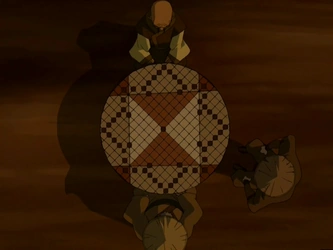
The objects that look like white coins are game tiles. Pai Sho is played on a circular board using round pieces marked with different designs, including flowers. The white lotus is one particular tile. Its significance extends beyond play: it becomes a discreet means through which members of the Order recognise one another.7
© Nickelodeon · Source: Avatar Wiki

In “The Desert,” Iroh uses Pai Sho and the lotus tile to establish contact with another member, securing help for himself and Zuko. It is an elegant storytelling device. A familiar pastime doubles as a language of trust, allowing a hidden network to become visible through an ordinary interaction.8
© Nickelodeon · Source: Avatar Wiki

The comparison with chess makes sense at the level of strategy. A piece gains significance through its position and relationships. A tempting move can weaken the wider position; an apparently quiet move can prepare something decisive. Both images encourage us to look beyond the object immediately in front of us.
However, Pai Sho should not simply be described as chess with flowers. The series does not present a complete, consistent playable rulebook, and real players have developed different versions. In the fan-created Skud Pai Sho, for example, players seek a ring of harmonies, and the white lotus can form harmonies with either player’s basic flower tiles.9 10
That particular rule makes a beautiful companion to the Order’s ideals, provided we identify it as a fan interpretation. It imagines a piece whose value can extend across opposing sides. The chess metaphor then opens into a wider question: what happens when our understanding of success includes the relationships that sustain the whole board?
Healing and life beyond the board
For me, this is where Avatar becomes relevant beyond its fictional nations. Communities, workplaces and public institutions all develop loyalties. Those loyalties can support cooperation, but they can also discourage people from noticing harm committed by their own side. The White Lotus offers an image of people maintaining connections across those divisions.
© Nickelodeon · Source: Avatar Wiki

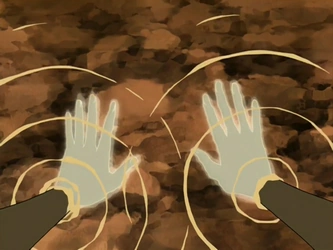
That brings me back to Jeong Jeong’s words: “Water brings healing and life.” In a city, that means caring for the systems that sustain its people. In Avatar, I see the same responsibility in the White Lotus: using knowledge and power to help a wounded world recover.
The flower rises from the mud; Iroh grows beyond the harm he once served. Both leave me with the same thought: wisdom becomes meaningful when it helps life flourish, and healing begins when we choose to make that possible.
Sources and image credits
1. The Avatarverse — report of Mamdani’s Avatar reference
2. NYC Mayor’s Office — Central Park project announcement, 26 October 2026
3. The Deserter — episode transcript
4. The Old Masters — episode transcript
5. The Metropolitan Museum of Art — lotus symbolism
6. BuddhaNet — The Symbol of the Lotus
8. The Desert — episode transcript
9. The Garden Gate — history of Skud Pai Sho
10. The Garden Gate — Skud Pai Sho rules
Images are stills from the original animated series Avatar: The Last Airbender, reproduced via Avatar Wiki. Series imagery © Nickelodeon; individual sources are linked in the captions.