
When a critical IT system stops working, everyone wants answers.
The technical team wants logs. Management wants to understand the operational risks. Colleagues simply want to know whether they can continue working.
Same incident. Three different perspectives.
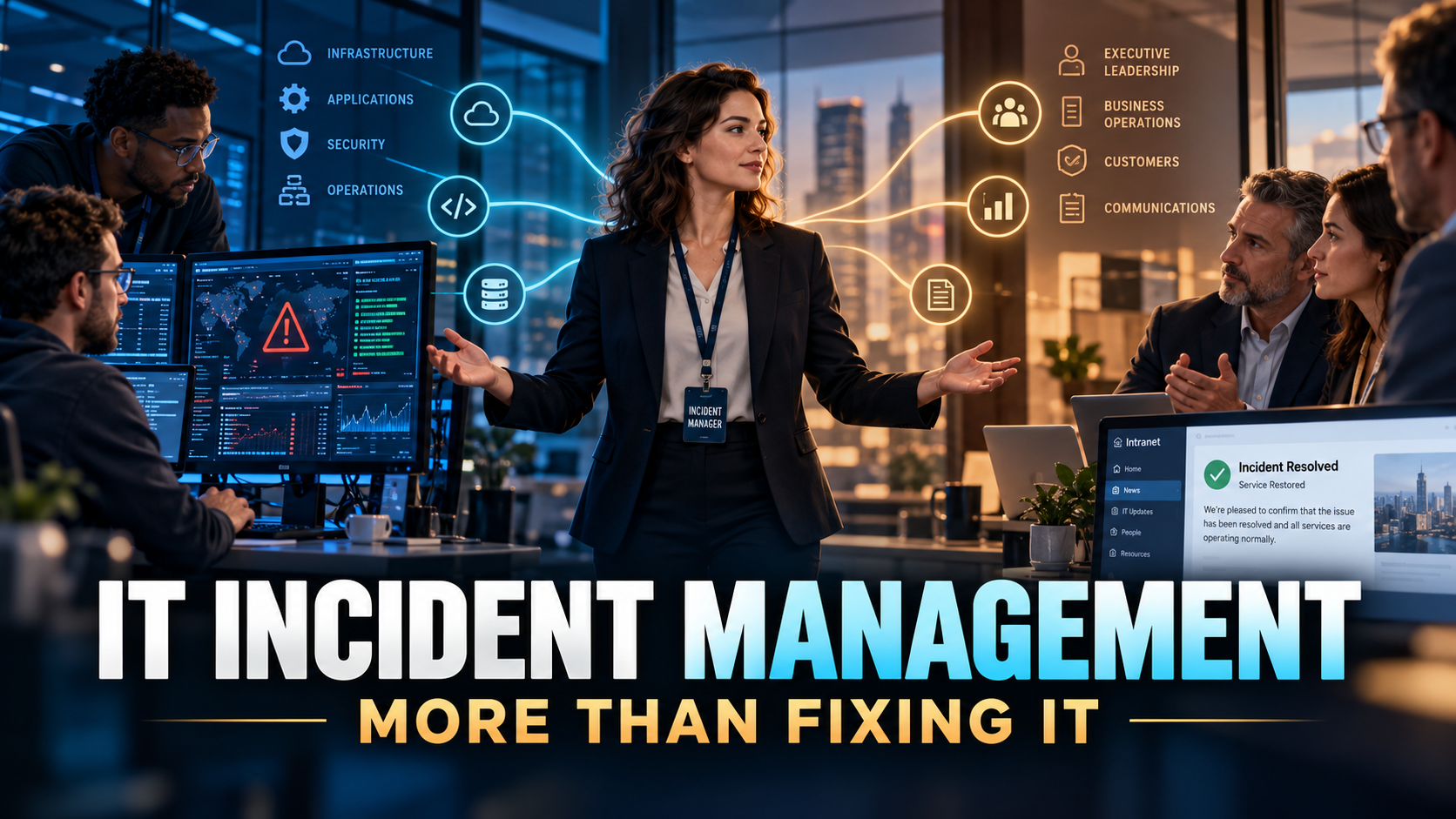
This is why I believe IT Incident Management is about much more than fixing technical problems. It is about restoring services, coordinating people, managing expectations and translating information between different layers of an organisation.
And much of that work happens behind the scenes.
What Does IT Incident Management Actually Involve?
The primary goal of Incident Management is to restore an agreed level of IT service as quickly and responsibly as possible, while minimising business disruption.
That sounds straightforward. In practice, it involves registering incidents, assessing impact and urgency, establishing priorities, coordinating investigations, escalating where necessary and overseeing service restoration.
Sometimes the immediate solution is a workaround. The service may be operational again even though the underlying root cause remains unknown.
Service restored does not necessarily mean problem permanently solved.
Understanding that distinction matters, especially when communicating with stakeholders who understandably want reassurance.
IT Services Coordination: More Than Just the Service Desk
One aspect people underestimate is the overlap between Incident Management and IT Services Coordination.
A service desk is essential. It provides a central point of contact, resolves issues and helps colleagues get their work done.
But IT Services Coordination is not simply answering calls or processing tickets.
It involves overseeing service delivery, coordinating technical specialists and suppliers, managing expectations, improving knowledge management and identifying recurring service issues.
You need to understand how IT services support business processes and how different departments depend on one another.
Incident Management builds on many of these responsibilities, particularly when something goes wrong.
Where IT Services Coordination focuses on maintaining effective service delivery, Incident Management concentrates on restoring disrupted services.
Both require something that cannot be measured by the number of tickets closed: the ability to see the bigger picture.
The Thought Process Behind Managing an Incident
My first question is not necessarily, “Which server failed?”
It is, “Which service is affected, and what does that prevent people from doing?”
An incident affecting one critical business process may have greater impact than an inconvenience affecting dozens of users.
Context determines priority.
Then come the questions that guide coordination:
- What do we know, and what are we assuming?
- Which services, departments and suppliers are involved?
- Who owns each action, and when should we escalate?
- What are the risks of implementing a workaround?
- What information does management need to make decisions?
Throughout the incident, maintaining a reliable timeline of findings, decisions and recovery actions becomes essential.
A technical hypothesis should never accidentally become an organisational fact.
And sometimes, the most responsible answer is simply, “We don’t know yet.”
Three Audiences, One Truth
Perhaps the most important skill in Incident Management is translating information without changing its meaning.
For IT specialists and DevOps teams, communication needs to be operational: symptoms, dependencies, technical findings, recovery actions and blockers.
For the management team (MT), the focus shifts toward business impact, continuity, risk, escalation and decisions that require approval.
Nobody benefits from an invented restoration time. A realistic update, even one acknowledging uncertainty, is far more useful.
For colleagues across the organisation, the communication takes another form.
During an incident, colleagues need timely operational instructions through the appropriate channels.
After a significant incident has been resolved, I believe they also deserve an accessible explanation of what happened.
That is where an internal intranet update becomes valuable.
After the Incident: The Power of a Transparent TL;DR
Not everyone understands technical terminology. Nor should they have to.
An internal post-incident news article can explain what happened without overwhelming colleagues with technical details.
Consider this fictional example.
Instead of:
Authentication dependencies experienced degraded availability following an infrastructure disruption.
Write:
Some colleagues could not sign in between 09:10 and 09:45. IT has restored access, and the service is working again. We are still investigating the cause. Please contact the service desk if you experience further problems.
The purpose is not to publish the entire technical Root Cause Analysis (RCA).
It is to provide a transparent summary of what was affected, how services were restored, what remains uncertain and what happens next.
Sensitive security information should, of course, remain protected.
Transparency creates understanding. Understanding builds trust.
What People Underestimate About Incident Management
The Incident Manager is not necessarily the person implementing the technical fix.
Instead, the role involves creating the conditions in which specialists can work effectively while keeping stakeholders informed.
That requires technical literacy, emotional intelligence, negotiation, prioritisation and sometimes difficult conversations.
Repeatedly asking engineers for updates can disrupt their concentration. Not updating management can create uncertainty and unnecessary escalation.
Finding the balance is part of the responsibility.
You are managing more than an incident. You are managing attention, expectations and trust under pressure.
Don’t Shoot the Messenger
One lesson I’ve learned from experience: don’t shoot the messenger.
During a major incident, an Incident Manager can become the person DevOps teams associate with yet another question, escalation or uncomfortable update.
You might even become the harbinger of bad news whenever you appear.
And yes, I’ve been “shot” quite a few times myself. Figuratively, of course.
Frustration under pressure is understandable. But directing it at the person trying to connect everyone doesn’t solve the incident.
Part of the job is absorbing pressure without passing it along, protecting technical teams’ focus and keeping communication constructive.
Being the messenger comes with the territory. Becoming the target shouldn’t.
After Service Restoration Comes Continuous Improvement
Closing an incident ticket should not mean closing the conversation.
A post-incident review can examine the timeline, escalation paths, communication, technical findings and opportunities for improvement.
Did everyone have the information they needed? Were responsibilities clear? Could something have been handled differently?
Root cause analysis and corrective actions may continue long after service restoration.
For me, the real value of Incident Management and IT Services Coordination lies in connecting people who see the same challenge from completely different perspectives.
From IT specialists to management, and eventually to colleagues reading a simple intranet update.
Because restoring technology gets the organisation working again. Understanding what happened helps the organisation become better.