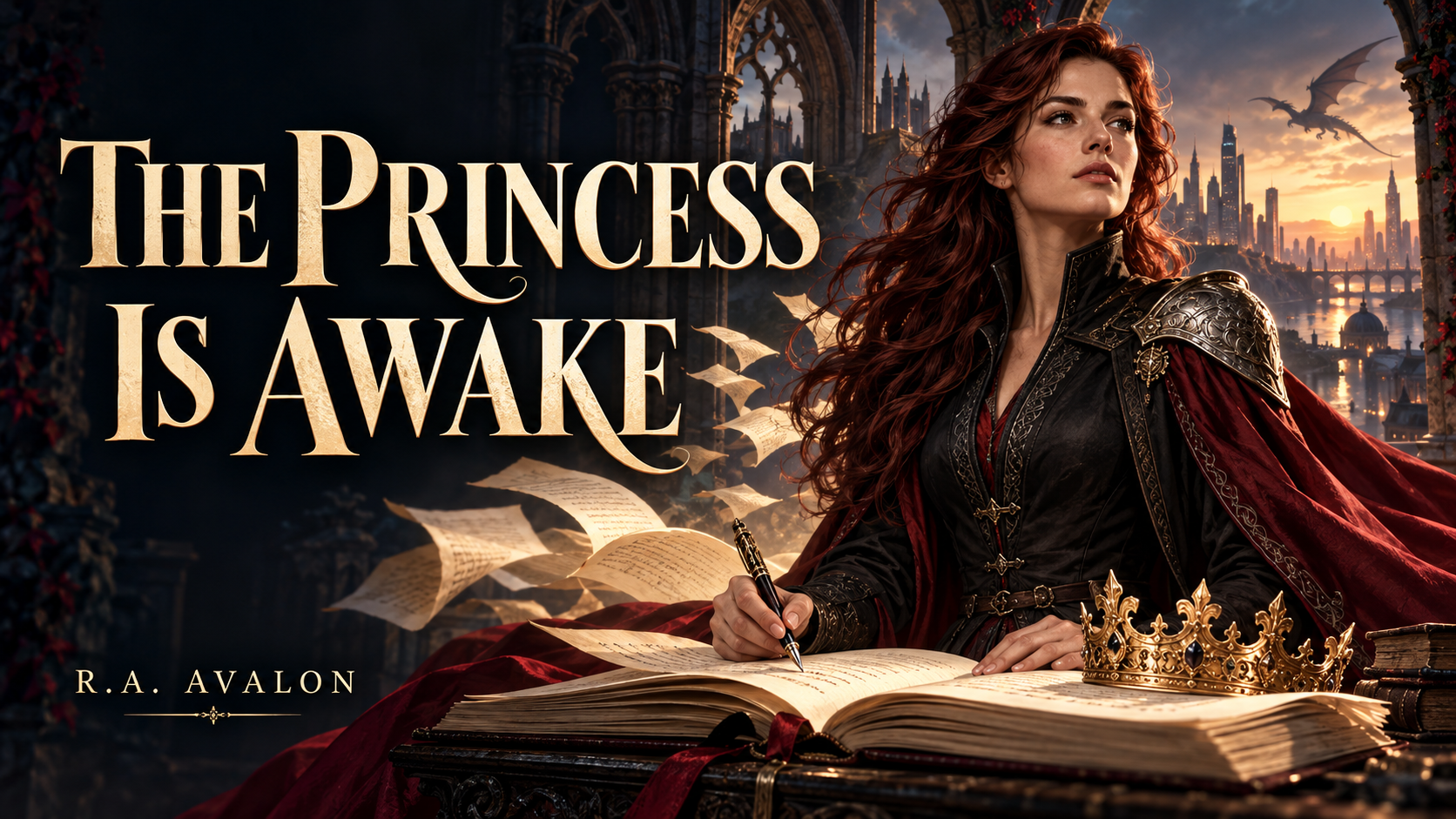
The princess lies still. Others decide what happens next. A prince approaches, a kiss breaks the spell, and her future begins.
In Disney’s Snow White and Sleeping Beauty, rescue gives the story its resolution. The decisive moment belongs to somebody else. Girls need not absorb this literally for repetition to make an arrangement familiar: a woman waits, a man acts, and being chosen becomes the happy ending.
Place those princesses beside Mulan, Éowyn or Rhaenyra Targaryen. What changes is who gets to decide. The image of handmaids above warrior women captures that struggle over authorship: whether a woman’s life belongs to her or to the role others assign.
In Giambattista Basile’s seventeenth-century Sleeping Beauty precursor, “Sun, Moon, and Talia,” a king rapes the unconscious heroine, who eventually marries him. Violation becomes part of a happy ending without consent becoming its organising principle.
Other traditions imagine women contesting that arrangement. In the medieval Jewish Alphabet of Ben Sira, Lilith is Adam’s first wife, made from the same earth. She claims equality, refuses subordination and leaves after pronouncing the divine name. This is later folklore, rather than Genesis’s account. The text also depicts her as a dangerous demon; modern feminist readings reclaim her refusal.
A different challenge appears in the Gnostic Hypostasis of the Archons. Eve’s daughter Norea resists rulers who claim power over her. Within its retelling of Noah’s flood, she calls to the highest God for protection, and the angel Eleleth answers. Read symbolically, she distinguishes power from rightful authority: those demanding obedience do not automatically deserve it.
Across these stories runs the question of who possesses authority. Simone de Beauvoir described man as the defining subject and woman as the Other, understood through her relationship to him. His ambitions supply the main plot; her life becomes supporting material. Her independent wishes can appear disruptive because somebody else expected cooperation.
Psychologists Peter Glick and Susan Fiske distinguish hostile sexism from benevolent sexism: protective, admiring attitudes that sustain women’s subordinate position. She is precious, delicate, supposedly unsuited to difficult decisions. Protection becomes an arrangement in which another person retains authority. Affection may be real, while equality remains conditional.
For men invested in that arrangement, independence creates uncertainty. A woman with resources can disagree, negotiate or leave. The relationship must offer something she values. Obedience removes that requirement by making authority a male entitlement.
In the Netherlands and the United States, this was never merely a private attitude. Institutions helped make dependence practical and independence difficult.
Dutch women gained voting rights in 1919. America’s Nineteenth Amendment prohibited denying the vote on grounds of sex in 1920, although racial discrimination continued to prevent many Black women from exercising that right. Political recognition arrived unevenly and did not automatically transform life inside the home.
A Dutch woman could vote while marriage restricted her independence in legal and financial matters. Legislation passed in 1956 abolished married women’s legal incapacity, taking effect on 1 January 1957. Later that year, national civil-service regulations removed provisions concerning dismissal upon marriage and the appointment of married women. Disney’s Sleeping Beauty appeared in 1959, just as these rules were being dismantled.
American women faced different barriers. Title VII of the Civil Rights Act of 1964 prohibited sex discrimination in covered employment. The Equal Credit Opportunity Act followed in 1974, prohibiting credit discrimination based on sex or marital status. Women had faced lenders demanding male cosigners or discounting their earnings. The change concerned access to credit; women’s bank accounts did not suddenly become legal for the first time.
Women had always worked, paid and unpaid. Many lacked equal opportunity and control over earnings. Marriage could contain love while providing otherwise inaccessible security. Historical marital stability requires a question: how could a woman survive leaving? Our grandmothers’ choices existed within those constraints.
Households can preserve hierarchies after laws change. If unpaid care falls mainly to one partner, reduced earnings can increase dependence. Calling this a preference can conceal the constraints producing it. Women can enforce these expectations too. Equality requires practical possibilities: time, money and support.
Against that history, Mulan’s disobedience becomes more than an exciting plot. Disney’s 1998 heroine protects her father by joining the army, breaking rules that prevent her from fulfilling the very family loyalty they demand. Her ingenuity saves people who dismiss her because she is female. She exposes a contradiction: a system can depend upon women’s devotion while refusing to trust their judgement.
Kiara reaches the same boundary without needing a sword. In The Lion King II, her romance with Kovu challenges her father’s division between insiders and outsiders. She refuses to inherit his feud. Where Mulan claims the right to enter a struggle, Kiara claims the right to end one. Agency includes deciding which battles deserve to continue.
Female courage was never new: Mulan’s legend predates Disney. Visibility gives girls familiar faces through which to imagine their own agency.
Éowyn makes exclusion itself the opening through which an enemy falls. “I am no man.” With Merry’s crucial assistance, she defeats the Witch-king, leader of the Nazgûl. Two underestimated figures interrupt the certainty of someone who believes power belongs to his kind. Her victory insists that those expected to wait also have a stake in shaping the future.
Yet entering the room does not guarantee being heard. Sansa Stark learns this through courts where courtesy conceals coercion. Watching Cersei and Littlefinger, she studies the machinery behind appearances. Becoming Queen in the North in the television ending gives governing authority to a girl once treated as a marriage alliance. Her survival belongs to her; her abusers deserve no credit.
House of the Dragon takes that tension further. Rhaenyra is Viserys’s only surviving child when he names her heir; her younger half-siblings arrive later. Even her own councillors repeatedly challenge her judgement and attempt to direct her decisions. She holds a title while struggling to make its authority real.
The parallel extends into workplaces and politics. A woman can receive responsibility while colleagues continue treating her competence as an unresolved question. Rhaenyra’s mistakes deserve scrutiny, as any ruler’s do. The injustice lies in making female leadership an endless audition. Formal recognition has limited value when everyone still expects to speak over you.
Arya confronts the cost of belonging from another direction. The Faceless Men offer skill through surrendering identity, but she ultimately reclaims herself as Arya Stark of Winterfell. Her journey suggests that entering powerful institutions need not require disappearing inside them. Learning the game can include refusing what it asks you to become.
That refusal also changes what counts as a happy ending. Frozen makes sisterly love decisive; Maleficent gives Aurora’s awakening kiss to a maternal figure. Romance remains possible, but family and solidarity no longer need to sit behind it.
Maleficent’s stolen wings make the connection bodily. Stefan drugs her and removes them to advance himself, a scene Angelina Jolie explicitly identified as a metaphor for rape. Symbolically, reclaiming those wings means recovering ownership of herself. Another person’s ambitions cannot justify taking control of her body.
Bodily autonomy remains politically contested. In 2022, America’s Dobbs ruling overturned Roe v. Wade and Planned Parenthood v. Casey, removing their federal constitutional protection for abortion. The Netherlands took another direction, ending the mandatory five-day waiting period in 2023 and enabling GPs to prescribe abortion medication under applicable conditions from 2025. Progress follows decisions that people can make, defend or reverse.
Digital culture makes these competing stories travel. A clip of Éowyn, Rhaenyra or Arya becomes a meme, an argument, a way to describe something happening at work. Audiences become publishers, interpreting authority instead of only watching it.
The viral spread of #MeToo in 2017 amplified the movement Tarana Burke had founded years earlier. Separate experiences became recognisable as shared patterns. Online communities help women exchange information about rights, money and work. An American ruling can enter Dutch conversations immediately. Knowledge once scattered across private lives becomes available for collective action.
The same landscape carries punishment. Misogynistic harassment can discourage women from speaking publicly. Obedience can also return as polished lifestyle advice, promising peace through surrendering decisions. A beautiful kitchen reveals little about who controls the income or whether both partners remain free to leave.
This makes storytelling a struggle over what feels normal. Films did not grant women rights: activists, workers, lawyers and ordinary women fought for them. Stories help us imagine using those rights, while digital networks help us compare what freedom looks like in practice.
The goal cannot be another compulsory costume. No woman owes the world a sword, a career or permanent fearlessness. Marriage, motherhood, softness and a quiet life can express freedom when meaningful alternatives exist.
Claiming power means control over money, bodily autonomy, opportunities and relationships we can leave safely. It can unsettle households, workplaces and political settlements. Comfort cannot measure justice when somebody else pays for it.
We can love without surrendering authorship of our lives. We can enter the game and question its rules.
The princess is awake. She has decisions to make.