
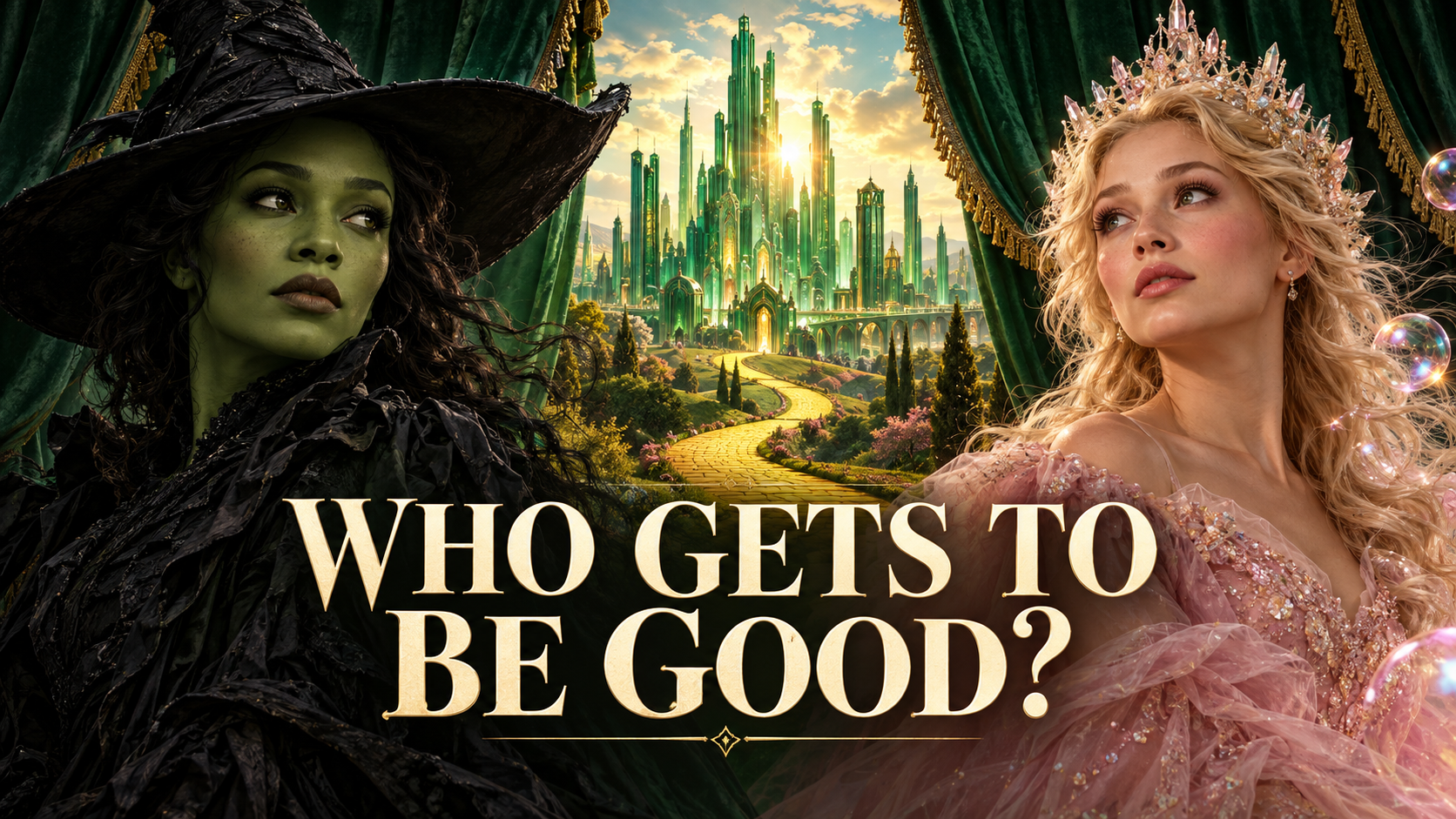
Contains spoilers for The Wizard of Oz, Wicked and Wicked: For Good.
A person can become a villain before anyone has examined what they did. A label settles first: difficult, dangerous, ungrateful, disloyal. After that, questions sound like attacks, silence looks suspicious, and defending yourself becomes evidence that you cannot accept criticism.
This is what interests me about watching The Wizard of Oz alongside Wicked and Wicked: For Good. Beneath the spectacle is a struggle over interpretation: who gets to describe a person, whose version becomes accepted, and what happens when that description serves somebody else’s interests.
The films offer different versions of Oz. Together, they expose the tension between being good, appearing good, and being useful to those who decide the difference.
Dorothy travels towards someone she believes can solve her problems. Her companions seek intelligence, a heart and courage, although their actions repeatedly demonstrate those qualities. The Wizard provides recognition dressed as a gift.
Qualifications, promotions and professional recognition can acknowledge real ability. They can also become the permission we wait for before trusting abilities we already possess. The danger begins when approval becomes more important than the judgement it supposedly recognises.
Elphaba initially wants that approval too. She imagines the Wizard recognising her gifts and making her acceptable. Recognition comes attached to obedience. She is welcome as a resource; her conscience makes her inconvenient.
Colour prepares us to judge before we understand.
Glinda’s pink suggests warmth and approachability. Elphaba’s green makes her impossible to overlook, while her black clothing draws on the familiar silhouette of the threatening witch. Yet costume designer Paul Tazewell also connects Elphaba’s clothes to mourning and the textures of roots, bark and fungi. What looks sinister can contain grief and care for living things.
Why emerald? In Baum’s original novel, the Wizard says the surrounding green landscape suggested the name. He then makes people wear green spectacles so their experience matches it. This is the book’s explanation, rather than the same mechanism operating across the films.
As a gemstone, emerald combines preciousness with associations of spring growth and renewal. It offers an image of prosperity: wealth presented in the colour of life. That is my symbolic reading, not proof of Baum’s intention. Its modern echo is green branding, where the reassuring appearance of sustainability still needs evidence behind it.
There is a telling contradiction in a society that celebrates an Emerald City while rejecting a green woman. The colour itself cannot explain the hostility. One expression of green belongs to the establishment; the other belongs to a person it has marked as different.
We can recognise that contradiction wherever diversity is attractive in a campaign but uncomfortable in a meeting. An organisation may celebrate individuality while rewarding those who express it within approved limits. Difference becomes easier to welcome when it asks nobody to change.
Cinematographer Alice Brooks deliberately associated Glinda with sunrise and Elphaba with sunset. Elphaba flies towards darkness as she discovers her power. I read this as a reversal of the comforting assumption that moral clarity will always arrive brightly lit. Sometimes a responsible decision means stepping away from approval without knowing what comes next.
Glinda makes that uncertainty particularly uncomfortable because she understands the social advantages of being liked. Her bubble offers a perfect image: elevated, visible, apparently close to everybody, yet protected from direct contact.
Modern public life has many such bubbles. Carefully managed interviews, selected audiences and polished social profiles can create familiarity without accountability. Access to someone’s image is different from access to their decisions. A reassuring tone tells us little about whether they will accept scrutiny.
Glinda’s predicament is more useful than a simple accusation of hypocrisy. Her desires for affection, opportunity and influence are recognisable. The problem develops through concessions that each seem survivable: remain quiet now, preserve access, avoid upsetting the people who might help later.
Eventually, the position that promised the power to make a difference can depend on refusing to acknowledge what needs changing.
Once a community agrees who its villain is, condemning that person can become a way of demonstrating membership. Asking for context risks looking disloyal to the group.
Research by William Brady and colleagues found that social feedback and network norms can reinforce expressions of moral outrage online. Their work concerned what people expressed, not proof of what they privately felt. Even that distinction matters: a platform can reward the performance of certainty while uncertainty remains socially expensive.
Outrage can expose genuine wrongdoing. Evidence, proportion and opportunities for correction still matter. Wicked becomes less useful if we turn its message into another automatic judgement: that every disliked outsider must be right, or every popular person must be corrupt.
The persecution of the Animals gives the problem a more literal form. They lose their voices. Exclusion reduces their ability to challenge the stories told about them.
In contemporary institutions, exclusion can be quieter. Consider a consultation held after the decision, a complaint summarised without its central concern, or a public debate in which affected people appear as examples but never as participants. Someone may technically be allowed to speak while having little chance of influencing the outcome.
The OECD’s 2024 trust survey found a substantial association between feeling politically heard and trusting national government. That does not prove a simple causal relationship, but it challenges the idea that trust can be restored through better presentation alone. People also need meaningful opportunities to influence decisions.
Even the Yellow Brick Road changes meaning when we look beyond the traveller. In For Good, its construction reveals the work and control behind the picturesque route. Production designer Nathan Crowley explicitly describes the road as oppression.
Promises of progress deserve similar questions. Who builds the convenience? Who absorbs its costs? Who can refuse? A new system may make life easier for its customers while increasing pressure on workers or shifting environmental costs elsewhere. Admiring the finished road should not prevent us from examining how it was made.
The curtain adds another layer. The Wizard’s apparent greatness depends on machinery, staging and an audience’s willingness to mistake an impressive presentation for an explanation.
Today, a confident spokesperson, an elegant dashboard or a fluent AI answer can produce a comparable impression of command. Each may be useful. Each still needs checking against what it represents. Confidence, scale and technical sophistication cannot substitute for evidence.
The Grimmerie sharpens this. Possessing an authoritative text does not mean understanding it, and making its words work does not guarantee a good outcome. Laws, procedures and software share that practical difficulty: instructions can be followed precisely while their consequences harm people.
This concern with appearances also has a documented cinematic lineage. Director Jon M. Chu cited The Truman Show and Pleasantville when discussing Wicked: attractive worlds whose inhabitants begin questioning what they have been taught. Their relevance lies in the cost of discovering that a reassuring account is incomplete.
There is a historical esoteric connection too. L. Frank Baum wrote about Theosophy and joined the Theosophical Society in 1892. That makes an initiatory reading plausible: a journey through trials changes how the traveller understands authority and themselves. It does not establish a secret occult code behind every prop.
Read symbolically, Dorothy’s journey brings recognition of capacities already present. Elphaba’s brings recognition that an institution’s approval may require abandoning those capacities. The spiritual question becomes practical: what kind of understanding changes how you act towards other people?
For Good makes the cost personal. The Wizard discovers that the woman he helped demonise is his daughter. Someone he treated as a political problem becomes a person whose loss he can feel. The recognition arrives after the harm.
That raises a question: why should someone have to resemble us, belong to us, or become personally familiar before their suffering matters?
Elphaba’s survival also depends on escaping the public story of her death. Glinda remains to take responsibility within Oz, while her friend leaves. Neither outcome restores everything that has been lost.
This reaches into ordinary life. A damaged reputation is not always repaired when the facts emerge. A person can survive an institution without receiving its apology. Someone who benefited from silence can still choose to behave differently, although that choice does not erase their earlier participation.
The Ozdust dance offers a smaller action worth remembering. Glinda joins the person everyone is watching and changes what that watching permits. She puts her own standing into the moment rather than offering sympathy from a safe distance.
That is a useful measure of solidarity today. It can mean asking what evidence supports a damaging label, letting someone finish their account, correcting a misleading summary, or refusing to turn another person’s humiliation into entertainment.
We cannot avoid telling stories about one another. We can make those stories more open to revision, and become more careful about who pays when we get them wrong.
Before accepting the next reassuring account of who is good and who is wicked, I want to ask: whose actions have I examined, whose words have I actually heard, and whose version have I simply inherited?