
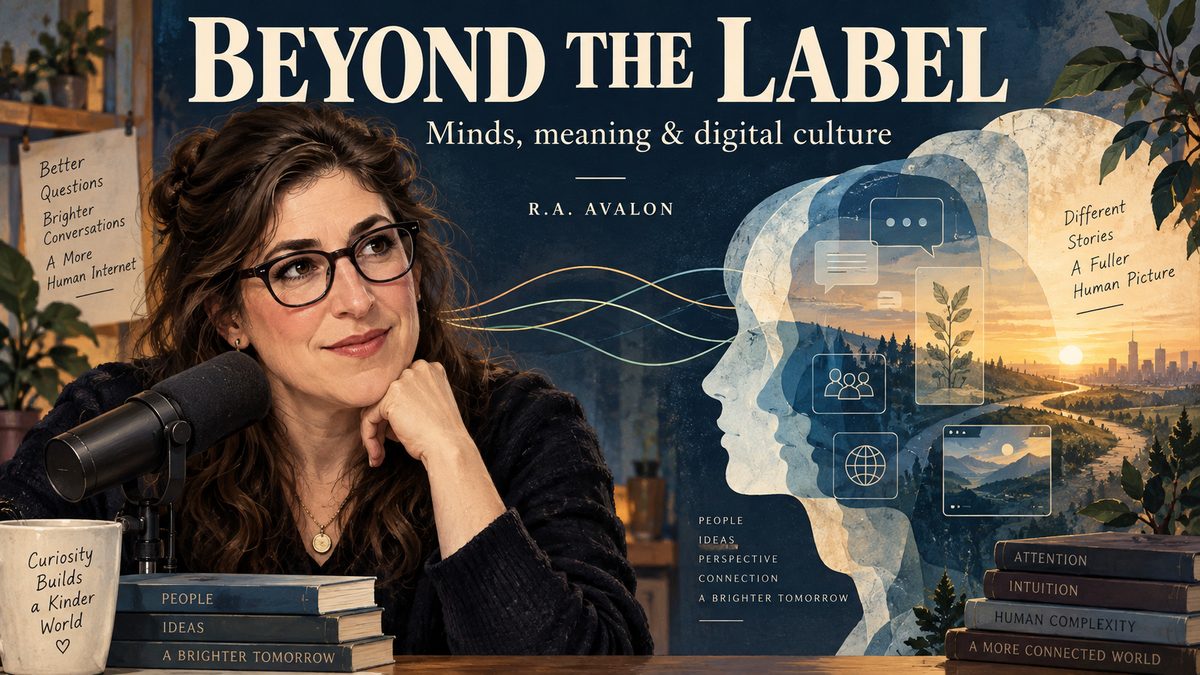
I found it fascinating to listen to Mayim Bialik’s conversation with consciousness researcher Helané Wahbeh on Mayim Bialik’s Breakdown. Alongside co-host Jonathan Cohen, they explore intuition, sensitivity, channeling and the explanations we give to experiences we do not fully understand. What stayed with me was how closely the conversation connected to digital culture: the language we find online, the labels we receive, and how those labels influence what we notice about ourselves. Listen to the episode.
Many people know Mayim as Amy Farrah Fowler from The Big Bang Theory, or as the lead in Blossom. Others may recognise her voice from animation, including Johnny Bravo. Her career has moved across several corners of popular culture, sometimes reaching us before we know the person behind the character. Her biography and a conversation about her voice acting show that range.
She is also a neuroscientist by training, with a PhD from UCLA. That scientific background belongs to the woman herself, beyond the scientist she played on television. Now, through her podcast, there is another way to encounter her: asking questions about mental health, belief and human experience. I enjoy that meeting of storytelling and scientific curiosity, while remembering that an interesting conversation still needs its claims examined. UCLA’s profile.
One exchange in particular caught my attention. Mayim asks whether some people described as highly sensitive or neurodivergent might be experiencing something they have never learned to recognise or explain. Wahbeh considers that possibility through her research into what she calls “noetic” experiences: a felt sense of knowing, sometimes interpreted as extending beyond familiar routes of perception. She also acknowledges that more research is needed to evaluate the proposed connection.
For me, the question opens several doors.
A diagnosis can provide recognition, support and a way to understand longstanding difficulties. It can give someone words for experiences they previously struggled to explain. But how much of a person’s life becomes invisible when everyone assumes the diagnosis has answered every question?
Someone can have a recognised condition and also be exhausted, grieving, under pressure, living in an overwhelming environment or struggling with expectations that leave little room for their needs. Understanding their diagnosis should help us investigate that fuller picture. Autism, for example, is a neurodevelopmental condition with varied characteristics and support needs; it cannot be reduced to feeling intensely or disliking a crowded room. NIMH’s explanation of autism.
That is one grounded meaning of “perhaps there is more going on.” There may be more to understand about someone’s circumstances, body, history and inner life.
The podcast also explores a more speculative meaning: whether certain experiences could involve psychic perception or channeling. I find those questions interesting, but the conversation does not establish that neurodivergence is an undiscovered psychic ability, or that an existing diagnosis is mistaken. Wahbeh herself acknowledges that she cannot definitively identify a nonphysical source for channeling. An experience can be sincere and deeply meaningful while its explanation remains uncertain.
This distinction matters online, where a question can become a confident claim surprisingly quickly.
Digital culture gives us extraordinary access to other people’s experiences. A person who has always felt out of place can encounter someone describing a familiar struggle and finally have language for it. Communities can make difficult subjects discussable. They can give people the confidence to seek an assessment, ask for support or stop treating every difficulty as a personal failure.
But the same spaces also offer instant explanations. A short video lists several familiar behaviours. A comment section supplies a label. Another creator offers a spiritual interpretation. We may recognise ourselves in more than one account, even when those accounts make very different claims about what is happening.
Recognition can begin an investigation. It cannot finish one.
Then the platform becomes part of the process. YouTube explains that watch history, searches and other interactions influence its recommendations. What we have already watched helps shape what appears next. How YouTube recommendations work.
My concern is the loop this can create around questions of identity. We explore an explanation, encounter more content built around it, and may begin to experience that repetition as confirmation. A feed can become increasingly familiar with our interests without becoming qualified to explain our minds.
That applies to mental health content, spiritual content and the confident commentators who dismiss both. The question is how much room remains for context, disagreement and the possibility that our first explanation is incomplete.
Wahbeh’s observation about our externally focused culture felt especially relevant here. Throughout the day, screens offer something else to absorb: another opinion, another crisis, another demand to react. I kept thinking about how rarely an ordinary online interaction invites us to pause and notice whether we are tired, uncomfortable, interested or simply overloaded.
There is a practical question beneath the podcast’s spiritual vocabulary: how do we recognise our limits when so much competes for our attention?
Wahbeh uses the image of a camera aperture when discussing sensitivity. In her spiritual framework, this concerns regulating channeling. As a metaphor, I find it useful for thinking about boundaries: choosing how much we take in, when we step back, and which conversations we have the capacity to hold. Using that image does not require treating chakras or psychic information as established biological mechanisms.
We can also take someone’s spiritual language seriously as part of understanding them. The American Psychiatric Association’s Cultural Formulation Interview asks about people’s own explanations, their social circumstances, and the role of faith or cultural identity. There is already space within clinical practice to explore meaning alongside symptoms. The Cultural Formulation Interview.
For me, that is a valuable direction: listening closely enough to understand what an experience means to someone, while remaining careful about what caused it. Spiritual reflection and appropriate clinical care can coexist. Neither an online label nor a spiritual explanation should make a person’s distress disappear from consideration.
Another point I appreciated was Wahbeh’s warning about placing channelers on a pedestal and handing them authority over our decisions. That observation travels well beyond the subject of channeling. It belongs in conversations about influencers, experts, public figures and increasingly the AI systems people consult about their lives.
Whoever offers an explanation, we should retain the freedom to question it.
That is why I found this podcast worth listening to. It brought together subjects that are often kept apart: science, personal experience, spirituality and the cultural habits through which we interpret ourselves. Some claims deserve further scrutiny. The questions about attention, identity and being understood deserve time.
I would like a digital culture where finding a useful name for an experience leads to a fuller conversation about the person having it. One where we can remain curious about what we do not yet understand, and careful with the certainty we offer each other.