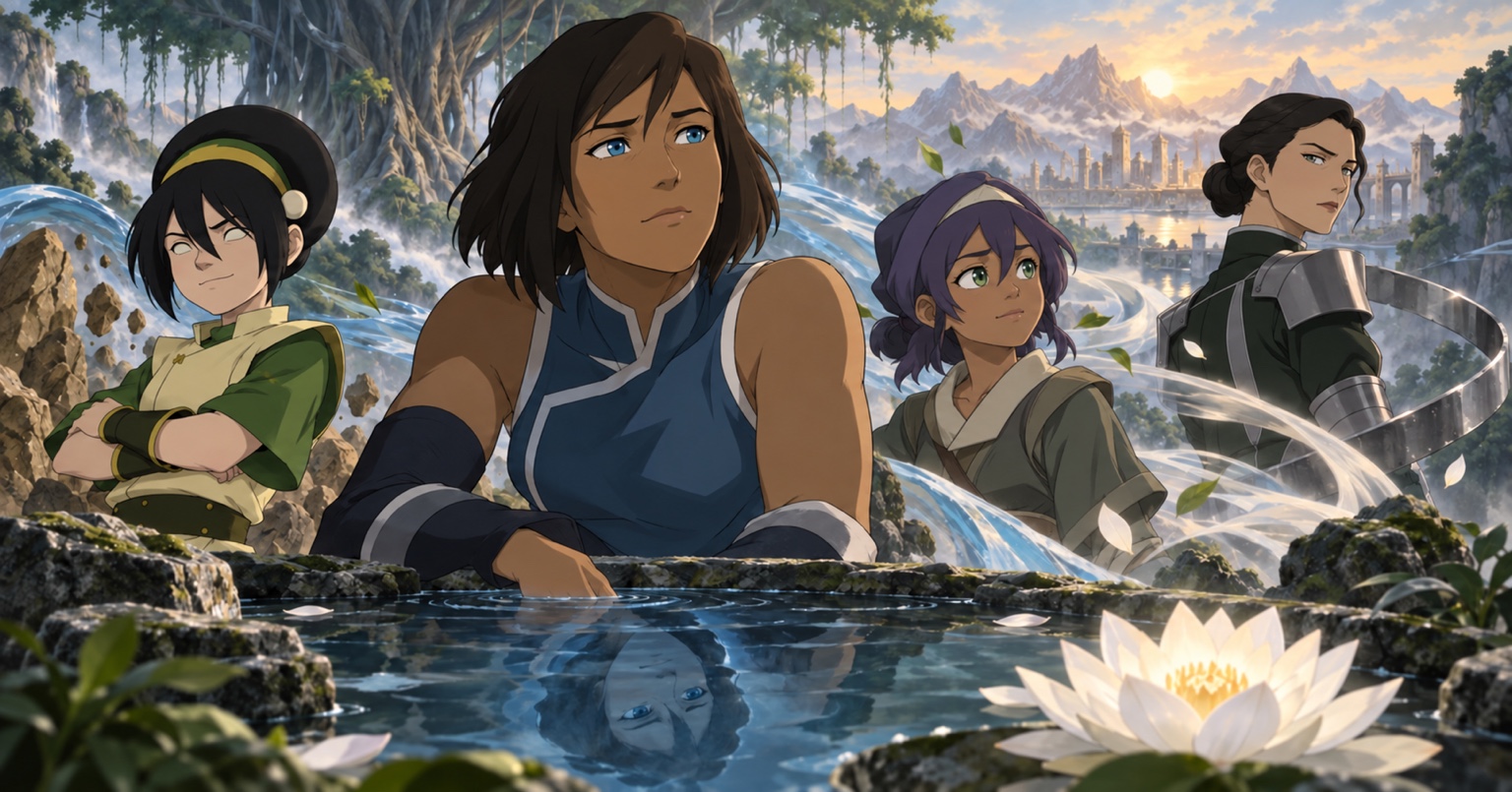
Korra’s recovery is one of the reasons Avatar has stayed with me. Watching someone so powerful become frightened of her own strength, lose her sense of identity and slowly reconnect with herself gives the story a weight that elemental battles alone could never carry.
Korra, Kuvira, Toph and Opal are particular favourites of mine because they make strength look different. It can be confrontational, disciplined, gentle, stubborn or dangerously certain. Their stories become interesting when those qualities meet circumstances they cannot easily control.
Aang and Korra approach responsibility from opposite directions. Aang is playful, compassionate and inventive, but sometimes avoids what frightens him. He must grow into being the Avatar without abandoning his principles. Korra embraces that identity immediately. Proud, competitive and protective, she trusts action. Her challenge becomes discovering who she is when action cannot solve everything.
The spiritual foundations give those struggles another dimension. Creators Michael Dante DiMartino and Bryan Konietzko drew on Asian cultural influences and worked with martial arts consultant Sifu Kisu. Bending makes philosophy physical: Aang circles around resistance, Toph holds her ground, and Korra often drives straight through it. Learning another element also means practising another response to life. Sifu Kisu interview
Their spiritual research was sometimes explicit. Discussing Korra’s cosmic form in Book Two, DiMartino referenced the Hindu concept of ātman, Shiva, Joseph Campbell and Alex Grey’s artwork. These influences belong to different traditions; the series brings them into a fictional conversation rather than presenting one universal doctrine. DiMartino’s commentary
In Aang’s chakra episode, “The Guru,” Pathik describes energy flowing through connected pools. Fear, guilt, shame, grief, lies, illusion and attachment become obstructions. Spiritual development requires confronting experiences already woven into Aang’s story. Official episode clip
I read his vast cosmic self as an image of awareness expanding beyond immediate fear. Attuning to your higher self can mean recovering perspective when pain has narrowed your world. Aang’s anxiety about releasing attachment to Katara also raises a difficult question: can we love deeply while accepting that we cannot control every outcome?
Korra’s recovery makes that question painfully personal.
After the Red Lotus attack, she struggles with rehabilitation, frightening memories and a threatening image of herself. “Korra Alone” allows recovery to take time. Cutting her hair and leaving familiar places cannot simply remove what she carries. The creators deliberately resisted letting a three-year time jump make everything fine. Episode reference Creator interview
The story also lets her be frustrated, withdrawn and impatient with recovery. That feels honest. Being wounded does not automatically make somebody serene or insightful; sometimes the first achievement is simply staying with yourself.
What affects me most is how much Korra has connected her worth to being capable. Helping, fighting and making a difference have defined her. When those abilities become uncertain, she must face whether she still matters when the world continues without her.
I see myself in that journey: feeling completely broken, becoming disconnected from yourself and trying to find a way back. There is grief in remembering who you used to be. There is also uncertainty in discovering that healing might lead somewhere different from returning to that earlier version of yourself.
For me, reconnecting means recovering trust in my own needs and judgment. It means recognising what hurts, what matters and what I can manage, without turning every day into another test of whether I am strong enough.
Ultimately, nobody else can do that inner work for me. That is what I mean when I say only you can heal yourself. But participation is different from isolation. Korra receives Katara’s care, Toph’s guidance and support from people who love her. Their help matters; the process still requires her presence.
Toph helps her identify the poison remaining in her body, and Korra eventually removes it herself in “The Calling.” Yet fear persists afterwards. “Beyond the Wilds” returns to her difficulty entering the Spirit World. One breakthrough does not complete the recovery. “The Calling”, “Beyond the Wilds”
The poison gives visible form to harm that remains after an attack. I read that as a metaphor, never as evidence that someone is choosing their suffering. I also resist the suggestion that Korra needed pain to become compassionate. She already cared. What she builds afterwards belongs to her; it does not justify what happened.
Her ending with Asami matters for the same reason. DiMartino confirmed the romantic meaning of their passage through the spirit portal. Korra’s future contains tenderness and mutual possibility, alongside responsibility. She gets to want a life that belongs to her. “Korrasami Confirmed”
Toph understands something about refusing another person’s definition of you.
Blunt, proud, funny and fiercely independent, she resists the fragile identity her parents assign her. Her stubbornness protects a truth they struggle to recognise: she knows things about herself that they do not.
Her blindness remains part of her experience. Seismic sense gives her extraordinary perception, but it depends on suitable contact with the ground and does not let her read ordinary writing. Her ability does not erase her disability. Toph character reference
Her discovery of metalbending is especially beautiful storytelling. While Pathik discusses apparent separation, Toph perceives earth inside metal. An abstract spiritual idea becomes a physical discovery that frees her from confinement. Her defiance works because she listens closely enough to perceive another possibility. “The Guru” transcript
Older Toph also shows how independence can become emotional distance. Her relationships with Lin and Suyin complicate the heroic image. I like that the story lets her remain difficult. Loving a character does not require treating every harsh remark as wisdom. “Operation Beifong” review
Opal offers another expression of the family’s strength. Gentle and earnest, she discovers freedom through airbending without surrendering her connections. Her kindness has boundaries, particularly when Bolin supports Kuvira. She can love someone and still expect accountability. Episode review Her gemstone name invites my own symbolic reading: something formed in earth revealing shifting light. That feels fitting for someone finding movement beyond inherited expectations.
Kuvira fascinates me because her strengths remain visible inside her wrongdoing.
She is capable, composed, organised and precise. Her appeal comes partly from recognising a fractured society’s need for stability. The danger emerges when restoring order becomes deciding what everybody else must accept. Security becomes coercion; disagreement becomes a threat. Her competence makes that progression more disturbing. Kuvira character reference
Her metalbending expresses her worldview. Restricting bands make control visible. The material Toph once used to escape confinement becomes an instrument of confinement in another woman’s hands. That parallel gives their powers meaning beyond spectacle.
Kuvira’s fear of abandonment helps explain her need for control without making her choices inevitable. In the finale, Korra recognises that vulnerability after saving her life. Compassion changes their encounter, while Kuvira still has to surrender. Official finale scene
Their encounter also avoids an easy equation between empathy and agreement. Seeing Kuvira’s wounds does not require Korra to minimise the harm she caused. That distinction matters in stories about healing: understanding someone can coexist with boundaries and consequences.
This is where Korra’s growth becomes convincing. She can protect someone she has every reason to oppose. Understanding becomes a capability alongside strength. Liking Kuvira as a character feels compatible with rejecting her actions: a compelling antagonist helps us understand how admirable qualities become destructive when they stop accepting limits.
Iroh offers a quieter version of the same storytelling wisdom. His patience exists beside grief and a past as a general. He guides Zuko but cannot choose for him. His study of waterbending produces lightning redirection, making openness practically useful. Wisdom acquires credibility through behaviour and consequences. Iroh episode references
The swamp’s connected roots suggest relationships continuing beneath apparent separation. I associate the lotus with growth through difficult conditions. These images resonate because the characters struggle with connection, change and belonging.
Names and symbols gain meaning through those consequences too. I find more value in Toph’s metal, Korra’s reflection and Opal’s newfound freedom than in assigning mystical translations to every name. Letter shapes can inspire personal sigils, but that remains an artistic interpretation, not established creator intent.
This is also why I feel closer to this Avatar than James Cameron’s. I appreciate Pandora’s ecological imagination, but the animated series gives its women time to change, contradict themselves and live beyond the decisive battle. The aftermath becomes part of what makes the adventure matter.
That makes me curious about Pavi. Avatar: Seven Havens is scheduled to premiere on Paramount+ on 9 October 2026. The official premise identifies her as the earthbender succeeding Korra, travelling with her long-lost twin, Nisha, through a world shattered by a cataclysm. Humans and spirits pursue them, and being the Avatar makes Pavi feared as a destroyer. Paramount’s official announcement
We cannot yet judge her complete personality or eventual choices. What interests me is the question already present: how do you discover yourself when the world has decided what your existence means? Aang inherits responsibility, Korra struggles beyond usefulness, and Pavi appears poised to confront an identity others consider dangerous.
I hope her story preserves what Korra gave me: room for a person to exist beyond a role. There is a life after being useful, a self deserving care while struggling, and a future that does not have to reproduce the person you were before.