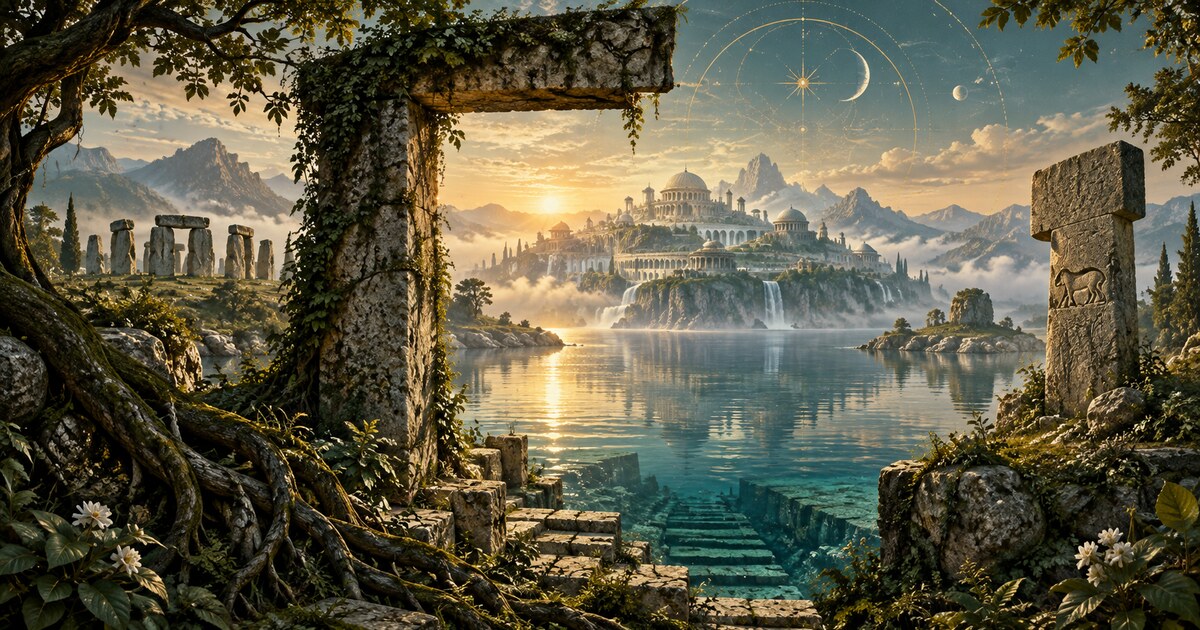
Some rabbit holes begin with an old map. Others begin with a stone pillar, a submerged landscape, or the question of why someone built a doorway to meet the rising sun. Before long, I have several centuries open in my browser and another idea for a book.
Atlantis, Tartaria, Göbekli Tepe, Stonehenge and the pyramids of Egypt all draw me in, although they belong to very different kinds of history. What connects them in my imagination is the possibility of encountering a world whose inhabitants understood their surroundings in ways we can only partly reconstruct.
Atlantis reaches us through Plato’s Timaeus and Critias: a powerful island society, its decline, and a catastrophe that takes it beneath the sea. Its existence as Plato describes it has not been established archaeologically. Yet the story already contains something that interests me as a writer: a civilisation can possess extraordinary resources and still fail to understand its own vulnerability. Plato’s Timaeus, Critias.
I once joked that the Netherlands might be Atlantis. With around a quarter of the country below sea level, the association practically writes itself. Ours would simply be an Atlantis with better pumps and a committee responsible for the dikes. Research on Dutch water management.
There is, however, a real lost landscape close to home. Doggerland, now beneath the North Sea, was once inhabited by people who hunted, made tools and lived through enormous environmental changes. Rising seas eventually submerged their world. The Rijksmuseum van Oudheden documents objects recovered from the seabed and beaches: physical traces of lives where we now see water. Doggerland does not establish a connection to Plato’s island, but it gives the idea of a drowned homeland a tangible presence. Rijksmuseum van Oudheden.
Tartaria opens a different door. The name really does appear on old maps, often as “Tartary”. European mapmakers used it broadly for parts of Asia and the peoples they understood imperfectly. It was a shifting geographical label. The maps alone do not support the modern claim of an advanced worldwide empire erased from history. HKUST’s Mapping Tartary project.
Still, I understand the fascination with a name that once occupied so much space and now seems to have vanished. It makes me think about how a map can preserve information while also revealing the assumptions of whoever drew it. Who named a place? What did its inhabitants call themselves? How much of their world disappeared in the translation?
My own imagination keeps returning to societies whose spiritual lives were closely attuned to nature. I picture people observing seasons, water, animals and the sky, then building that understanding into their surroundings. Geometry could carry practical knowledge alongside sacred meaning: a courtyard measuring light, a doorway marking a turning point in the year, a circle giving a community somewhere to gather.
There are real places where parts of that picture become visible.
Stonehenge aligns with the sunrise at the summer solstice and the sunset at the winter solstice. Whatever meanings its builders attached to those moments, the relationship between stone, landscape and sunlight is physically present. That alone holds my attention: people arranged an enduring structure around something that moves. English Heritage.
Egypt brings that relationship into sharper focus. In Egyptian religion, the sun god Ra, also called Re, embodied life and renewal. His daily passage across the sky and nightly journey through the underworld formed a cycle that sustained cosmic order. Sunrise could therefore carry the promise of rebirth. The Metropolitan Museum of Art: Divine Egypt.
I find sun worship compelling because the physical and the symbolic meet so naturally within it. The sun provides light and warmth, disappears, and returns. That rhythm gives a storyteller an entire narrative: arrival, departure, passage through darkness and renewal. It also makes me wonder how differently a person might experience the morning when the return of daylight belongs to a sacred story.
The Egyptian pyramids gave that relationship a monumental form. Built as royal tombs within larger funerary complexes, they also carried solar symbolism. The Met connects the pyramid’s form to the sacred benben stone at Heliopolis, a centre of solar worship. Beliefs about kingship, the sun and the afterlife became part of the architecture itself. The Met: Egypt in the Old Kingdom.
Then there is the extraordinary geometry of Khufu’s Great Pyramid. Its nearly square base measures roughly 230 metres along each side. Its orientation follows the cardinal directions with an accuracy of about one-fifteenth of a degree, while the surrounding platform was levelled to within a few centimetres across a perimeter of roughly 920 metres. The exact surveying methods remain debated, but the precision demonstrates considerable skill in measurement and construction. Glen Dash’s alignment research, his study of surveying and the equinox.
What holds my attention is the meeting of precision and belief. Someone had to turn an idea about the world into measurements that other people could build from. The geometry makes me think about how knowledge passed between observers, planners and craftspeople, and how a society made its understanding of the cosmos visible on the ground.
That knowledge also had a history. Djoser’s Step Pyramid preceded the work of Snefru, whose building projects developed the smooth-sided pyramid form. Khufu, Snefru’s son and successor, then commissioned the Great Pyramid at Giza. Seen in that sequence, the monuments reveal a developing architectural tradition. Each generation inherited possibilities that the next could explore and reshape. The Met: Egypt in the Old Kingdom.
At Göbekli Tepe in present-day Türkiye, monumental structures dating to around 9600–8200 BCE contain distinctive T-shaped pillars and carvings of wild animals. Their age, craftsmanship and likely ritual significance offer a remarkable glimpse of early communities and their symbolic worlds. The animals belonged to the landscape around them; their precise meanings remain much harder to recover. UNESCO, Göbekli Tepe research team.
Geometry appears in the research here too. In a 2020 study, Gil Haklay and Avi Gopher found that reference points between the paired central pillars of three enclosures lie close to the corners of an equilateral triangle, with sides of about nineteen metres. They interpreted this as evidence of coordinated architectural planning. It is a specific scholarly proposal about the site’s design, and an intriguing glimpse of how early builders may have organised space. Haklay and Gopher, Cambridge Archaeological Journal.
The sky invites further questions, but the evidence varies. Göbekli Tepe’s research team reports that astronomical links to the positioning of its pillars and buildings have not been identified. Stonehenge’s solar alignments are much better established. Astronomy concerns observing celestial bodies and their cycles; astrology interprets celestial patterns as meaningful for earthly affairs. An alignment can establish the former without telling us exactly what beliefs accompanied it. Göbekli Tepe research FAQ.
Across the Atlantic, Chankillo in Peru offers another striking example. Its thirteen towers and observation points allowed people to follow the sun’s changing position across the year. Architecture and landscape worked together as a calendar, within what UNESCO describes as a probable solar cult. UNESCO: Chankillo.
These places belong to different societies and periods. Similar forms or an interest in the heavens cannot, by themselves, establish a shared civilisation. What fascinates me is how people in different settings found ways to give their relationship with nature a physical form. I wonder what it felt like to inhabit buildings in which time, belief and daily life met so visibly.
Religious traditions today offer another way to think about that relationship. Beliefs can find expression through metaphor, material objects and familiar actions. The Catholic Catechism describes light, darkness, water and other elements of the natural world as religious signs, and explains how actions such as washing and anointing communicate spiritual meaning. Within that faith, sacramental signs also participate in sacred realities. Their symbolism belongs to a larger understanding of what the ritual does. Catechism of the Catholic Church.
During Diwali, lamps express the victory of light over spiritual darkness and knowledge over ignorance, alongside stories and customs that vary between communities. Here, too, something as tangible as a flame carries an idea about how to live. Hindu American Foundation.
These traditions have their own histories and meanings. As a writer, I am interested in how an inherited image can remain familiar while a person’s understanding of it changes. A story heard in childhood may speak differently after loss, love or responsibility. A ritual repeated for years may suddenly become meaningful in a way it never was before. That gives me a way to explore both continuity and change without assuming that every religion conceals the same forgotten origin.
The Sun and Moon, summer and winter, draw me towards the language of duality. I see them as pairs through which to explore rhythm, balance and change. What interests me most is the transition. At dawn, the first light arrives while something of the night remains. At dusk, the daylight recedes as darkness gathers. Spring and autumn offer a slower version of that experience: one season is still present while the next is beginning to make itself known.
These are liminal moments: thresholds between states. Paying attention to them lets me hold both sides in view and notice how one gives way to the other. I recognise something similar in the stories I want to write. A character can feel grief and relief at once, or begin to change while still carrying the habits of the person she has been.
In that sense, I think we live on a threshold all the time. The past has happened; the future has yet to arrive. We inhabit the moment between them, carrying memories while making choices whose consequences are still unfolding. Even when our attention wanders backwards or forwards, the remembering and imagining happen here.
Eckhart Tolle’s The Power of Now, with its emphasis on presence, brings me back to that experience. I understand the idea of an eternal now as the continually renewed present in which life is actually encountered. There is room within it to learn from yesterday and prepare for tomorrow. The moment in which we can pay attention, reconsider or act is always this one. Eckhart Tolle’s books.
An ancient building gives that thought a physical form. Its stones carry decisions made by people whose lives have ended. We encounter their work in our own time, asking questions they might never have anticipated. What we preserve, discover or misunderstand will become part of what someone else inherits. A ruin sits within all three: the past that made it, the present that interprets it, and the future that may read it differently.
Research takes place within that continuing exchange. We begin with earlier observations, test explanations and revise them when the evidence calls for it. Understanding evolves through accumulation and correction; it can also be interrupted, lost and recovered. I see a connection with the architectural tradition behind the pyramids: knowledge passes through people who work with what they have inherited and find new possibilities within it. As our questions and methods develop, we keep rebuilding our understanding of what earlier societies built.
The challenge is finding language that makes those connections clear. When I write about being attuned to nature, I can begin with something concrete: a change in the light, the first cold morning, or the way a familiar place feels different at dusk. From there, I can explain what it brings to mind. I want a reader to understand the observation, follow my interpretation and recognise where the fiction begins. The wonder survives that translation; it becomes easier to share.
Those connections feed directly into my fiction. A city might inherit a geometric street plan after forgetting what it measures. A ritual might preserve instructions long after its explanation has disappeared. A character taught to worship the light might discover that her culture has quietly removed the part of its oldest myth in which the sun must first travel through darkness. A familiar symbol suddenly carries a meaning her society now considers dangerous.
Atlantis also draws me inward. As a metaphor, a world beneath the water feels close to the unconscious: memories, fears and possibilities that influence us before we can clearly name them. I can read the descent into a drowned city as an encounter with what has been buried within a person. Placed beside the sun’s journey through darkness and return to light, it offers another way to write about grief, identity and recovery. These are symbolic connections I make as a writer; they give my characters places to go, both outwardly and within themselves.
The question of lost knowledge remains compelling. At Göbekli Tepe, we can see the carvings while still struggling to understand the stories behind them. An object can survive for millennia without carrying its full explanation into the present. We do not possess a complete account of what its makers knew. Göbekli Tepe research team.
The saying that history is written by the victors makes me ask whose voices were preserved, whose were excluded, and what was destroyed. It is an incomplete description of historical research, which also works to recover those missing perspectives. But the question of who gets to define the past matters enormously to the stories I want to tell.
The Knights Templar readily enter that imaginative territory. Their documented history places a military and religious order across Europe and the Holy Land during the Crusades, protecting pilgrims and accumulating considerable wealth and influence. Those journeys east, and the encounters they involved, are fertile ground for a novelist. English Heritage: Temple Manor.
My mind can easily supply the next scene: a manuscript carried home, a translation concealed, a vault opened centuries later. Whether any particular secret was preserved requires evidence of its own. The possibility of undiscovered material leaves room for questions; it does not tell us what a vault contains. On the page, though, I can ask what someone would risk to keep that knowledge hidden, or to bring it back.
As Ahsoka says in Star Wars Rebels: “There’s always a bit of truth in legends.” Twilight of the Apprentice.
I like that line because “truth” can take several forms in a story. A legend might preserve a trace of an event, express a fear, or reveal what a society wanted to believe about itself. Each possibility asks something different of the person investigating it.
Some historical questions remain open. Others have answers more solid than the rabbit holes suggest. As a writer, I find inspiration in both. Give me a fragment of a vanished world, and I start wondering who would recognise it, who would fear it, and whose life would change when it returned. The story begins when someone in the present decides what to do with what the past has left behind.