
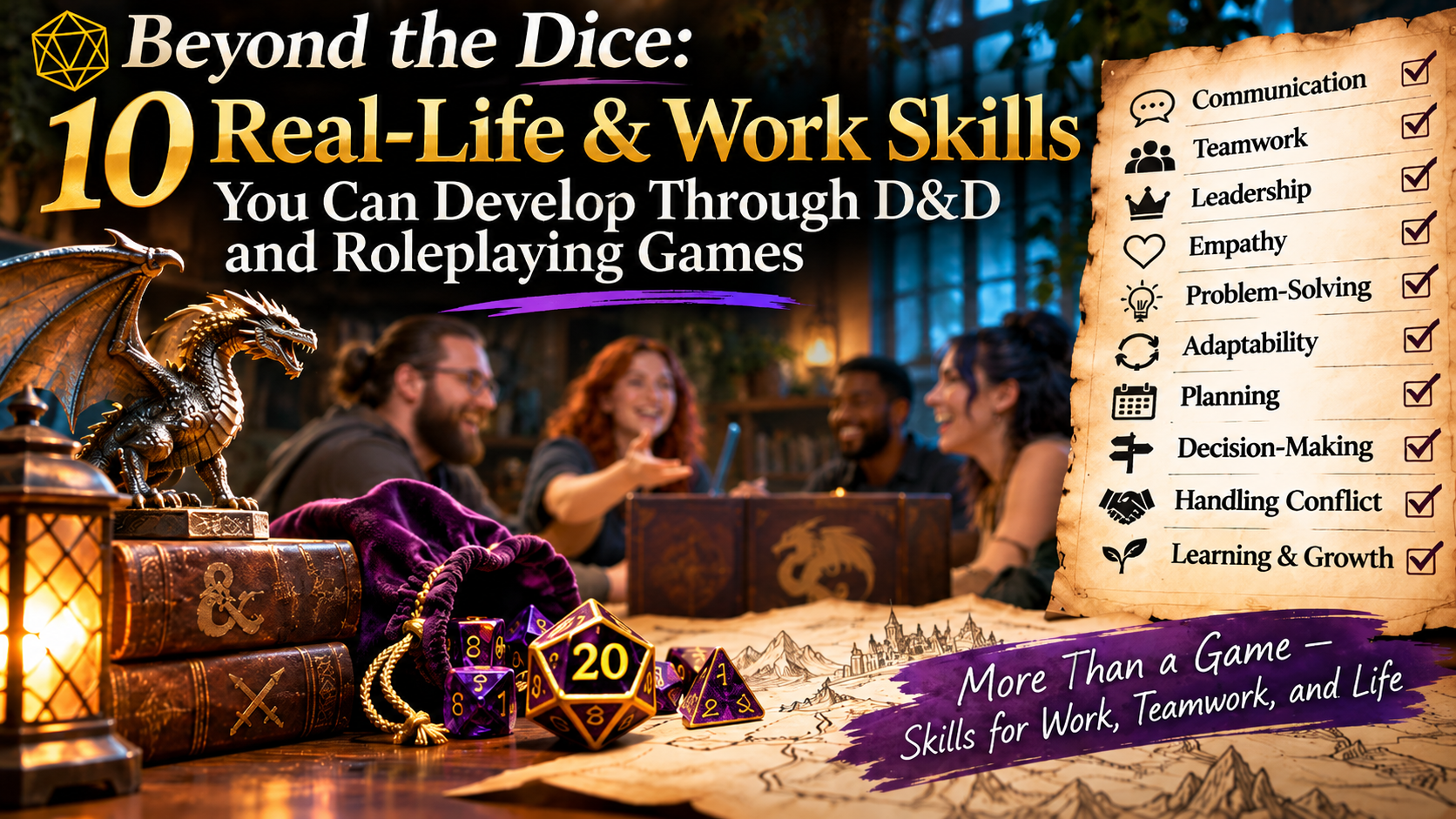
What Dungeons & Dragons and shared storytelling can teach us about working together and navigating everyday life.
The plan was sensible until somebody decided to negotiate with the dragon.
Now five people need to reconsider their options, listen to an unexpected idea and agree on what happens next. The setting is imaginary. The collaboration is real.
Tell someone you enjoy roleplaying, however, and you may find their judgement arrives before your explanation. Some picture childish escapism. Others attach entirely different meanings to the word; those associations can stay outside this article.
I mean people creating stories together: around a table with dice, through an online tabletop, or as characters inside a multiplayer game. In Dungeons & Dragons, the Dungeon Master describes the world and adjudicates the rules, while players decide how their characters respond. Everyone contributes to the adventure.
I want to challenge the stigma around both roles. Look closely at what a considerate group actually does, and you will recognise skills we value in colleagues, friends and ourselves. Here are ten worth noticing.
1. Listening with attention
A clue can disappear beneath somebody’s enthusiastic speech. A teammate’s idea can do the same. Playing together gives you reasons to listen, check your understanding and ask a useful question before acting. Online, that may mean leaving space after someone speaks or checking whether a quiet player wanted to contribute. In meetings and relationships, the same habit helps prevent confident misunderstandings.
2. Communicating clearly
“I do something clever” gives the group very little to work with. Explaining what you want to achieve, how you intend to try and what help you need is far more useful. Roleplaying offers repeated opportunities to practise that clarity. Describing a scene or proposing a plan also asks you to consider your audience. You do not need an impressive character voice; you need to help others understand.
3. Working with different strengths
One character notices the trap. Another understands the inscription. A third persuades the guard to let everyone leave before the situation becomes embarrassing. The useful lesson is recognising contributions beyond your own. A strong team makes room for different abilities and shares credit. At work, that means involving the colleague with relevant knowledge, even when their approach differs from yours. You do not have to solve everything personally.
4. Leading while making room for others
A thoughtful Dungeon Master prepares possibilities, explains decisions and helps everyone participate. When players take an unexpected direction, the challenge is to respond without taking away their choices. Players practise leadership too: summarising options, inviting another perspective or helping a newcomer. These are useful habits for chairing a meeting or guiding a project. Leadership includes knowing when to hand the conversation to somebody else.
5. Considering another perspective
Your character might trust someone you distrust, or fear something you would dismiss. Making that choice asks a useful question: what makes this response understandable from their position? Playing a character does not grant expertise in somebody else’s lived experience. It does offer practice in pausing before judging. At work, that pause might help you ask why a colleague resists a change before assuming they are simply being difficult.
6. Handling disagreement constructively
One player wants to sneak into the castle. Another wants to negotiate. A third has already started climbing the wall. Finding a workable plan means identifying what each person cares about and deciding what the group can accept. When disagreement becomes personal, step outside the fiction and talk directly. “It is what my character would do” does not remove responsibility for how you treat other players.
7. Planning and following through
An ongoing campaign needs preparation: agreeing on dates, keeping notes, remembering commitments and managing limited resources. Scheduling several adults may be its most demanding encounter. This is practical organisation in miniature. Players can share the workload by recording decisions or arranging the next session. Those habits carry a familiar lesson for projects and everyday life: reliability includes doing your part without making someone else chase you.
8. Adapting and solving problems creatively
The bridge is gone. The group has rope, an unusual spell and a very questionable alternative route. What now? Situations like this invite you to combine resources, test ideas and revise your plan. A Dungeon Master gets similar practice when players bypass carefully prepared material. The useful habit is staying curious when circumstances change. In a project, a changed requirement can become a problem to explore together.
9. Making decisions under uncertainty
You rarely know everything behind the next door. Waiting for perfect information may leave the adventure permanently in the corridor. Choosing a course of action involves weighing what you know, what you are assuming and who bears the consequences. Dice also make room for an uncomfortable possibility: a reasonable decision can still produce a disappointing result. That distinction is useful when reviewing choices at work or in your own life.
10. Learning from mistakes and feedback
A failed plan offers a chance to ask what the group could try differently. A joke that upset another player offers a different responsibility: listen, apologise and adjust. A brief conversation after a session can help: what worked, what felt frustrating, and what should change? The value lies in practising an honest response to feedback. At work and at home, improvement needs room for both accountability and another attempt.
The people behind the characters
These opportunities depend on the group. Research involving 1,120 D&D players highlighted meaningful choices, fair decisions and social cohesion in their experiences. A smaller exploratory study of workplace roleplaying workshops found that participants valued getting to know colleagues and tackling challenges together, although it does not establish that recreational gaming improves job performance.
The practical bridge is reflection: notice a useful habit during play, then deliberately try it elsewhere.
Of course, a hobby does not need to improve your CV to deserve respect. Friendship, imagination and an enjoyable evening are enough.
Still, before dismissing the Dungeon Master or the player, consider what happens around that table. People make plans, take turns, disagree, repair mistakes and build something together.
Sometimes, there is also a dragon.
Further reading: International Journal of Role-Playing: D&D player research and workplace roleplaying workshops.